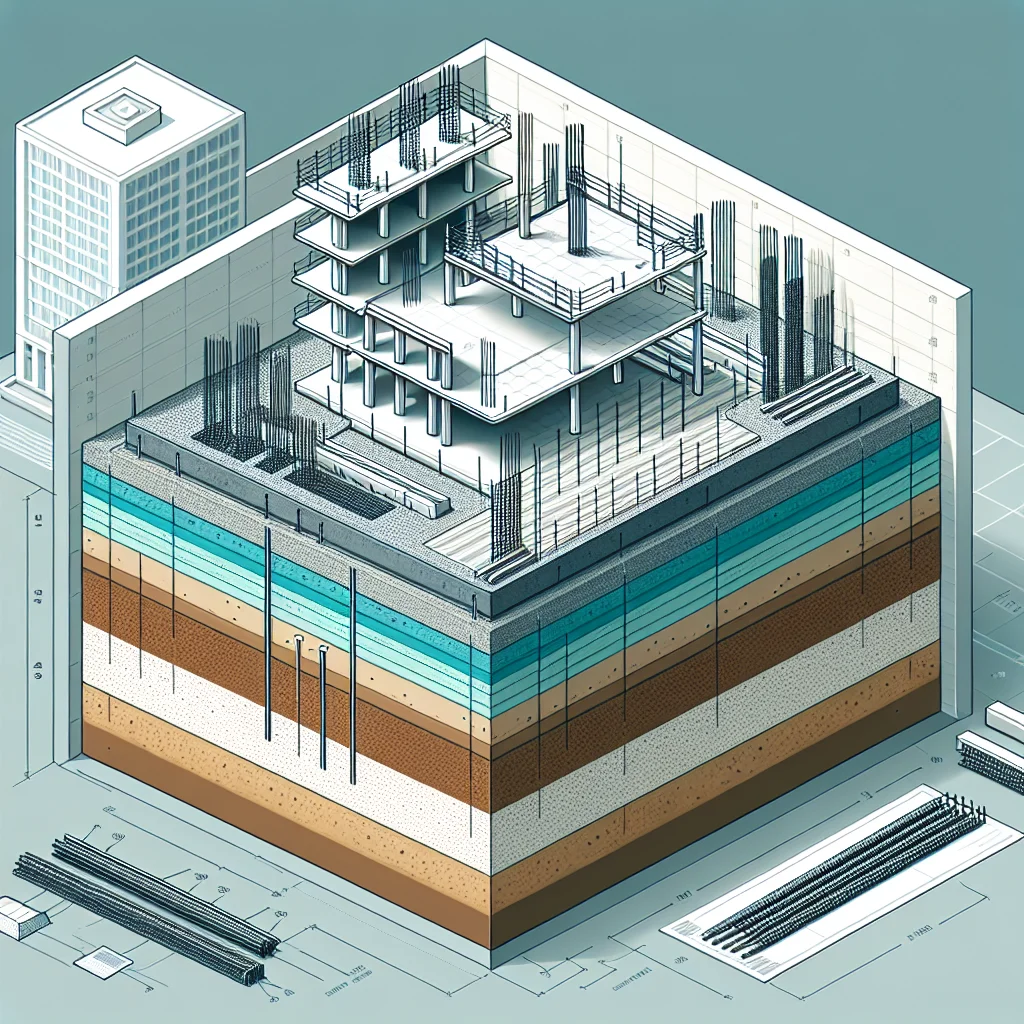
A building stands or falls on its foundation. Good foundation design turns soil and loads into a stable base that resists settlement, moisture, and shifting forces.
This article explains the key ideas behind designing foundations so you can understand choices, trade-offs, and common pitfalls when planning any small to medium structure.
Why foundation design matters
Foundations transfer the weight of the building into the ground. If this transfer is uneven or poorly planned, the result is cracks, uneven floors, and expensive repairs.
Beyond strength, a well-thought-out foundation controls water, provides thermal stability, and integrates with structural systems above. Early attention saves time and money later.
Soil and site considerations
Soil type and ground conditions drive most foundation decisions. A compact, well-draining soil behaves very differently from soft clay or peat.
Simple visual checks are not enough. A basic site assessment focuses on soil bearing capacity, layer depth, and groundwater behavior to match foundation type to conditions.
Common soil types and behavior
Different soils react to loads and water in specific ways. Knowing this helps choose a stable foundation system.
- Granular soils (sand, gravel): Good drainage and bearing capacity, often favor shallow foundations.
- Fine-grained soils (silt, clay): May compress over time and react to moisture, increasing risk of settlement.
- Organic soils (peat, topsoil): Highly compressible and unsuitable for bearing loads without treatment.
Groundwater and drainage
High groundwater raises buoyancy risks and can weaken soils. Foundation depth and waterproofing decisions often depend on seasonal water levels.
Simple drainage measures like grading and perimeter drains can dramatically improve long-term performance.
Types of foundations and typical uses
Foundations fall into shallow and deep categories. The choice depends on load, soil, and budget.
Below are common types and the circumstances that make them appropriate.
Shallow spread footings
Spread footings sit near the surface and widen the contact area to reduce pressure on the soil.
- Best where soil near the surface has good bearing capacity.
- Common under columns and load-bearing walls in small buildings.
- Simple construction and lower cost than deep systems.
Strip footings
Strip footings run continuously under load-bearing walls. They distribute wall loads evenly to the soil below.
- Used in masonry and framed structures with continuous wall loads.
- Require uniform soil conditions along their length.
Raft and mat foundations
Mats spread loads from the entire building footprint across a large area. They help when soils are weak but relatively uniform.
- Useful where individual footings would be too close or where loads must be spread.
- Often used under heavy, rigid structures to control differential settlement.
Pile foundations
Piles transfer loads through weak surface layers to deeper, stronger strata. They can be driven, cast-in-place, or screw-type.
- Chosen when shallow soils cannot safely carry loads.
- Common in coastal, marshy, or reclaimed sites.
Design steps and load reasoning
Design is a series of decisions: quantify loads, test soils, select a system, size elements, and detail connections and drainage.
Each step reduces uncertainty and helps prevent surprises during construction and occupancy.
Estimate loads
Start by tallying dead loads (structure), live loads (occupancy), and environmental loads (wind, seismic). Use conservative assumptions where data is limited.
- Dead load includes walls, floors, roofing, and fixed equipment.
- Live load covers people, furniture, and temporary loads during use.
- Consider unusual loads like tanks, heavy machinery, or concentrated point loads.
Soil testing and bearing capacity
At least one borehole with simple tests helps determine allowable bearing pressure and soil layering. In many cases standard penetration tests or hand-auger samples provide needed insight.
Treat published bearing values cautiously; always adjust for local conditions and water presence.
Settlement control
Two settlement concerns matter: total settlement and differential settlement between parts of the structure.
Design aims to keep total movement within acceptable limits and to minimize differences that cause cracking or functional issues.
Sizing footings and elements
Footing area equals the applied load divided by allowable soil pressure, plus a safety margin. Depth and reinforcement depend on frost risk, drainage, and rebar spacing norms.
- Increase footing width where soil capacity is low.
- Provide ties and reinforcement to resist bending and shear.
Construction details that matter
Execution quality is as important as the design itself. Small errors in excavation, compaction, or concrete curing create long-term issues.
Attention to sequencing, materials, and on-site checks prevents many common failures.
Excavation and base preparation
Excavations should be to the planned level and inspected before placing concrete. Soft pockets must be removed and replaced or treated.
- Compact fill in layers, and avoid frozen or overly wet material.
- Use geotextiles or granular layers when needed to separate soil types.
Reinforcement and joints
Rebar placement controls cracking and provides tensile capacity. Maintain cover distances to protect steel from corrosion.
Control joints in mats and slabs reduce random cracking by directing where cracks will form.
Waterproofing and insulation
Moisture control begins at the foundation. Use membranes, drainage boards, and insulated slabs where needed to protect finishes and reduce energy loss.
- Perimeter drains reduce hydrostatic pressure on walls.
- Insulation under slabs can improve thermal comfort and protect from frost heave.
Common pitfalls and how to avoid them
Avoiding a few recurring mistakes improves long-term performance: underestimating loads, ignoring groundwater, and cutting corners on compaction.
Simple checks during planning and construction reduce the chance of expensive repairs later.
Underestimating site variability
A single test pit rarely tells the whole story. Extend testing where conditions look inconsistent or where the site is large.
Design conservative solutions where uncertainty remains high.
Skipping drainage planning
Poor drainage accelerates soil weakness and corrosion. Drainage is often cheaper than repair after a failure.
Poor quality control in concrete and compaction
Low-strength concrete, improper curing, or loose fill reduce the capacity of even well-designed foundations.
Simple on-site tests and inspections catch many issues before they become permanent.
Conclusion
Designing a reliable foundation means matching soil capacity, loads, and site conditions with practical construction methods.
Thoughtful testing, clear detailing, and good site practices keep buildings stable, dry, and durable over decades.
Frequently Asked Questions
How deep should a foundation be?
Depth depends on frost depth, soil bearing layers, and groundwater. In many mild climates shallow foundations work; in cold or soft sites deeper footings or piles are required.
When is a raft foundation a better option?
A raft is useful when loads are spread over weak but uniform soils or when differential settlement must be controlled across a wide footprint.
Can drainage fix weak soil problems?
Drainage helps by lowering water content and improving strength, but it may not be enough where soils are highly compressible or organic. Combined strategies are often needed.
What role does frost play in foundation design?
Frost can lift and shift shallow foundations. Depth below frost line, insulation, and good drainage reduce risk of frost heave.
Is piling always more expensive?
Piles cost more per element but may be the only practical choice on very weak or submerged soils. Long-term performance and reduced repair risk can justify the extra cost.