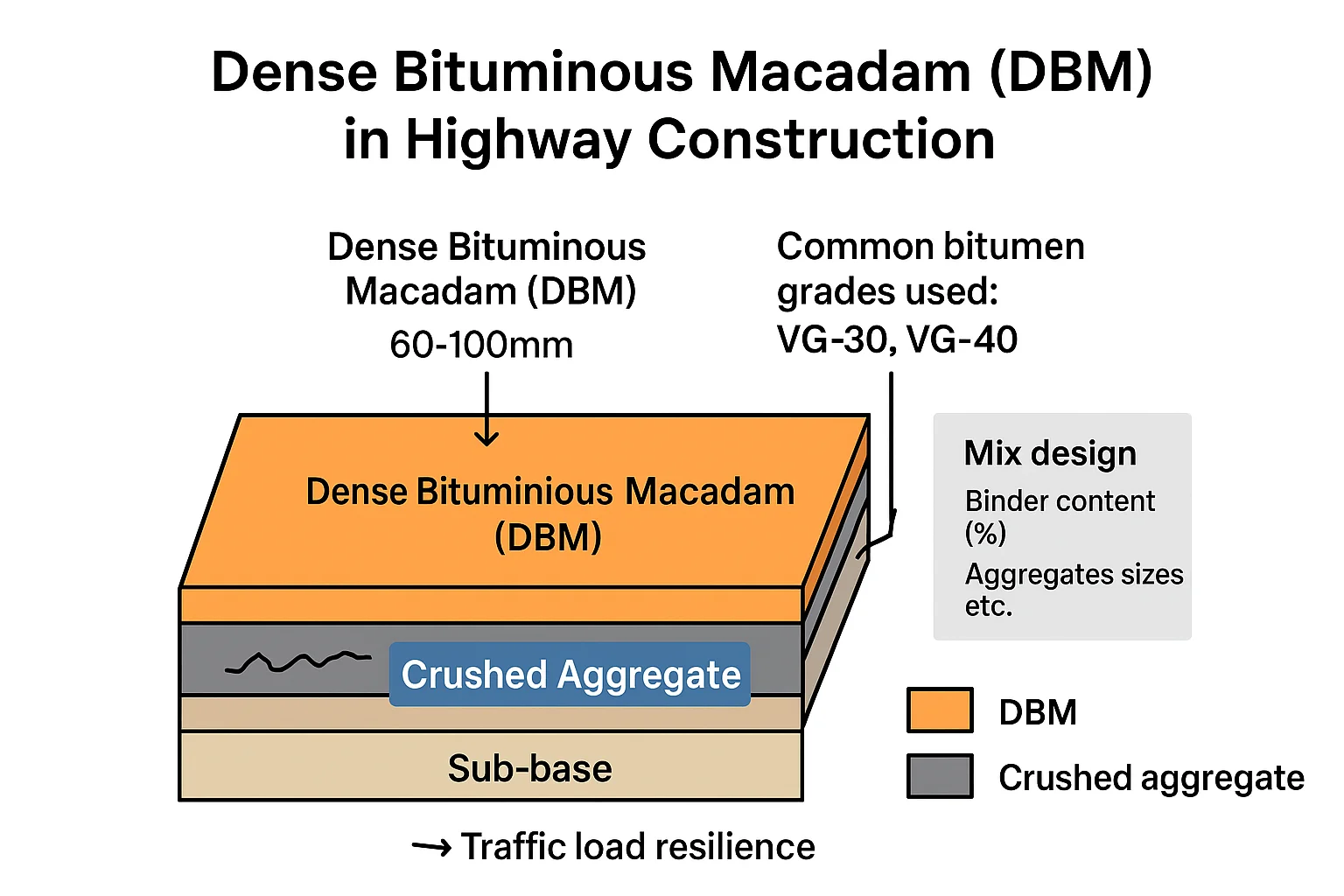
dbm in road construction refers to Dense Bituminous Macadam, a widely used bituminous layer in highways and major roads. It is placed below the wearing course and above the base layer, mainly to provide structural strength, distribute traffic loads, and resist deformation.
If you are a civil engineering student, site engineer, contractor, or diploma engineer, the key things to understand are the binder grade, aggregate gradation, and the required layer thickness. These factors directly affect performance, durability, and construction quality.
This article explains DBM in simple terms, including its role in highway construction, typical material choices, mix design basics, and the main difference between DBM and BC.
What Is DBM in Highway Construction?
Dense Bituminous Macadam is a dense-graded bituminous binder course used in flexible pavements. It is designed to carry repeated wheel loads and reduce stresses on the layers below. In many pavement structures, DBM acts as the intermediate structural layer between the base course and the bituminous concrete wearing surface.
Because it is a dense mix, DBM has fewer voids than open-graded mixes and offers good stability. It is not the final riding surface, but it plays a major role in pavement strength and long-term performance.
Main Components of DBM
DBM consists of four basic ingredients:
- Coarse aggregate for strength and load resistance
- Fine aggregate to fill voids and improve compaction
- Mineral filler to improve density and mix cohesion
- Bitumen binder to coat the aggregates and hold the mix together
The quality of these materials is critical. Poor aggregate shape, dusty material, or incorrect bitumen selection can reduce durability and lead to early failure.
Bitumen Grade Used in DBM
In highway construction, the binder grade for DBM is selected based on climate, traffic loading, and project specifications. In practice, VG-30 and VG-40 are commonly used in many hot-mix bituminous works, but the exact grade must match the approved design and local requirements.
- VG-30 is generally used where traffic and temperature conditions are moderate.
- VG-40 is often chosen for heavier traffic or hotter regions because it offers higher viscosity and better resistance to rutting.
The actual binder selection should never be treated as universal. It depends on the pavement design, traffic category, and the adopted specifications for the project.
Dense Bituminous Macadam Mix Design
dense bituminous macadam mix design focuses on achieving a dense, stable, and durable mix with good aggregate interlock and proper bitumen coating. The objective is to provide enough strength without making the mix too brittle or too rich in binder.
A proper mix design generally checks the following:
- Aggregate gradation within the specified envelope
- Binder content that gives good cohesion without bleeding
- Stability and flow characteristics
- Voids in mineral aggregate and compacted mix
- Moisture resistance and workability
The exact design value for binder content is not fixed for all projects. Bitumen content in DBM depends on gradation, aggregate absorption, traffic level, and the approved job mix formula. It is determined through laboratory mix design and should be verified during production.
Why Mix Design Matters
Even small changes in aggregate grading or binder content can affect field performance. Too little bitumen may cause cracking, raveling, and poor durability. Too much bitumen can reduce stability and cause flushing or bleeding.
That is why DBM must be designed in the lab and then controlled at the plant and site during execution.
Typical DBM Layer Thickness
dbm layer thickness is project-specific and depends on pavement design, traffic loading, and construction stage. DBM is usually laid as a structural bituminous layer, and it may be placed in one or more lifts depending on the required total thickness and compaction capability.
In practice, the thickness is decided by the design consultant or specified in the project documents. It should be enough to achieve proper compaction, uniformity, and structural capacity, while avoiding segregation or inadequate density.
For site work, thickness control is important because an under-thick layer reduces service life, while an over-thick layer may affect compaction and cost. Thickness should be checked during laying and after compaction, as required by the project quality plan.
DBM vs BC Difference
The dbm vs bc difference is one of the most common doubts in pavement construction. Both are dense bituminous layers, but they serve different purposes.
| Aspect | DBM | BC |
|---|---|---|
| Full form | Dense Bituminous Macadam | Bituminous Concrete |
| Main function | Structural binder course | Wearing course / surface course |
| Location in pavement | Below BC, above base course | Top layer exposed to traffic and weather |
| Surface texture | Rougher and more structural | Smoother and more finished |
| Design priority | Strength and load distribution | Ride quality, skid resistance, and surface durability |
In simple words, DBM gives strength, while BC gives riding comfort and surface protection. They work together as part of the flexible pavement system.
Construction Procedure for DBM
The construction method must ensure uniform mix, proper temperature, and effective compaction. A typical sequence is shown below.
- Prepare the base layer and clean the surface properly.
- Apply tack coat where required for bonding with the layer below.
- Produce the mix in a hot mix plant using the approved job mix formula.
- Transport the mix with minimal heat loss and segregation.
- Lay the mix using a paver to the required line, level, and thickness.
- Compact the layer using the correct rolling pattern and temperature window.
- Check density, thickness, and surface regularity during quality control.
Good compaction is essential. If the mix cools too much before rolling, density will suffer and the layer may become permeable or weak.
Quality Control and Site Considerations
DBM quality depends not only on design but also on execution. Common site checks include material cleanliness, aggregate gradation, binder temperature, plant output, mix uniformity, and compaction level.
- Avoid excess dust on aggregates, as it can weaken bitumen bonding.
- Do not allow segregation during loading, transport, or paving.
- Monitor rolling promptly to achieve the required density.
- Check joints carefully, since poorly made joints often become weak points.
- Maintain the paver and plant settings to ensure consistent output.
Many early pavement problems occur because of poor temperature control or incorrect compaction rather than the DBM concept itself.
Advantages of DBM
- Provides strong structural support in flexible pavements
- Distributes wheel loads effectively
- Offers better durability than a weak base layer
- Works well as a binding layer below BC
- Can perform reliably when mix design and compaction are properly controlled
Practical Example
Consider a highway section carrying heavy commercial traffic. The pavement may use a granular base below, followed by DBM as the structural bituminous binder course, and then a BC wearing course on top. In this arrangement, DBM carries much of the traffic stress, while BC protects the surface from wear, water entry, and skid issues.
If the DBM thickness is not maintained properly or the bitumen content is not controlled, the upper BC layer may crack or rut earlier than expected. This shows why DBM is a critical layer in highway pavement performance.
FAQs on DBM in Road Construction
What is DBM in road construction?
DBM stands for Dense Bituminous Macadam. It is a dense bituminous layer used mainly as a binder course in flexible pavements.
Is DBM the top layer of the road?
No. DBM is usually placed below the Bituminous Concrete wearing course. It is a structural layer, not the final riding surface.
Which bitumen grade is used in DBM?
VG-30 and VG-40 are commonly used, but the correct grade depends on project specifications, traffic loading, and climate conditions.
What is the normal DBM layer thickness?
The thickness varies from project to project. It is decided by pavement design and construction requirements, so it should be checked from the approved drawings and specifications.
What is the main difference between DBM and BC?
DBM is mainly a structural binder course, while BC is a wearing course that provides the finished surface and riding quality.
Why is DBM mix design important?
Mix design ensures proper aggregate grading, binder content, stability, and durability. Without a proper mix design, the layer may fail early due to cracking, rutting, or bleeding.
Conclusion
DBM is one of the most important layers in flexible pavement construction. Understanding the bitumen grade, layer thickness, aggregate grading, and mix design helps ensure a durable and stable road structure. In short, dbm in road construction is not just another bituminous layer; it is a key structural element that supports the pavement above it and extends road life when executed correctly.