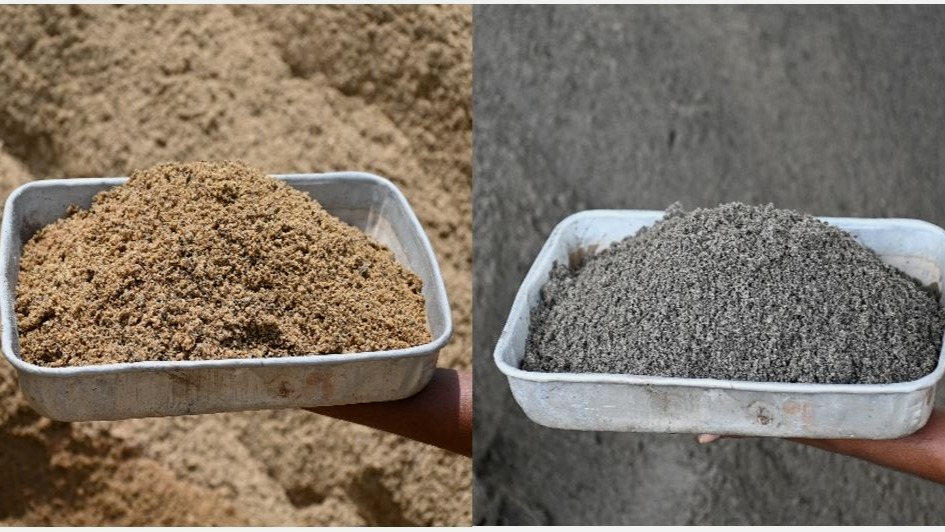
Fine aggregate is a key component of concrete and mortar. In standard aggregate terminology, it is the fraction passing the 4.75 mm IS sieve, with grading and material limits defined by the applicable specification. Natural sand and manufactured sand (M-sand) are common sources. Particle-size distribution, cleanliness, shape, moisture condition and harmful impurities affect workability, water demand, finish and hardened concrete performance. For concrete, fine aggregate should satisfy applicable IS 383 requirements and the approved concrete mix design; generic density or absorption figures should not replace test results.
What is Fine Aggregate?
In practice, fine aggregate is selected not only by particle size but also by its grading zone, cleanliness, shape, moisture condition and compliance with the relevant material specification. These properties influence water demand, workability, finish and the performance of hardened concrete.
Importance of Fine Aggregate in Construction
Fine aggregates are essential for:
- Providing smooth surfaces in concrete.
- Improving workability and uniformity in concrete mixes.
- Acting as a filler material between coarse aggregates.
- Helps achieve a dense and workable aggregate skeleton when proportioned correctly.
Types of Fine Aggregate
- Natural Sand
- Derived from the weathering of rocks.
- Includes types like river sand, pit sand, and sea sand.
- Manufactured Sand (M-Sand)
- Produced by crushing stones into fine particles.
- Offers consistency in quality.
- Crushed Stone Sand
- Obtained by crushing hard stones.
- Commonly used in concrete production.
- Recycled Sand
- Derived from the processing of demolished concrete structures.
Classification of Sand Based on Source
- River Sand: Smooth and rounded grains, ideal for construction.
- Pit Sand: Angular grains, suitable for plastering.
- Sea Sand: Contains salts; requires thorough washing before use.
- Desert Sand: Finer grains, often unsuitable for concrete.
Properties of Fine Aggregate
- Particle size
Fine aggregate is the aggregate fraction passing the 4.75 mm IS sieve. The permitted quantity of very fine material, including material passing the finer sieves, is controlled separately by the applicable grading and material-quality requirements. It should not be described as a universal 0.075–4.75 mm size band. - Specific Gravity of Fine Aggregate
- Depends on the mineral source and aggregate composition; determine it by the specified laboratory test rather than assuming a fixed value.
- Specific gravity is the ratio of aggregate particle density to the density of water at the test temperature. Use the tested value in mix proportioning and yield calculations.
- Density of Fine Aggregate
- Bulk density varies with grading, particle shape, moisture content and the method of filling or compaction. Measure it for the actual material and stated test condition before using it for quantity conversion.
- Water Absorption of Fine Aggregate
- Determine water absorption by the specified test method and compare it with the limit in the governing material specification or project document. There is no single 3% limit that should be applied to every source without checking the applicable requirement.
- Absorption and free surface moisture affect the water correction required in concrete batching; account for both when adjusting batch water and aggregate mass.
- Fineness Modulus
- Fineness modulus is calculated from cumulative percentages retained on the specified sieve series. Its value describes the relative coarseness of the aggregate; it is not a direct measure of quality and has no single universal “ideal” range.
- Use the measured fineness modulus together with the full sieve analysis and grading-zone limits when assessing suitability for a concrete mix.
Testing Methods for Fine Aggregate
1. Sieve Analysis of Fine Aggregate
- Determines particle size distribution.
- Helps classify sand as well-graded or poorly graded.
2. Specific Gravity Test
- Measures the density of fine aggregate.
3. Water Absorption Test
- Ensures sand does not absorb excessive water.
Fine Aggregate Grading Zones as per IS 383:2016
IS 383:2016 classifies fine aggregate into four grading zones based on sieve analysis. The table below gives the percentage by mass passing each sieve. Compare a representative test sample with the grading zone specified or accepted for the concrete mix; do not treat one column as a universal grading for all sand.
| IS sieve | Zone I (%) | Zone II (%) | Zone III (%) | Zone IV (%) |
|---|---|---|---|---|
| 4.75 mm | 90–100 | 90–100 | 90–100 | 95–100 |
| 2.36 mm | 60–95 | 75–100 | 85–100 | 95–100 |
| 1.18 mm | 30–70 | 55–90 | 75–100 | 90–100 |
| 600 μm | 15–34 | 35–59 | 60–79 | 80–100 |
| 300 μm | 5–20 | 8–30 | 12–40 | 15–50 |
| 150 μm | 0–10 | 0–10 | 0–10 | 0–15 |
Grading zone influences workability, water demand and mix proportions. Zone IV is the finest of the four zones and requires particular care in mix design; its use should be checked against the standard’s provisions and the project specification, especially for reinforced concrete. The final suitability of natural sand or manufactured fine aggregate must also satisfy limits for material quality, fines and deleterious substances and the approved concrete mix design. Confirm the current standard edition and amendments adopted by the project.
Difference Between Fine Aggregate and Coarse Aggregate
| Property | Fine Aggregate | Coarse Aggregate |
|---|---|---|
| Size | < 4.75 mm | > 4.75 mm |
| Shape | Rounded or angular | Irregular or angular |
| Water Absorption | Lower | Higher |
| Role in Concrete | Fills voids, enhances workability | Provides bulk, resists loads |
Applications of Fine Aggregate
- Concrete Production
- Essential in achieving desired concrete strength.
- Plastering
- Used for smooth wall finishes.
- Pavement Construction
- Fills voids in asphalt and concrete roads.
- Mortar Production
- Acts as a filler material between bricks and blocks.
Fine Aggregate Tests and Standards
For concrete aggregate, consult the specification edition and amendments adopted in the project. The references commonly used for fine aggregate grading and test methods include:
- IS 383:2016: Specification for coarse and fine aggregates from natural sources for concrete, including fine aggregate grading zones.
- IS 2386 (Part 1): Methods of test for aggregates for concrete — particle size and shape tests, including sieve analysis.
- IS 2386 (Part 3): Methods of test for aggregates for concrete — specific gravity, density, voids, absorption and bulking.
FAQs Of Fine Aggregate
Q1: What is the difference between coarse and fine aggregate?
Fine aggregate consists of smaller particles, while coarse aggregate includes larger ones.
Q2: What is the ideal fineness modulus for fine aggregate?
There is no single ideal value for every concrete mix. Fineness modulus is used with the complete sieve analysis to describe the relative coarseness of sand. The grading zone, source, mix design and required workability should guide selection.
Q3: Can sea sand be used as fine aggregate in concrete?
Do not assume that washing alone makes sea sand suitable. It must be assessed for chloride and other harmful salts, grading, shell content and all applicable material requirements. Use it only where the governing specification permits it and test results and project approval confirm suitability; reinforced concrete has particular durability concerns because chlorides can increase the risk of reinforcement corrosion.
Conclusion Of Fine Aggregate
Fine aggregate is indispensable in construction, significantly impacting the strength and durability of structures. Understanding its properties, testing methods, and applications ensures quality in every construction project. Always choose well-graded, clean, and appropriately sized fine aggregate to achieve the best results.