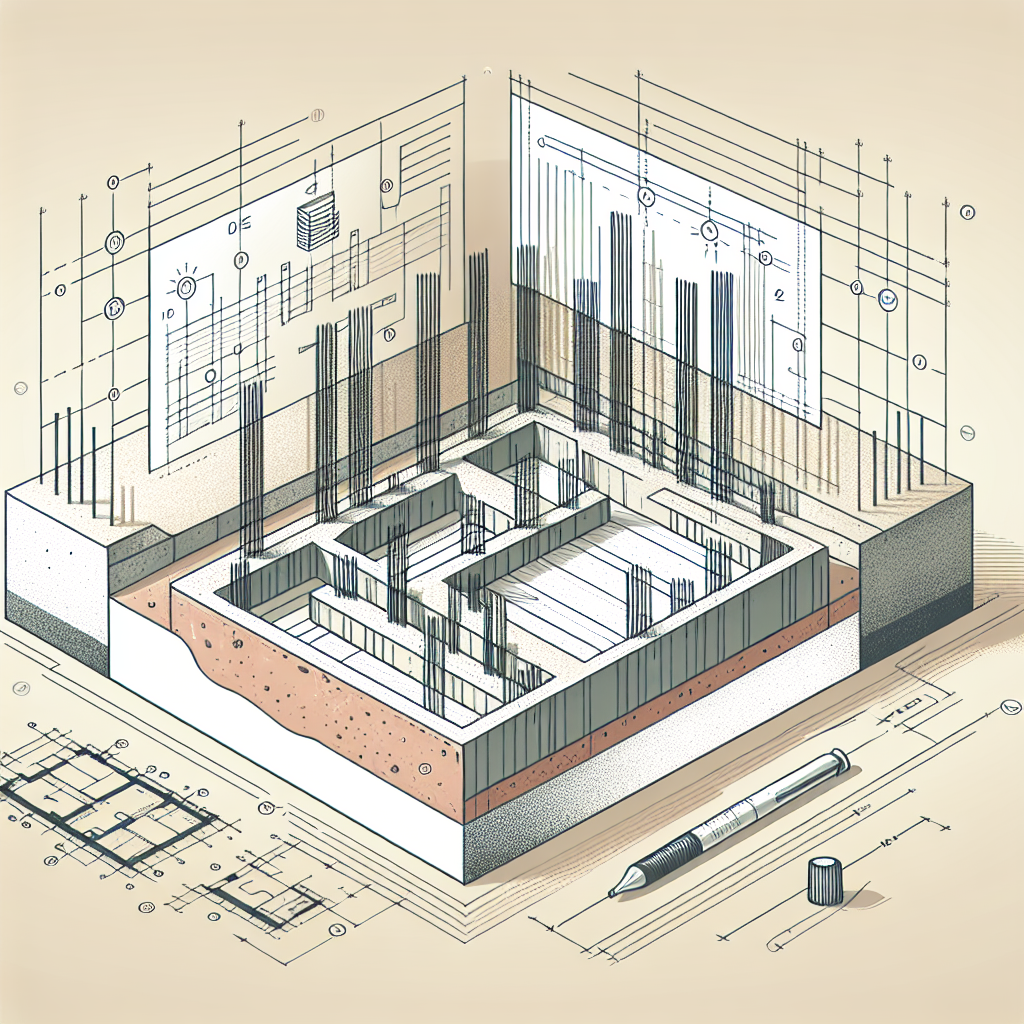
Combined footings join two or more columns on a single concrete base when column loads are close or when one column sits near a property line. They help spread loads where individual footings would interfere or cause uneven settlement.
This article explains how to assess when a combined solution fits, how to calculate loads and soil capacity, and what checks and reinforcement details ensure a reliable foundation. Practical steps and concise calculations are included to help you plan confidently.
When a combined footing is the right choice
Combined footings are commonly used where two columns are close together or when one column is at the edge of a plot and an isolated footing would extend beyond property limits.
They are also useful when adjacent loads interact, making independent footings impractical or likely to cause differential settlement. A combined base balances loads and reduces eccentricity on the foundation slab.
Common scenarios
Typical situations include unequal column loads, limited site width, and high bearing pressures that require larger footing areas. Each case needs a site-specific check to confirm a combined base is the best solution.
Assessing loads and soil capacity
Start with accurate column loads, including dead, live, and any additional imposed loads. Combine vertical loads and consider moments that will cause eccentricity in the footing.
Next, obtain soil bearing capacity from a geotechnical report or in-situ tests. Safe bearing pressure determines the required footing area and influences footing thickness and reinforcement.
Calculating required area
Divide the total column load by allowable soil pressure to get the gross footing area. If you have two columns, sum their vertical loads and include the effect of moments as needed.
- Required area = (Total vertical load) / (Allowable bearing pressure)
- Check for eccentricity: if the resultant of vertical loads is offset, treat the pressure as non-uniform.
- If pressure becomes tension on one side, redesign layout or add stiffness to avoid uplift.
Step-by-step design and checks
Designing a combined footing follows a systematic sequence: layout, area check, bending and shear checks, and reinforcement detailing. Keep calculations clear and document assumptions.
Always begin with a plan layout showing column positions, distances, and the preliminary footprint of the footing. This layout defines spans and lever arms for moment calculations.
Plan layout and centroid
Locate the centroid of the loaded area to find eccentricity. If columns carry different loads, the pressure distribution will be skewed and the centroid shifts toward the heavier load.
Bending moment and shear
Compute bending moments about critical sections using the pressure distribution and column reactions. Use simple beam-on-foundation assumptions or strip method for rectangular footings.
For shear checks, find punching shear around columns and one-way shear at critical sections parallel to column lines. Ensure the slab thickness and reinforcement meet shear capacity limits.
- Compute maximum bending moment: use load position and tributary width for rectangular strips.
- Punching shear: check perimeter around each column and increase slab thickness if needed.
- One-way shear: check at distance d from face of column; compare V_ed to V_rd (design shear capacity).
Settlement and differential movement
Estimate settlement based on soil compressibility and loaded area. A combined footing reduces differential settlement between adjacent columns but may still need soil improvement if settlements are excessive.
When columns have very different loads, check that the maximum allowable differential settlement is not exceeded between them. If it is, consider stiffening the slab or improving the ground.
Reinforcement detailing and practical considerations
Provide distributed reinforcement to control flexure and shrinkage. Longer footings often require continuous top and bottom bars with splices placed away from high-moment zones.
Stirrups or closed links may be needed near columns to resist punching shear. Ensure clear concrete cover per exposure conditions and place chairs to maintain bar positions during pouring.
Main reinforcement layout
Place main bars in both directions, with larger top bars where negative moments occur near columns. Use a minimum amount of reinforcement to control cracks even when bending demands are low.
- Maintain minimum bar area to prevent wide cracks and to provide ductility.
- Lap splices should be staggered and placed where moment is lower, or use mechanical couplers.
- Provide sufficient development length considering bar diameter and concrete strength.
Practical tips on construction
Ensure accurate formwork levels and compacted subgrade. Poor site preparation leads to unexpected settlements or uneven load transfer to soil.
Cure concrete adequately and avoid premature loading. Monitor temporary shoring and protect the foundation from water accumulation during curing.
Conclusion
Combined bases are an efficient way to handle adjacent column loads, limited site width, or near-boundary situations. Proper assessment of loads, soil, and bending and shear demands is essential.
Detailed reinforcement and careful construction practice reduce risk of cracking and settlement. Use clear calculations and conservative checks to achieve a durable, economical foundation.
Frequently Asked Questions
Below are short answers to common concerns when planning a combined footing. Each question focuses on a practical point to help clarify typical design choices.
When is a combined footing preferable to individual footings?
A combined solution is preferable when column spacing is small, an isolated footing would extend beyond a property limit, or when adjacent loads interact significantly. It helps reduce differential settlement and avoids footing overlap.
How do you account for eccentric loads in the design?
Find the resultant of vertical loads and its distance from the geometric center. Convert that eccentricity into a non-uniform pressure distribution. Check that the maximum pressure does not exceed allowable soil bearing and that tension zones are avoided.
What soil data is essential before final design?
At minimum, obtain safe bearing capacity, typical soil stratigraphy, and an estimate of compressibility. Ideally, a geotechnical report with CPT or SPT results informs settlement estimates and any need for ground improvement.
How should punching shear be checked near columns?
Check punching shear around each column by calculating shear force within a critical perimeter at distance 1.5d or per local code. Compare to the design punching shear capacity and increase slab thickness or add reinforcement if required.
Are there common mistakes to avoid?
Common mistakes include underestimating soil settlement, ignoring eccentricity from uneven loads, inadequate top reinforcement near columns, and poor site compaction. Address these early to prevent costly repairs later.