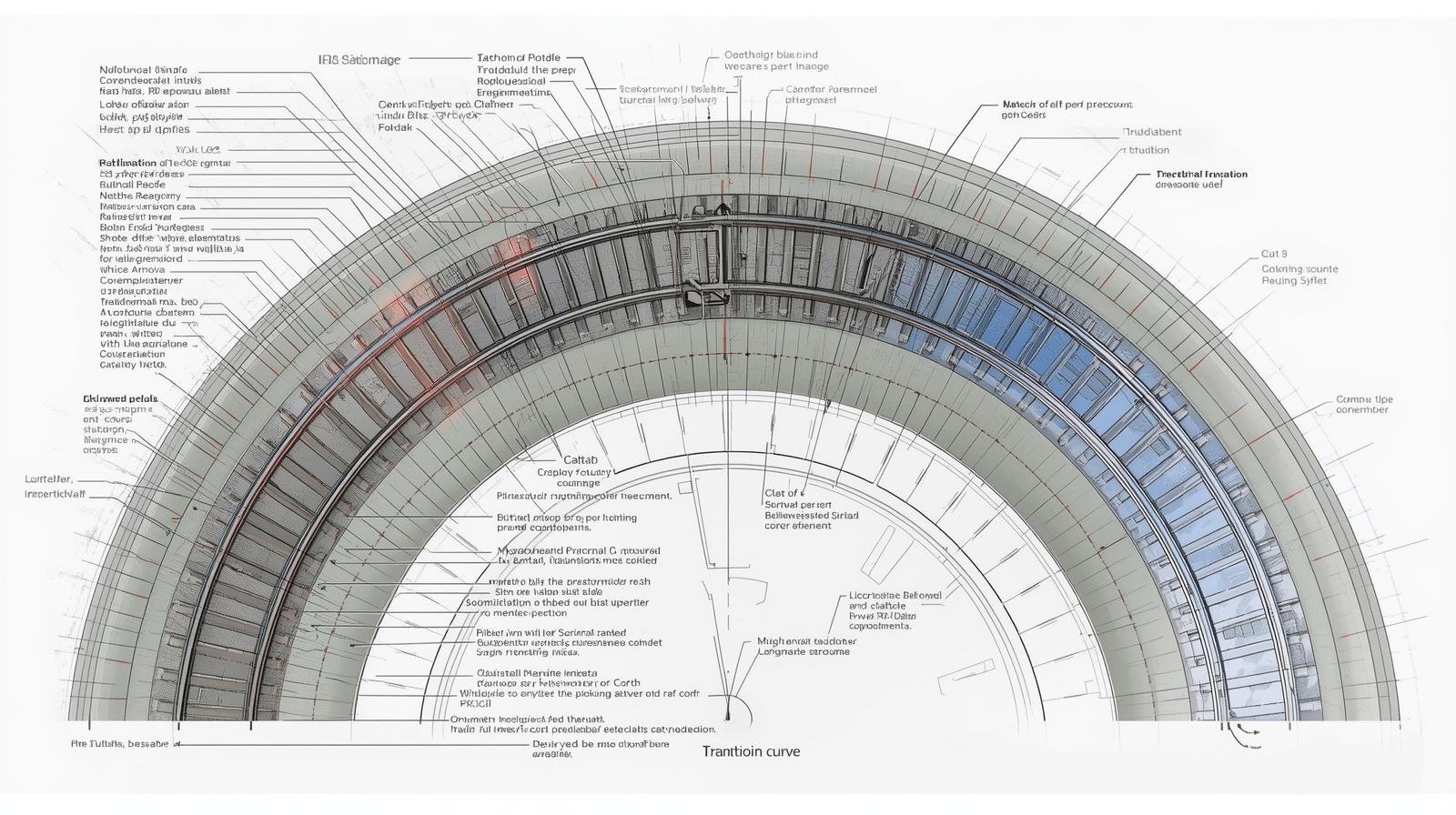
The Transition Curve Length Super elevation Runoff is a key design topic for safe highways. In this article I explain how to use the spiral formula and IRC standards to calculate transition curve length, super elevation runoff, and rate of change. Common search terms include IRCtransition curve lengthsuper elevation, runoff irc, and spiral formula.
Why Transition Curves and Superelevation Matter
Transition curves make the change from straight to curve smooth. Superelevation helps vehicles stay on the road at speed. Runoff is how you move from the normal crown to full superelevation. Good design improves comfort and safety.
Key ideas
Here are the simple points to keep in mind before calculation.
- Transition curve length controls lateral acceleration change.
- Superelevation runoff limits slope change per unit length.
- IRC standards set safe limits for both spiral and runoff.
IRC Standards Overview
The Indian Roads Congress (IRC) gives rules for spiral length, superelevation, and rate of change. These rules help designers pick safe values for different speeds and road classes.
Basic IRC limits
IRC sets maximum rate of change for superelevation and recommends formulas for transition length. The standards balance safety, comfort, and constructability.
Spiral Formula and Transition Curve Length
Transition curves often use a spiral (clothoid) form. The spiral formula links curvature and distance. This lets curvature change evenly along the length.
Spiral formula in plain words
The spiral or clothoid has curvature proportional to the distance along the curve. That means curvature increases linearly from zero at the tangent to the full curve curvature at the circular arc.
Transition curve length calculation
Use the spiral formula to find length. IRC suggests using comfort and rate limits to decide length. A common approach:
- Find design speed and curve radius.
- Compute required change in superelevation and side friction.
- Choose length so the rate of change of superelevation is within IRC limits.
Superelevation Runoff and Rate of Change
Runoff is the length over which pavement cross slope changes from normal crown to the full superelevation. The rate of change matters for vehicle stability and drainage.
Runoff calculation steps
To calculate runoff:
- Decide full superelevation e (from IRC tables or local practice).
- Pick allowable rate of change r (per IRC limits).
- Runoff length L = e / r.
Rate of change limits
IRC gives maximum allowable rate of change for crossfall. Use that to keep L from being too short. Short runoff can feel abrupt. Long runoff may affect drainage and cost.
Combined Design: Spiral plus Runoff
Designers often combine spiral length and runoff length. You must ensure smooth curvature and slope change together. Keep superelevation runoff outside the curve start where possible.
Steps to combine
- Compute spiral length from curvature needs and comfort limits.
- Compute runoff length from superelevation and rate limits.
- Place runoff so the cross slope reaches full e before or at the circular curve entry.
Worked Example (Simple)
This table shows a clear example using typical numbers. It is for illustration only. Follow IRC for final values.
| Parameter | Value |
| Design speed | 80 km/h |
| Curve radius | 300 m |
| Full superelevation (e) | 0.06 (6%) |
| Allowable rate of change (r) | 0.0008 per m |
| Runoff length L = e / r | 0.06 / 0.0008 = 75 m |
| Spiral length (approx) | Depends on comfort – often 40–80 m for this speed |
Practical Tips and Checks
Design work must be simple and practical. Use small checks to avoid errors.
Design tips
- Always confirm values from the latest IRC manual.
- Check both superelevation runoff and spiral length together.
- Use conservative rate of change for busy highways.
- Consider drainage when runoff is long.
Common mistakes
- Ignoring runoff and making superelevation abrupt.
- Using too short spirals for high speed.
- Forgetting to check side friction and comfort limits.
Quick Reference Formulas
Below are the simple formulas you will use often.
- Runoff length L = e / r
- Spiral curvature change k = 1/R, curvature varies linearly with s
- Choose spiral length so curvature increases smoothly from 0 to 1/R
Frequently Asked Questions
What is the best way to pick transition curve length?
Pick length using the spiral formula and comfort limits. Start from design speed and radius. Then check rate of change of superelevation and adjust.
How do I calculate superelevation runoff?
Calculate runoff length L = e / r, where e is full superelevation and r is allowable rate of change from IRC or local rules.
Does IRC give fixed spiral formulas?
IRC gives guidance and limits. It shows how to use spirals and limits for rate of change. Use the latest IRC codes for exact numbers.
Can spiral and runoff overlap?
They can overlap, but plan so slope and curvature changes remain smooth. Avoid abrupt combined changes.
Conclusion
Transition curve length, superelevation runoff, and the spiral formula work together to make roads safe and smooth. Use IRC standards, keep rates of change low, and check both spiral and runoff lengths. Simple checks and formulas will help you design better curves.