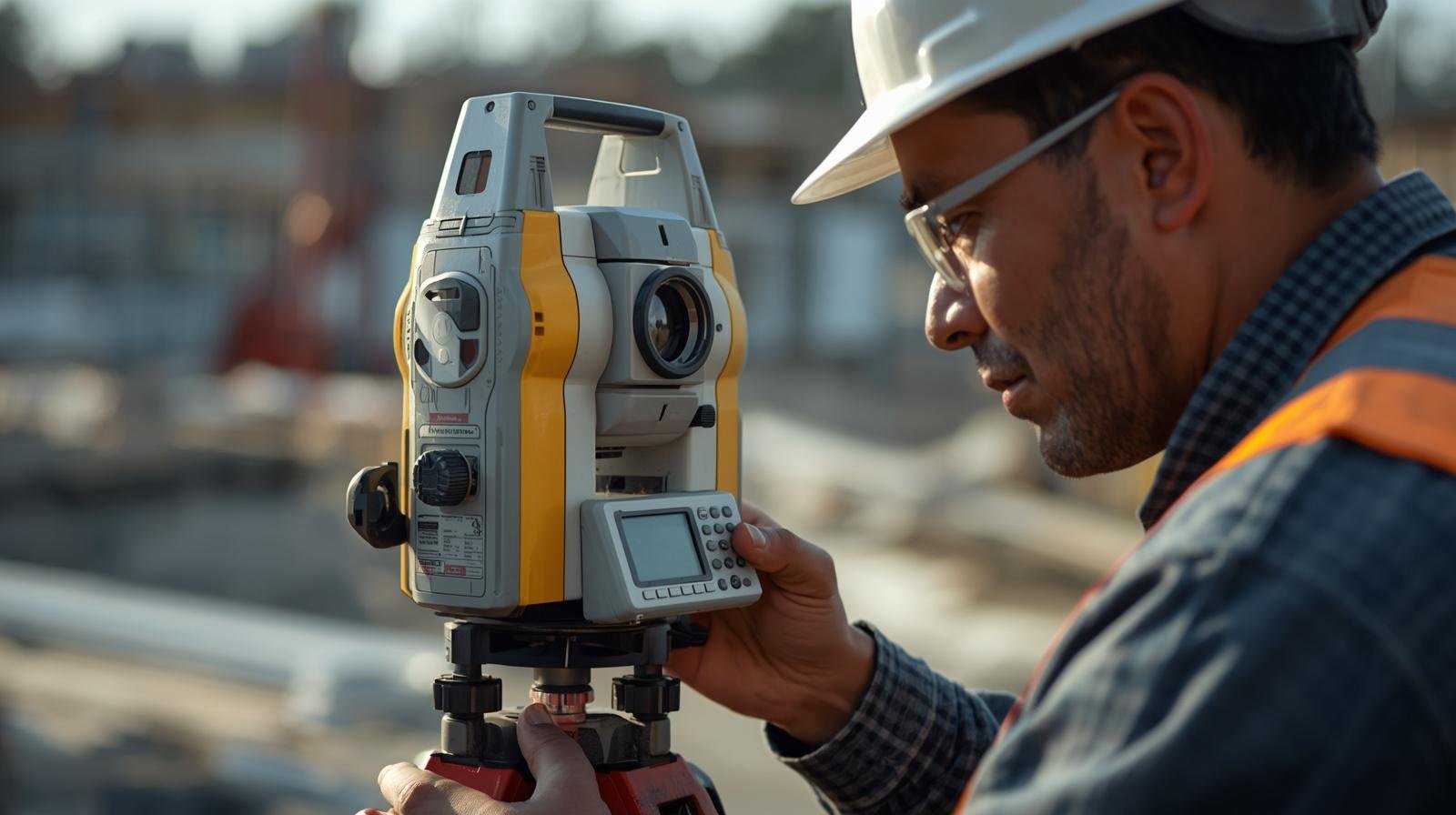
The Total station survey procedure is the backbone of accurate site layout. This guide explains stakeout resection, grid setup, and data collection in simple steps. It is a clear, practical, and complete field guide for surveyors and site teams. Read on to learn step-by-step methods, tips, and checks to keep your work fast and precise.
Overview of Total Station Survey and Key Concepts
Before starting field work, understand the core ideas. A total station measures angles and distances. You use it to set out points (stakeout) and to locate the instrument from known points (resection). Grid setup ties your site to a coordinate system. Good data collection keeps your results reliable.
What is stakeout resection?
Stakeout resection combines two tasks. Resection finds the instrument location by measuring to known control points. Stakeout uses those coordinates to place new points on the ground. Together they help you work without a tripod at a known benchmark.
Why grid setup matters
Grid setup aligns your project to a map system. A good grid reduces confusion later. It ensures that your measured points match plans and that construction fits the design.
Equipment and Pre-Field Checks
Simple checks in the morning save time later. Inspect equipment and set up your files before leaving the office.
Essential equipment list
- Total station with charged batteries
- Prism pole and prism
- Tripod and tribrach
- Field book or data logger
- Control point coordinates and site plans
- Measuring tape, range pole, and safety gear
Pre-field setup tips
- Charge batteries and back up data files.
- Load the project coordinate system into the total station.
- Check instrument calibration if possible.
- Review control point coordinates and tolerances.
Grid Setup and Control Points
Grid setup creates the working coordinate system on site. Start with stable control points that match project plans.
Selecting control points
Choose points that are visible from many angles. Prefer permanent markers or established benchmarks. Note their coordinates and accuracy.
Establishing the grid
Place temporary control if needed. Use the total station to measure from known coordinates to set local grid points. Record everything clearly.
Resection: Determining Instrument Position
Resection lets you find the total station location when it cannot be set directly over a known point.
Resection step-by-step
- Set up the tripod and level the instrument roughly.
- Measure horizontal angles and distances to at least three well-spaced control points.
- Enter the known coordinates into the instrument.
- Use the instrument’s resection function to compute your station coordinates.
- Verify residuals and repeat if errors exceed tolerance.
Common resection checks
- Ensure control points are not collinear.
- Check that angular and distance measurements are consistent.
- Confirm the computed instrument height matches your setup.
Stakeout Procedure
After resection and grid setup, stakeout places design points on the ground. Follow clear steps to avoid mistakes.
Stakeout step-by-step
- Load design coordinates into the total station or data logger.
- Confirm instrument position via resection or known station.
- Set prism on the pole and aim at the total station.
- Request the instrument to guide you to the point or read offsets.
- Mark the point with nails, stakes, or paint.
- Record the measured as-built values for verification.
Tips for precise stakeout
- Work in pairs for faster and safer staking.
- Re-check a random sample of staked points.
- Use short sight distances for higher accuracy when possible.
Data Collection and Quality Control
Good data collection keeps the project traceable and reduces rework. Follow consistent steps for logging and checking data.
Best practices for data collection
- Use clear file names and project codes on the total station.
- Record instrument height, target height, and date/time for each session.
- Save backups daily and transfer files to the office.
- Note weather conditions and any site issues.
Quick field quality checks
- Repeat measurements for critical points.
- Check closure errors for traverses.
- Compare staked points with plan coordinates for offsets.
Step Summary Table
| Phase | Key Actions |
| Preparation | Charge batteries, load grid, review control points |
| Grid Setup | Establish control, set local grid, record coords |
| Resection | Measure to control points, compute instrument position |
| Stakeout | Load design points, guide to location, mark points |
| Data Collection | Save files, record heights, perform quality checks |
Common Errors and Troubleshooting
Small errors can cause big problems. Watch for these common issues and fix them quickly.
Frequent mistakes
- Poor leveling of the instrument.
- Using collinear control points for resection.
- Not accounting for instrument or prism heights.
- Wrong grid or coordinate system loaded into the instrument.
How to fix problems
- Re-level and re-check measurements.
- Use at least three well-spaced control points for resection.
- Confirm all heights and offsets before staking.
- Cross-check coordinates with a paper plan or CAD export.
Frequently Asked Questions
What is the difference between stakeout and resection?
Resection finds the instrument position using known points. Stakeout places design points on the ground using that instrument position. Resection is a setup step. Stakeout is the layout step.
How many control points do I need for resection?
Use at least three well-spaced control points. More points increase redundancy and help detect errors. Avoid points that lie on a straight line.
How do I ensure my grid is correct?
Use verified control coordinates from reliable sources. Check distances and bearings between control points. Confirm that your instrument is using the same coordinate system as the plans.
What is a quick way to check stakeout accuracy?
Re-measure a random selection of staked points back to control. Compare these as-built coordinates to the design coordinates and check for acceptable offsets.
Can I do stakeout without a prism?
Yes, many total stations support reflectorless measurements. But using a prism often gives higher accuracy, especially at longer distances or in poor visibility.
Conclusion
This complete field guide covers the core total station survey procedure: stakeout, resection, grid setup, and data collection. Follow the steps, use simple checks, and keep clear records. With practice you will speed up work and improve accuracy on every site.