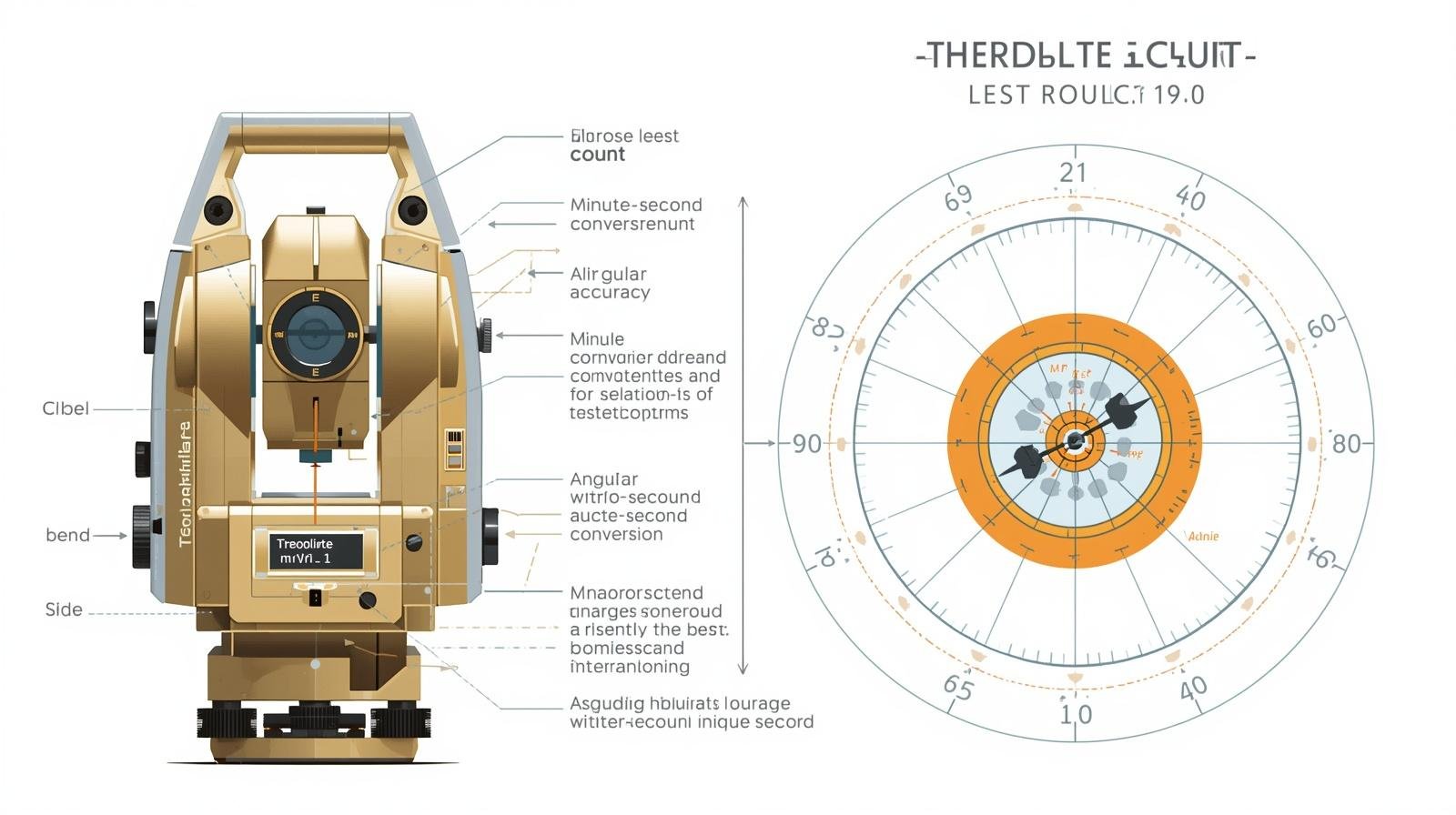
Theodolite Least Count Calculation Method helps surveyors find the smallest angle a theodolite can measure. In this article we explain the theodolite least count, minute second conversion, angular accuracy, and the calculation method. You will also see practical examples and clear steps to compute least count and check angular accuracy against instrument specifications.
Understanding Theodolite Least Count and Angular Accuracy
Before diving into formulas, it helps to know what least count and angular accuracy mean in simple terms. This section gives a clear, short explanation to build a strong base.
What is Least Count?
The least count is the smallest angle that can be read directly on the theodolite scale. It depends on the number of divisions on the vernier or micrometer.
What is Angular Accuracy?
Angular accuracy is how close a measured angle is to the true angle. It includes instrument limits like least count and other errors like human reading error and collimation error.
How to Calculate Theodolite Least Count (Minute-Second Conversion)
Here we give the formula and a clear step-by-step calculation method. We also show how to convert the result into minutes and seconds for real-world use.
Least Count Formula
The common formula for least count depends on the type of scale. For a vernier theodolite:
Least Count = Value of one main scale division – Value of one vernier scale division
When the main scale is in degrees, you convert to minutes and seconds to express small values.
Step-by-Step Calculation Method
- Find the value of one main scale division (MSD), usually in degrees, minutes, or seconds.
- Find how many vernier divisions (VD) match a certain number of main scale divisions.
- Compute value of one vernier division: VD value = (number of MSD covered) / number of vernier divisions.
- Least Count = MSD – VD value.
- Convert the result into minutes and seconds if needed.
Minute and Second Conversion Quick Rules
Use these basic conversions:
- 1 degree = 60 minutes (60′)
- 1 minute = 60 seconds (60″)
To convert decimal degrees to minutes and seconds, multiply fractional degree by 60 for minutes, then fractional minute by 60 for seconds.
Practical Examples and Worked Problems
Examples help make the calculation method concrete. Below are clear worked problems that use minute-second conversion and show angular accuracy checks.
Example 1: Basic Vernier Theodolite Least Count
Suppose the main scale is divided so that 1 MSD = 1 minute (1′). The vernier has 30 divisions that coincide with 29 main scale divisions.
Value of 1 vernier division = 29 MSD / 30 = 29′ / 30 = 0.966666…’
Least Count = MSD – VD value = 1′ – 0.966666…’ = 0.033333…’ which equals 0.033333 x 60 = 2″ (approximately 2 seconds).
So the least count is 2 seconds (2″). This is the smallest angle you can read directly.
Example 2: Degree-Based Scale with Minute Conversion
If 1 MSD = 1 degree and the vernier has 40 divisions matching 39 MSD:
Value of 1 VD = 39° / 40 = 0.975°
Least Count = 1° – 0.975° = 0.025°
Convert to minutes: 0.025° × 60 = 1.5′ which is 1′ 30″. So the least count is 1 minute 30 seconds.
Table: Common Least Count Examples
| Instrument Setup | Least Count | In Minutes and Seconds |
| Main scale 1′ , Vernier 30 divisions = 29′ | 0.03333′ | 2″ |
| Main scale 1°, Vernier 40 divisions = 39° | 0.025° | 1′ 30″ |
| Main scale 1′ , Vernier 60 divisions = 59′ | 0.016666′ | 1″ |
Specification and Angular Accuracy Guidelines
Instrument specs often state angular accuracy in seconds or arc-seconds. This section shows how to interpret those specs and compare with your least count.
Reading Instrument Specifications
Specifications may say things like “Angular accuracy ±20” or “Least count 2”. This means the instrument aims to measure within that range, but actual field accuracy depends on technique and setup.
Comparing Least Count and Angular Accuracy
If least count is larger than the claimed angular accuracy, you cannot reliably reach the specification. For example, an instrument with least count 1′ (60″) cannot deliver true ±20″ accuracy without averaging or other methods.
Tips for Accurate Measurements
Small habits improve the practical angular accuracy beyond raw least count limits. Use these tips in the field.
- Always level the instrument properly.
- Use both face left and face right readings and average them.
- Repeat critical angle measurements and compute mean values.
- Keep the instrument and optics clean and check collimation.
- Account for temperature changes that can affect mechanical parts.
Frequently Asked Questions
Below are short answers to common questions about theodolite least count, minute second conversion, and angular accuracy.
What is the difference between least count and accuracy?
Least count is the smallest readable unit on the instrument. Accuracy is how close measurements are to the true value and depends on least count plus other errors and procedures.
How do I convert decimal degrees to minutes and seconds?
Multiply the fractional part of degrees by 60 to get minutes. Multiply the fractional part of minutes by 60 to get seconds. Keep values short and round sensibly for field use.
Can I improve angular accuracy beyond the least count?
Yes. Using repeated readings, averaging face left and face right, and careful setup can improve practical accuracy. But you cannot read smaller than the least count without estimation or interpolation methods.
What is a typical least count for modern theodolites?
Modern optical theodolites often have least counts like 1″, 2″, 5″, or 10″. Digital theodolites may give finer display resolution, but practical accuracy still depends on setup and errors.
Conclusion
The theodolite least count calculation method is a simple but essential skill for accurate angle measurement. Knowing how to convert minutes and seconds and how least count relates to angular accuracy helps you choose the right instrument and use better technique in the field. Use the worked examples and tips here to check your own instruments and improve measurement reliability.