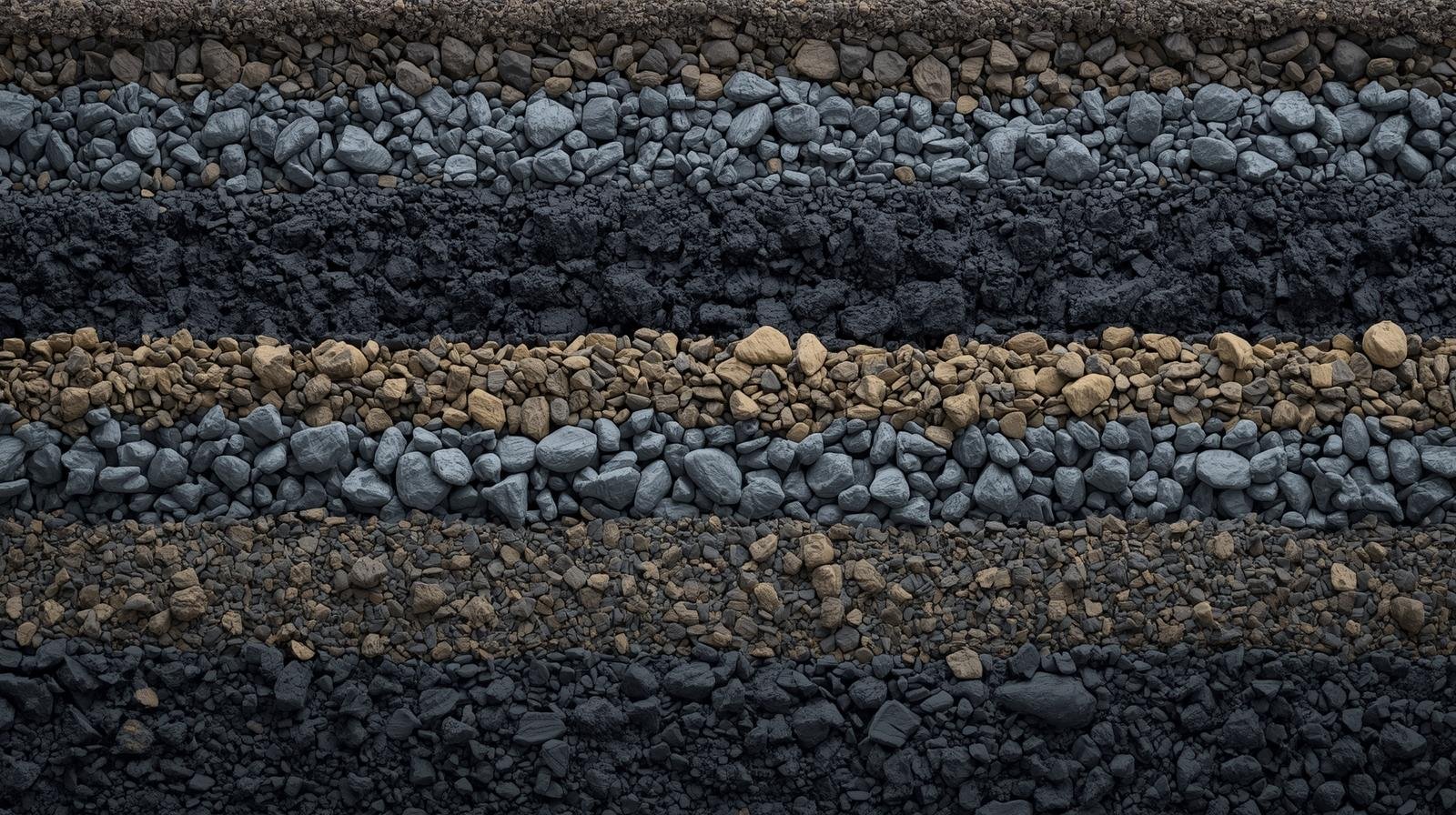
GSB Grading I under MoRTH refers to one of the particle-size distribution envelopes specified for Granular Sub-Base in MoRTH Specifications for Road and Bridge Works, Fifth Revision (2013), Clause 401 and Table 400-1. “Grading I” identifies a sieve gradation, not a separate quality class or a new 2026 standard. Always confirm the specification edition and amendments named in the project contract.
What Is GSB Grading I under MoRTH?
GSB is the granular sub-base layer placed over the prepared subgrade and below the pavement base or other specified upper layers. Grading I is one of the sieve-wise gradation categories in Table 400-1. This article focuses on checking that grading and the associated source material; for the general layer design, construction sequence and other GSB gradings, see the main granular sub-base guide and the GSB material requirements article.
Key points of the specification
- Controls on particle size distribution (gradation) for stability and compaction.
- Limits on plasticity and harmful materials to avoid weakening.
- Requirements for maximum dry density and field compaction.
- Specific test methods and sampling frequency for quality control.
Material Properties and Tests
For the grading named in the contract, compare the laboratory sieve-analysis result with the percentage-passing limits at every sieve in Table 400-1. Separately check the material’s physical properties and construction acceptance criteria under the same specification edition.
- Gradation: Ensures proper mix of coarse and fine particles.
- Plasticity Index (PI): Low PI is required to reduce expansion or softening.
- Maximum Dry Density (MDD) and Optimum Moisture Content (OMC): For compaction control.
- Los Angeles Abrasion / Aggregate Impact: Indicates toughness and resistance to breakdown.
- CBR (California Bearing Ratio): Where the applicable GSB specification requires it, use the specified sample preparation, soaking condition, test method and acceptance limit. Confirm the contract edition and any project-specific requirements.
Key specification areas to verify for the selected GSB grading include:
- Gradation limits: specified sieve percentages
- Plasticity index: compare the laboratory result with the exact limit specified in the contract edition; do not assume one generic PI value.
- Compaction: achieve the density and test frequency specified in the contract and approved method statement
- Testing frequency: follow the sampling and acceptance frequency stated in the project specification and quality-control plan
Site Preparation and Compaction
Proper placement is as important as material quality. Follow the approved method statement for lift thickness, moisture conditioning, equipment, rolling pattern and field-density testing.
- Subgrade must be stable and scarified where needed.
- Spread and compact the GSB in layer thicknesses that the specified equipment can compact uniformly and that are permitted by the project specification.
- Select roller type, operating speed and number of passes through the approved method statement and trial section. Vibratory smooth-drum rollers are commonly used for granular layers, but the suitable equipment depends on material grading, layer thickness and project requirements.
- Test MDD/OMC and compact to the required percentage.
- Condition the material near the specified moisture content before compaction; do not place material outside the permitted moisture range.
Practical Tips for Contractors
Practical field controls help demonstrate that the approved GSB material and layer meet the project’s requirements.
- Keep a record of sieve analyses and daily compaction test results.
- Source mixes from reliable quarries and request certificates.
- Use calibrated field testing devices and trained technicians.
- Plan for drainage; a good GSB loses less strength when dry.
- Communicate with designers if materials deviate slightly — many issues can be resolved with approved adjustments.
Why Specification Compliance Matters
Using the specified grading and verifying material properties, moisture, compaction and layer geometry helps achieve a consistent sub-base. It does not remove the need for pavement design, drainage and construction quality control.
- Better load distribution and reduced pavement deformation.
- Fewer potholes and less frequent overlays.
- Predictable construction timelines due to clear quality steps.
- Easier approvals and audits with documented testing.
FAQs
How many GSB gradings are listed in MoRTH Table 400-1?
The cited MoRTH Fifth Revision (2013), Clause 401 and Table 400-1 lists six GSB gradings, designated I to VI. Check the specification edition and amendments adopted in the project contract before applying the table.
Can recycled or crusher-run material be used as GSB Grade 1?
Alternative or recycled materials may be used only where the contract specification permits them and the proposed source demonstrates compliance with the specified grading and material-quality tests. Obtain approval from the Engineer before use.
How often should compaction tests be done on site?
Test frequency must follow the applicable MoRTH specification edition, contract quality-assurance plan and approved inspection and test plan. Record the test location, chainage, layer, date, moisture condition and result so that each accepted lot can be traced.
What roller type works best for GSB grade 1?
Use roller types suited to the mix: vibratory smooth-drum for free-draining granular, sheepfoot for mixes with some fines needing kneading action.
Conclusion
GSB Grading I is a particle-size distribution category in the cited MoRTH Fifth Revision, not a material quality rank. Acceptance requires sieve-analysis compliance with the grading selected in the contract, separate checks on the required physical properties, moisture conditioning, compaction, layer thickness and traceable quality records. Before construction, verify the specification edition and amendments adopted by the project and use the approved inspection and test plan.