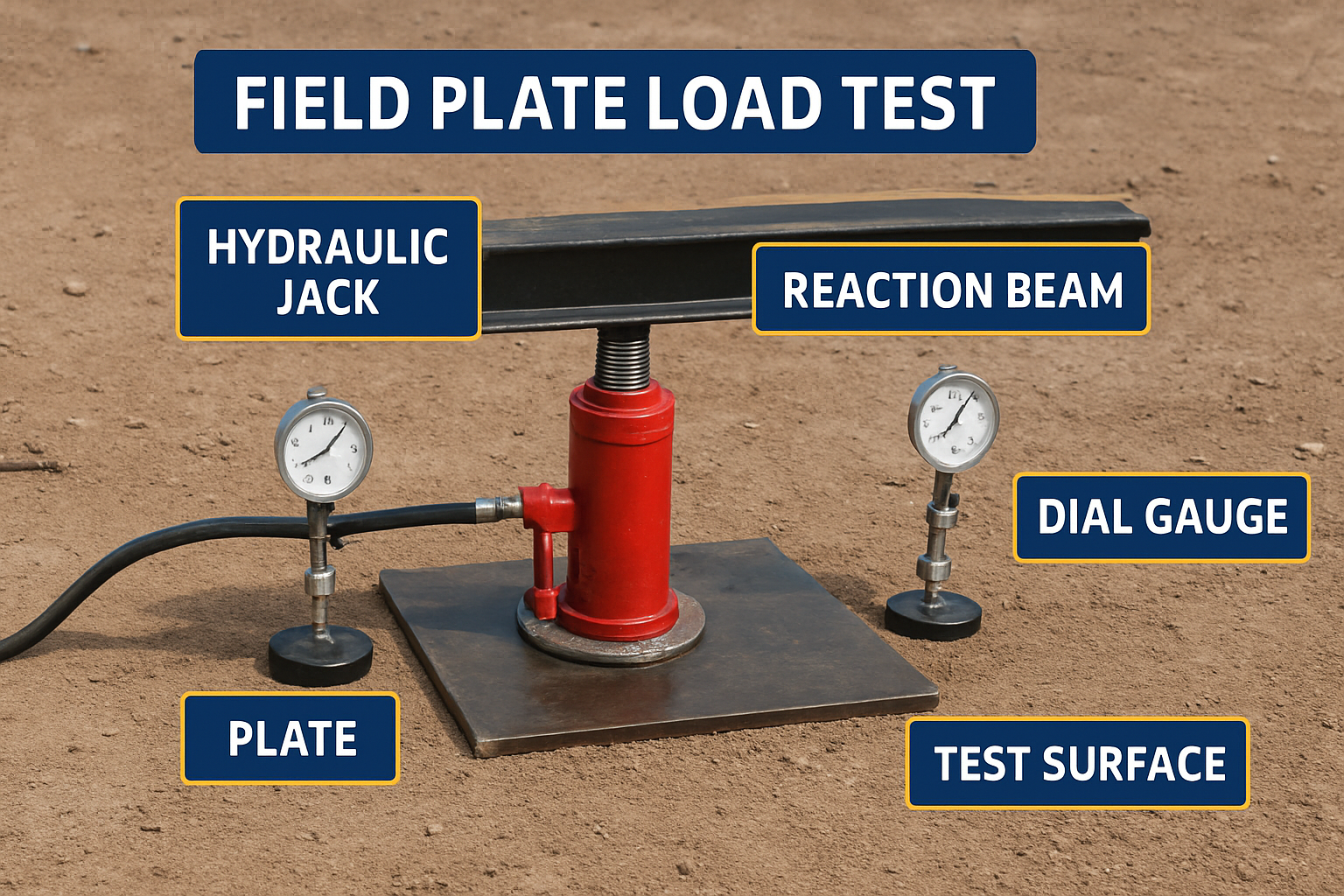
The Plate Load Test is a crucial field experimentation technique employed to ascertain the load-bearing capacity of soil beneath a proposed structure. This test provides key insights into the mechanical response of soil and assists engineers in making informed decisions regarding foundation design. By understanding the plate load test procedure and its implications, civil engineers can gauge the performance of foundation systems, ensuring they meet both safety and serviceability criteria. For the current method and revision, check the relevant entry in the BIS standards portal.
In this article, we will dive into the comprehensive procedure for conducting a plate load test, the interpretation of the resulting load-settlement curve, and the potential applications of this valuable test method in assessing soil bearing capacity.
Plate Load Test Procedure
To perform a plate load test, several steps must be followed meticulously to ensure accurate results. The procedure typically involves the following stages:
- Site Preparation: Select an appropriate site, clear it of debris, and ensure that the ground is stable. The test location should be representative of the overall soil conditions at the foundation.
- Plate Selection: Choose a steel plate of known dimensions, commonly ranging from 300 mm to 750 mm, for the test. The plate should be thick enough to resist bending during loading.
- Setting up the Apparatus: Position the plate on the prepared ground surface. Use leveling tools to ensure it’s horizontal. Attach dial gauges at the edges of the plate to measure settlement.
- Loading Arrangement: Utilize a loading frame to apply a vertical load to the plate. Load can be applied through various means, such as hydraulic jacks or weights. Step-load increments are typically added during the test.
- Data Collection: Monitor and record the corresponding settlements for each applied load increment. This should continue until the desired load is reached or until settlements become negligible.
- Load Removal: After reaching the maximum load, remove the load systematically, recording any rebound or residual settlement.
Load-Settlement Curve
Once the actual testing is complete, the next critical aspect is interpreting the results through the load-settlement curve. The load-settlement curve is a graphical representation that plots applied load against the observed settlement. Here’s how to derive and interpret this curve:
- Plotting the Graph: Use the recorded data to create a graph with the load on the y-axis and the corresponding settlement on the x-axis.
- Understanding the Curve: The curve generally starts with a linear relationship under initial loading, indicating elastic deformation. As the load increases, soil begins to yield, leading to nonlinear behavior. Notable zones on the curve include:
- Elastic Region: Initial portion where soil behaves elastically.
- Plastic Region: Non-linear part where settlement accelerates with increased load.
- Failure Point: Indicate load at which failure occurs (if applicable).
- Determining Bearing Capacity: The ultimate bearing capacity can be approximated from the curve, typically reflecting the load at which the settlement becomes excessive or structural failure is evident. The acceptable settlement limit should be defined based on the type of structure being considered.
Limitations When Interpreting Foundation Soil Response
While the plate load test is widely accepted, several limitations must be acknowledged:
- Scale Effects: The results are applicable only to conditions similar to the test setup. Variability in soil characteristics may lead to discrepancies at larger scale foundations.
- Homogeneity Assumption: The test assumes a homogenous soil layer, which may not represent the true subsurface conditions, especially in layered soils.
- Time Dependency: The rate of loading can influence settlements, hence continuous loading and unloading should be managed carefully to avoid misinterpretation of data.
Applications of the Plate Load Test
The plate load test serves various applications in civil engineering, including:
- Foundation Design: Provides essential data for determining the allowable bearing capacity of shallow and deep foundations.
- Site Assessment: Evaluates soil conditions in site investigation stages, informing potential risks associated with soil settlement.
- Quality Control: Acts as a verification method post-construction, ensuring that soil and foundation work meet specified standards.
FAQs
- What is the plate load test?
The plate load test is a field test used to assess the load-bearing capacity of soil by applying loads on a rigid plate and measuring the corresponding settlements.
- How do you perform a plate load test?
The test involves site preparation, plate placement, loading with weights or hydraulic jacks, and observing settlement at various load increments.
- What does the load-settlement curve indicate?
It represents the relationship between applied load and resulting settlement, providing insights into soil behavior under stress. It can also indicate the ultimate bearing capacity.
- What are the limitations of the plate load test?
Limitations include scale effects, assumptions of soil homogeneity, and the timing of applied loads affecting settlement readings.
- How is the plate load test used in foundation design?
The test results help engineers determine the allowable bearing capacity and assess soil stability, which is crucial for designing foundations.
In conclusion, the Plate Load Test is a valuable tool for civil engineers in assessing soil bearing capacity and foundation suitability. By following proper procedures and interpreting the load-settlement curve accurately, engineers can enhance the safety and effectiveness of structural designs, minimizing risks associated with foundation failures.