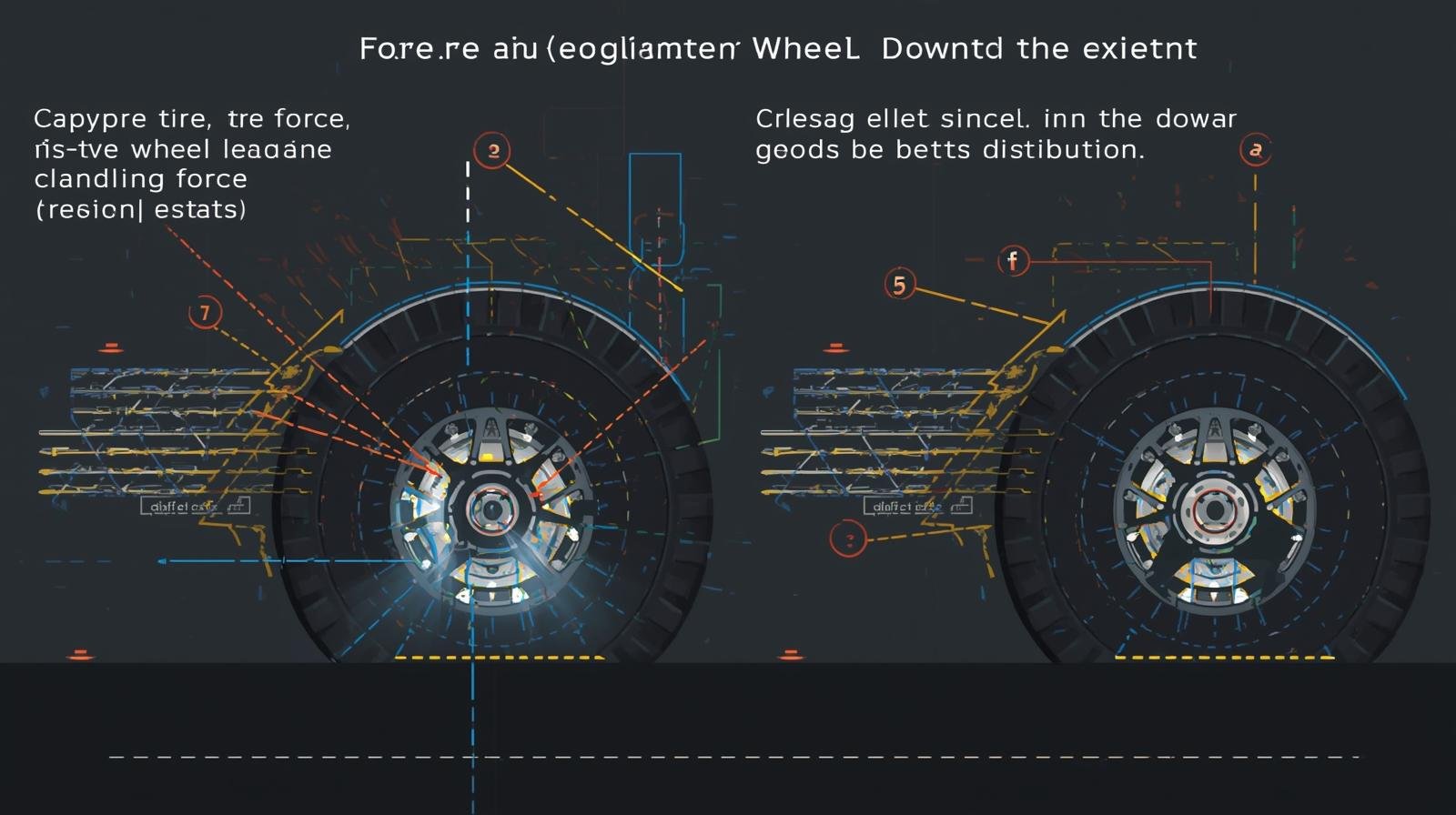
The Equivalent Single Wheel Load (ESWL) is a fundamental concept in pavement design used to simplify the complex effect of multiple wheel loads into a single equivalent load that produces the same stress or deflection in the pavement. In civil engineering, ESWL plays a critical role in the design, analysis, and evaluation of both flexible and rigid pavements. Understanding this concept ensures that pavements are designed to withstand the real-world traffic loads efficiently and economically.
What is Equivalent Single Wheel Load (ESWL)?
The Equivalent Single Wheel Load (ESWL) is defined as the load on a single wheel that causes the same stress, deflection, or strain in a pavement system as that caused by multiple wheel loads. In simpler terms, it helps engineers replace complex wheel configurations (such as dual or tandem axles) with a single load for analysis.
When a vehicle moves over a pavement, the stress distribution under each wheel overlaps with others in multi-wheel systems. ESWL helps convert these overlapping effects into one equivalent single load that simplifies pavement thickness design calculations.
In mathematical terms:
ESWL = Single wheel load that produces same deflection as multiple wheels at a specific point.
Why is ESWL Important in Pavement Design?
The importance of Equivalent Single Wheel Load in pavement design cannot be overstated. It allows engineers to:
- Simplify complex multi-wheel load systems into a single representative load.
- Determine pavement thickness accurately.
- Ensure pavement durability under varying traffic loads.
- Reduce design errors caused by uneven load distribution.
- Enhance cost-efficiency by avoiding overdesign or underdesign.
By using ESWL, engineers can evaluate the impact of heavy vehicles such as trucks and buses on roads more accurately, ensuring a longer pavement lifespan.
Factors Affecting Equivalent Single Wheel Load
Several factors influence the Equivalent Single Wheel Load (ESWL), including:
- Spacing between wheels – The closer the wheels, the more overlapping stress zones, which affects the equivalent load.
- Depth of pavement layer – ESWL varies with the depth at which the stress or deflection is considered.
- Wheel load magnitude – Heavier loads create larger stress zones in the subgrade.
- Contact area of tires – Tire pressure and contact shape affect how stress distributes through pavement layers.
- Type of pavement – Flexible and rigid pavements behave differently under wheel loads.
Understanding these factors ensures that ESWL is accurately determined for safe and efficient pavement design.
Equivalent Single Wheel Load in Flexible Pavements
In flexible pavements, stress and deflection occur in multiple layers, such as the bituminous surface, base, and subgrade. The ESWL is used to compute the total stress transmitted to the subgrade due to multiple wheel loads.
When determining ESWL for a dual wheel assembly, engineers consider the overlapping stress bulbs of both tires at a certain depth below the surface.
The graphical method or analytical formulas can be used to calculate ESWL at different depths. Typically, the influence lines are plotted between the load effect and depth to find the point where ESWL equals the combined load effect.
Equivalent Single Wheel Load in Rigid Pavements
In rigid pavements, the concrete slab distributes the load over a larger area due to its high flexural strength. Hence, the Equivalent Single Wheel Load for rigid pavements differs from flexible ones.
In rigid pavement analysis, load transfer efficiency at joints, radius of relative stiffness, and edge stresses are considered while determining ESWL. The concept ensures that the concrete slab thickness is optimized to resist the tensile stresses induced by wheel loads without cracking.
Methods to Determine Equivalent Single Wheel Load (ESWL)
There are several methods used to calculate ESWL in pavement design. The two most common methods are the graphical method and the analytical method.
1. Graphical Method
This is one of the most widely used approaches in flexible pavement design. The steps include:
- Plot the influence lines for both individual and dual wheel loads.
- Determine the deflection or stress at various depths below the pavement surface.
- Plot the ESWL curve where the stress caused by the equivalent single load matches the combined stress of the dual load.
This method provides a visual understanding of how ESWL changes with pavement depth.
2. Analytical Method
The analytical method involves direct calculation using formulas. One of the commonly used relationships for a dual wheel assembly is:ESWL=P×[21+2ZS]
Where:
- P = Load on one wheel (N)
- S = Center-to-center distance between dual wheels (mm)
- Z = Depth of pavement layer considered (mm)
This formula is valid for flexible pavements where stress distribution is assumed to follow a semi-elliptical pattern.
Example Calculation
Suppose a dual wheel load has:
- Load on each wheel = 40 kN
- Center-to-center spacing between wheels = 300 mm
- Depth of interest = 200 mm
Then,ESWL=40×[21+2×200300]=40×[21+0.75]=40×0.875=35 kN
Thus, the equivalent single wheel load at a 200 mm depth is 35 kN.
Applications of ESWL in Pavement Engineering
The Equivalent Single Wheel Load is used in several aspects of pavement engineering, including:
- Pavement thickness design (as per IRC 37 and AASHTO methods)
- Stress and deflection analysis in pavement layers
- Evaluation of existing pavements under modern vehicle loads
- Design of airport runways and heavy-duty industrial pavements
- Pavement performance modeling for mixed traffic conditions
These applications demonstrate how essential ESWL is in achieving both structural safety and economic efficiency in pavement design.
Equivalent Single Wheel Load vs. Equivalent Single Axle Load (ESAL)
While ESWL and ESAL may sound similar, they serve different purposes:
| Aspect | Equivalent Single Wheel Load (ESWL) | Equivalent Single Axle Load (ESAL) |
|---|---|---|
| Definition | Converts multiple wheel loads into a single wheel load causing the same stress | Converts mixed axle loads into a standard 80 kN single axle load |
| Used For | Pavement thickness and stress analysis | Pavement design life and load repetitions |
| Units | kN or lbs per wheel | Number of equivalent load repetitions |
| Application | Flexible and rigid pavement layer design | Traffic loading and fatigue analysis |
Understanding both concepts is key for comprehensive pavement analysis.
Advantages of Using ESWL
The benefits of using Equivalent Single Wheel Load include:
- Simplifies complex wheel configurations into one representative load.
- Ensures accurate pavement thickness calculations.
- Enhances the reliability of pavement designs.
- Reduces overestimation or underestimation of stresses.
- Makes comparison between different axle configurations easier.
Limitations of ESWL
Although widely used, ESWL has some limitations:
- It assumes linear stress distribution, which may not hold true in all cases.
- Tire pressure variations and non-uniform load distributions can cause inaccuracies.
- It may not accurately represent the effects of tandem or tridem axle assemblies.
Despite these limitations, ESWL remains a cornerstone of pavement design methodology.
Conclusion
The Equivalent Single Wheel Load (ESWL) is an indispensable concept in the field of pavement design and analysis. By converting complex multiple wheel loads into an equivalent single wheel load, engineers can simplify the process of determining pavement thickness, stress distribution, and performance under various loading conditions.
Understanding and applying ESWL correctly leads to safer, longer-lasting, and more cost-effective pavements. Whether it’s for highways, airports, or industrial roads, ESWL ensures that the pavement structure can sustain real-world vehicle loads efficiently and economically.
In short, ESWL bridges the gap between theoretical load analysis and practical pavement performance.