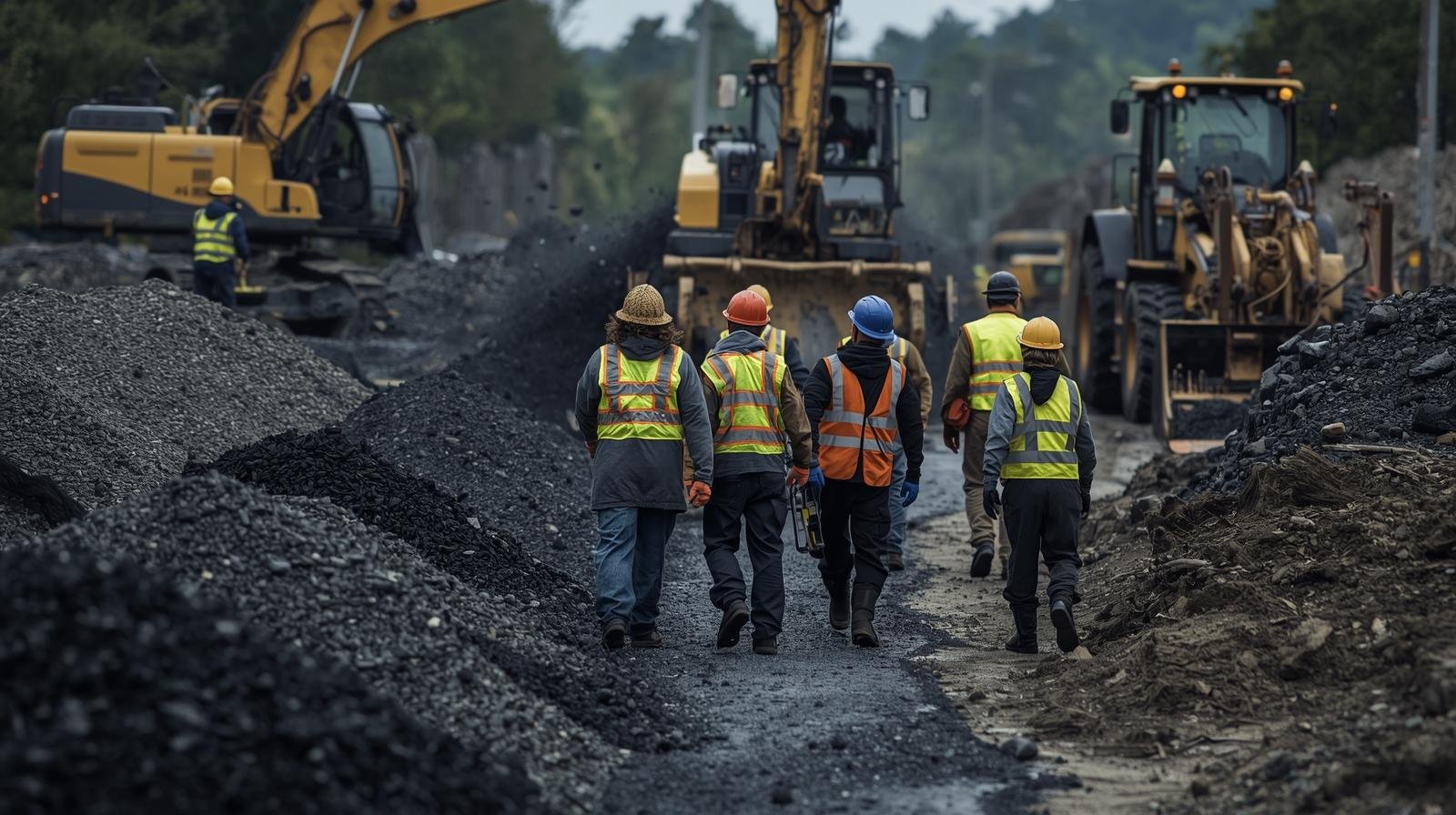
GSB material types include selected crushed stone, gravel and other permitted granular materials that meet the grading and quality requirements of a road project. The source is chosen according to the specified grading, aggregate properties, availability, transport distance and project approval. This article focuses on material sources and selection; it does not treat MoRTH grading I–VI as quality rankings.
What is GSB in Road Construction?
Granular Sub-Base (GSB) is a layer of coarse aggregates or crushed stone material placed above the prepared subgrade soil and below the base course in flexible pavements. Its primary purpose is to create a stable and strong foundation that can withstand traffic loads and provide proper drainage. In simple terms, GSB converts weak natural soil into a reliable platform for road construction.
Key Properties of GSB Material
- Grading: Must comply with the grading envelope selected in the project specification and verified by sieve analysis.
- Particle quality: Strength, abrasion resistance, soundness and particle shape are checked using the tests required by the governing specification.
- Fine fraction: Plasticity, fines and deleterious substances must remain within the specified limits.
- Moisture-density behaviour: Moisture content and achievable compaction are established from the prescribed laboratory test.
- Source consistency: Material should be free from unsuitable organic matter and contamination and should be supplied from an approved source.
Importance of GSB in Pavement Layers
Where it is included in the pavement design, GSB can provide the following functions:
- Load Distribution: Spreads vehicle wheel loads to prevent soil failure.
- Drainage support: Can assist water movement when the grading, permeability, outlet and pavement drainage details are designed to work together.
- Working Platform: Provides a stable surface for placing upper layers like WMM and DBM.
- Long-Term Durability: Enhances road life and reduces maintenance costs.
Types of GSB in Road Construction
GSB material may come from approved quarried crushed stone, natural gravel or other permitted granular sources. Recycled aggregates may be considered only where the contract specification allows them and test results demonstrate compliance. The source type does not itself determine the GSB grading or quality; those are established by the project requirements and laboratory tests.

GSB Grading Is Not a Quality Ranking
MoRTH Table 400-1 identifies six GSB grading envelopes, I to VI, based on the percentage passing specified IS sieves. The numerals are gradation designations; they do not mean premium, medium or low-quality material, and should not be mapped to highway class or traffic level. The project contract states which grading is required.
Check the complete sieve-wise limits for the selected grading and test the actual source material. Physical quality, plasticity, CBR and other acceptance criteria are checked separately under the applicable specification edition and project requirements. See our GSB grading guide for the six grading envelopes.
Material Source Classification
- Quarried crushed stone: A commonly used source where the aggregate meets the specified grading and physical-property requirements.
- Natural gravel or processed natural materials: May be used where the source, particle-size distribution and material properties satisfy the project specification.
- Recycled aggregates: May be used only where permitted by the governing specification, with source approval and compliance testing for grading and material properties.
- Stabilized sub-base: Material treated with cement, lime or another stabilizer is a separate stabilized-layer treatment and should not automatically be described as ordinary unbound GSB.
Where Approved GSB Materials May Be Used
- Road pavement sub-base layers where included in the approved pavement design
- Industrial and access roads where the project specification permits the selected granular material
- Other paved areas only where the design documents specify GSB and define the required material properties
GSB Material Tests and Acceptance Requirements
The chosen source must satisfy the grading and physical-property requirements specified for the project. A sieve-analysis result is compared with the selected grading in MoRTH Table 400-1; the physical tests are checked separately against the applicable material requirements and amendments in the contract specification. Do not use a single generic sieve table or one universal CBR range for all GSB sources.
- Grading / sieve analysis: Verify percentage passing at each specified IS sieve for the selected grading envelope.
- Aggregate quality: Check the strength, abrasion resistance, soundness or other physical tests required for the material source and project.
- Plasticity and fines: Test the fine fraction and deleterious materials against the limits in the governing specification.
- CBR: Use the specified test condition, density and acceptance limit stated in the pavement design and contract.
- Moisture and density: Establish the moisture-density relationship and verify field compaction at the required frequency in the approved quality-control plan.
Construction Process of GSB Layer
GSB construction generally involves accepting the prepared subgrade, approving the material source, spreading the specified grading uniformly, conditioning the material near its specified moisture content, compacting it with suitable equipment, and checking line, level, thickness, density and grading. Lift thickness, compaction target, roller type and test frequency must follow the contract specification and approved method statement rather than a universal rule.

Subgrade Preparation
- Remove vegetation and debris
- Compact the subgrade soil to specified density
- Ensure proper slope for drainage
Material Handling and Placement
- Transport aggregates carefully to avoid segregation
- Spread in uniform layers using motor graders
- Maintain the loose and compacted lift thickness permitted by the project specification and the approved method statement so the selected equipment can compact the full layer depth uniformly.
Compaction and Quality Checks
- Use the roller type, operating weight, vibration setting and rolling pattern approved for the material, lift thickness and project method statement.
- Control moisture content for maximum density
- Carry out field-density and other acceptance tests at the locations and frequency stated in the approved inspection and test plan.
- Proof rolling to detect weak spots
Common Problems and Prevention
- Segregation: Prevent by controlled loading/unloading
- Contamination: Use approved sources and proper handling
- Inadequate Compaction: Ensure correct equipment and moisture control
GSB Layer Thickness
GSB thickness is determined by pavement design, subgrade strength, design traffic, drainage requirements and the governing project specification. There is no universal thickness table that assigns one fixed value to highways, urban roads and rural roads. Use the compacted thickness shown in the approved drawings and construct multiple lifts where required by the specification and method statement.
Difference Between GSB and WMM Layer
| Aspect | GSB | WMM |
|---|---|---|
| Full form | Granular Sub-Base | Wet Mix Macadam |
| Typical position | Sub-base over prepared subgrade | Base course, commonly above GSB where specified |
| Material | Selected granular material meeting the specified GSB grading and quality tests | Aggregates mixed with water to the specified grading and moisture condition |
| Main role | Support, stress distribution and possible drainage support | Structural base layer providing support to upper pavement layers |
| Acceptance | Project-specified grading and material-property tests | Project-specified WMM grading, compaction and quality checks |
Cost, Sustainability, and Environmental Aspects
- Cost factors: Estimate approved material quantity, source price, haul distance, spreading, watering, compaction, testing and site overheads from dated local rates. The cost split varies by project location and procurement arrangement.
- Recycled aggregates: Where permitted and technically suitable, approved recycled aggregate can reduce demand for virgin material; environmental benefits depend on processing, transport and project conditions.
- Local sourcing: A nearby approved source may reduce transport demand, but it must still satisfy the same specified grading and material acceptance requirements.
FAQs on GSB in Road Construction
Q1. What is the required thickness of GSB?
There is no one thickness for all roads. The required compacted thickness is determined by pavement design, subgrade strength, traffic and project specifications, and is shown in the approved drawings.
Q2. Can GSB be laid during monsoon?
Yes, but it requires strict moisture control and protective measures, otherwise quality suffers.
Q3. What happens if poor-quality GSB is used?
It leads to early pavement failure, rutting, and higher maintenance costs.
Q4. Can recycled aggregate be used in GSB?
Only where the governing specification and project contract permit it, and the proposed source is approved after the required grading and material-quality tests.
Conclusion
GSB is one component of the pavement structure. Its performance depends on selecting an approved material source, meeting the specified grading and physical-property requirements, placing and compacting it correctly, and providing suitable drainage. The compacted thickness and acceptance criteria must come from the project design and contract documents rather than a generic rule.