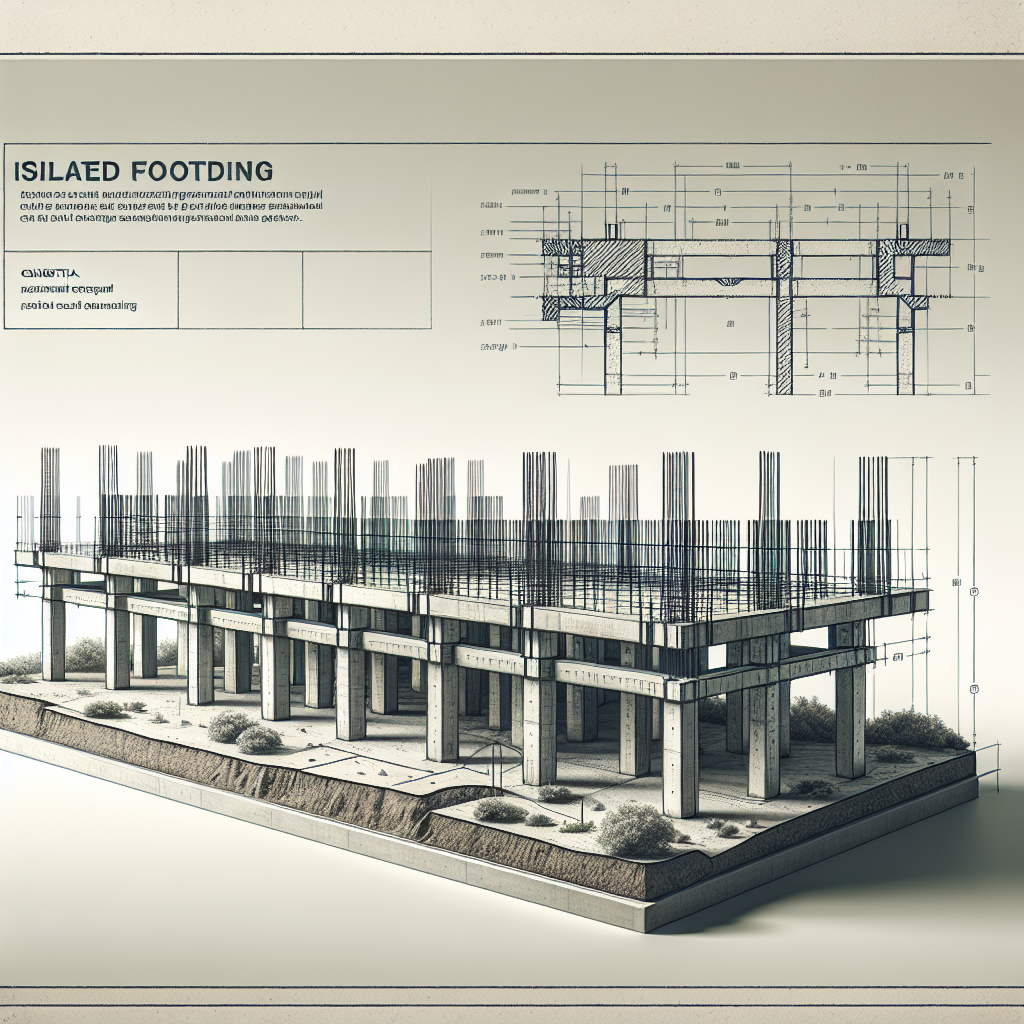
A clear isolated footing design keeps a single column stable and transfers loads safely to the soil. This article breaks down the essential checks and calculations in a simple, stepwise way.
Expect practical tips on soil capacity, footing sizing, bending and shear checks, and reinforcement layout without heavy theory. Short examples help make each step usable on real projects.
Understanding isolated footing basics
Isolated footings support individual columns where loads are moderate and soil conditions are relatively uniform. They are economical when columns are spaced and loads are not too high.
Key ideas are load transfer, bearing capacity of soil, and how footing geometry affects stresses. Early checks prevent overstress or excessive settlement.
What an isolated footing does
An isolated footing spreads a column load over a larger area so the soil sees lower pressure. That reduces settlement and keeps the structure stable.
Common shapes and when to use them
Square and rectangular footings are most common. Circular and stepped footings appear where column layout or load patterns require them.
Shape choice depends on column load, spacing, and architectural limits. Rectangular footings can be optimized to match column reactions and soil strength.
Soil and load checks before sizing
Before calculating footing dimensions, two inputs are essential: the column load acting on the footing and the safe bearing capacity of the soil. Both set the minimum area needed.
Use accurate loads and conservative soil strength values to reduce the chance of settlement or bearing failure.
Compute the design column load
Add dead loads, live loads, and any additional imposed loads. Apply appropriate load factors if using ultimate limit state checks.
Consider eccentricity and uplift if lateral actions exist. Eccentric loads reduce effective area and change pressure distribution under the footing.
Determine safe soil bearing capacity
Soil capacity can come from a site investigation or local codes. Use conservative values when data is limited.
Typical values: compacted sand and gravels are higher, soft clays much lower. If unsure, order a simple bearing test or consult geotechnical notes.
Sizing the footing area and preliminary thickness
With column load and safe bearing capacity known, the footing area follows directly. This gives a first estimate of plan dimensions before checking internal forces.
Then choose a practical thickness that resists bending and shear while allowing reinforcement placement and concrete cover.
Area and plan dimensions
Required footing area = design column load / allowable soil bearing pressure. Round up to a convenient dimension and keep symmetry if possible.
For a square footing, side = sqrt(area). For rectangular footing, choose a ratio that fits column orientation and neighboring footings.
Initial thickness selection
Start with a slab thickness based on column size and anticipated bending span. Common practice uses thickness between 0.2 to 0.5 times the shorter footing dimension for heavily loaded footings, less for light cases.
Check practical needs: enough depth for reinforcement, cover, and a little shear resistance. Adjust later after bending and shear checks.
Checking bending and shear
Once plan size and thickness are set, evaluate bending moments and shear forces using soil pressure under the footing. These checks ensure the concrete and reinforcement layout are adequate.
Use design load combinations and material strengths consistent with local practice when calculating stresses and required reinforcement.
Bending moment calculations
For a uniformly distributed soil pressure, bending can be found by treating the footing slab as a strip spanning between load reactions or as a two-way slab supported by soil pressure.
Many designers use the Kirchhoff or equivalent strip method. For preliminary work, simple one-way span assumptions often give conservative estimates to size the main reinforcement.
Shear checks near the column
Punching shear around the column is often critical for isolated footings. Check the critical perimeter at d/2 from the column face, where d is the effective depth.
If punching shear capacity is inadequate, increase thickness or provide shear reinforcement such as studs or bent-up bars to raise capacity.
Reinforcement layout and detailing
After bending and shear checks, choose reinforcement to satisfy moment capacity and serviceability limits. Reinforcement must be placed to follow load paths and ensure crack control.
Provide adequate clear cover and anchorage length. Use bars of appropriate diameter to reduce congestion and ease concrete placement.
Designing flexural reinforcement
Compute required steel area from moment demand using concrete and steel strengths. Distribute bars evenly in both directions if two-way action is present.
Place main bars near the bottom in tension zones, with distribution bars at the top or in the perpendicular direction. Observe minimum reinforcement ratios in codes to control cracking.
Detailing to prevent punch-through
A common solution is to extend reinforcement into the column and provide confinement with ties or a thickened column neck. Increasing slab thickness around the column reduces punching stress.
Keep bar spacing practical and avoid overlaps in critical zones. Use mechanical splices or extended development lengths as needed.
Settlement and serviceability considerations
Limits on settlement often govern design more than ultimate bearing checks. Even if the footing is safe against bearing failure, excessive settlement can damage the structure.
Estimate settlement using soil compressibility parameters. When settlements are too high, options include larger footings, soil improvement, or deeper foundations.
Predicting settlement
Use consolidation theory for clays and elastic settlement methods for granular soils. Engineers often rely on geotechnical input for reliable estimates.
Two concerns are total settlement and differential settlement between adjacent footings. Keep differential settlement small to avoid cracking in framed structures.
Mitigation measures
- Increase footing area to reduce stress on the soil.
- Improve soil using compaction, replacement, or stabilization techniques.
- Consider piles or combined footings if soil near surface is weak.
Practical example: simple calculation
This short example shows the steps without heavy algebra. It helps check that the process ties together and yields realistic numbers.
Assume a column load of 500 kN and allowable soil pressure of 150 kN/m2. Required area = 500 / 150 = 3.33 m2. Choose a square footing of 1.85 m side (round up to 1.9 m).
Thickness and reinforcement estimate
Choose initial thickness 0.35 m to allow for flexure and punching checks. Compute bending demand assuming simple strip action; then compute steel area required.
If bending requires 0.5% steel, a 1.9 m x 1.9 m footing would need main bars spaced to provide that area, using 12 mm or 16 mm bars as practical.
Punching check and adjustment
Check perimeter at 0.5d from column face; if punching shear exceeds concrete capacity, increase thickness or provide additional shear reinforcement near the column.
In many small footings, increasing thickness by 50 mm or slightly enlarging plan size corrects the issue cheaply.
Conclusion
Designing an isolated footing combines clear input data with stepwise checks: soil capacity, footing area, bending, shear, and settlement. Practical choices early save costly changes later.
Careful reinforcement layout and simple adjustments to thickness or size often solve most problems. Use geotechnical values and conservative assumptions when data is limited.
Frequently Asked Questions
Below are common questions and concise answers to clarify typical concerns about isolated footings. Each answer focuses on practical implications.
How is the area of an isolated footing found?
Divide the total column load by the allowable soil bearing pressure. Round dimensions to practical sizes and maintain symmetry when possible.
What causes punching shear in footings?
Punching shear occurs when concentrated column loads try to punch through the slab. It is most critical near the column and is checked using a critical perimeter at about d/2 from the column face.
When should footing thickness be increased?
If bending or punching shear demands exceed concrete capacity, or if required reinforcement needs more cover or anchorage, increase thickness. Also increase depth to control settlement when needed.
Can isolated footings handle uneven soil?
Uneven soil can cause differential settlement. Solutions include soil improvement, larger footings, or switching to deep foundations. A geotechnical review helps decide the best approach.
Is reinforcement necessary in all isolated footings?
Yes. Even lightly loaded footings need minimum reinforcement to control cracking and provide ductility. Design codes set minimum reinforcement ratios to ensure serviceability.