Pile foundations transfer building loads to deeper, more competent soil or rock when shallow foundations are unsuitable. They are essential where surface soils are weak, groundwater is high, or heavy vertical and lateral loads must be carried safely.
This article explains common classifications, materials, installation methods and key design and testing concerns. It aims to give a practical view of how different pile types meet site and load demands.
Basic classifications and load transfer
Piles are grouped by how they carry loads and how they are made. The main load-transfer mechanisms are end-bearing and skin friction, and many piles use a mix of both.
Choosing the right classification depends on ground conditions, load magnitude, settlement limits and construction constraints. Below are common categories and what they mean in practice.
End-bearing vs friction piles
End-bearing piles rest on a strong layer such as rock or dense sand. The load is transmitted through the tip into that layer. These are preferred when a distinct bearing stratum exists at workable depth.
Friction piles transfer load along their length via shear between the pile surface and surrounding soil. They are useful where no firm layer is reachable or when working in deep soft soils.
Based on construction method
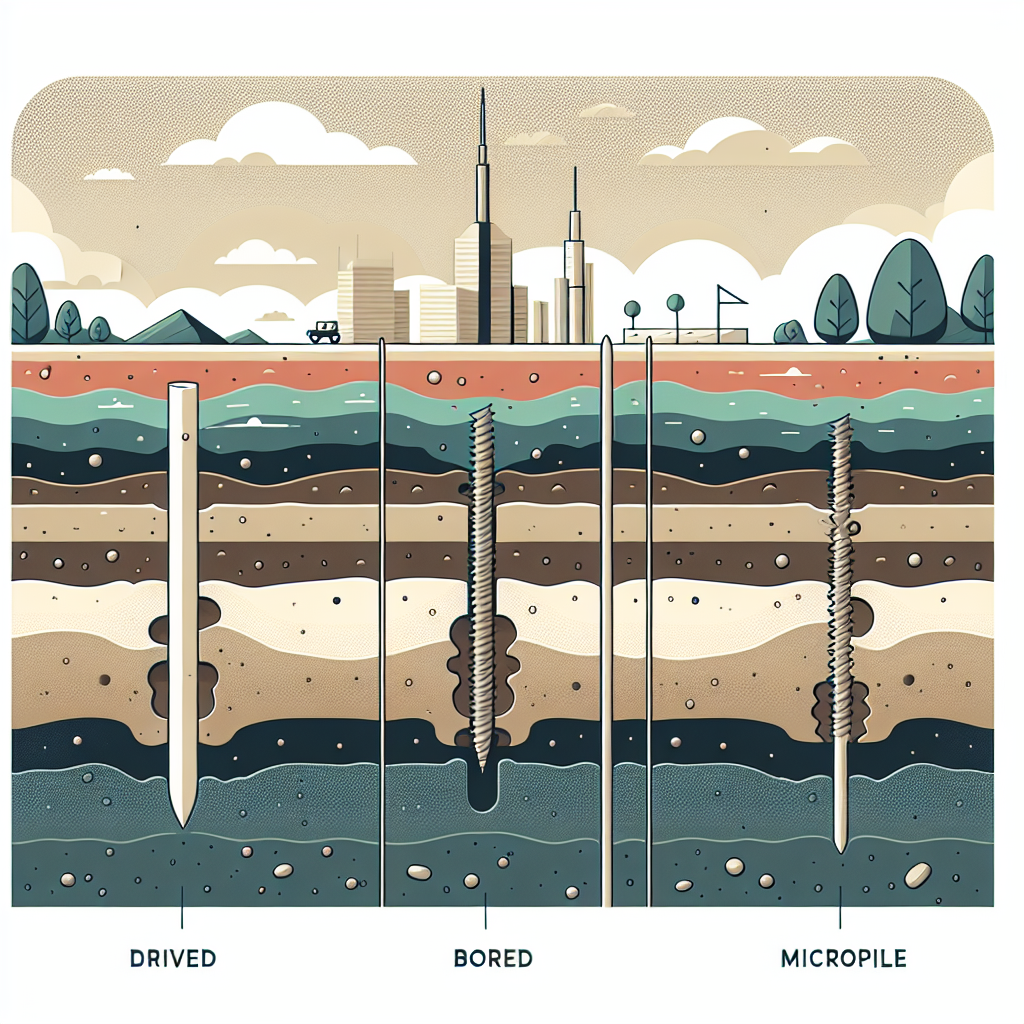
Driven piles are hammered or pressed into the ground and generally give immediate load capacity as soils densify. Bored piles are cast in place, avoiding vibration and noise, and are often used near existing structures.
Other methods include screw-in piles, continuous flight auger piles, and micropiles, each suited to specific access or load conditions.
Group piles and piled rafts
Piles rarely work alone. Groups share loads and interact through group effects that reduce individual pile efficiency. Piled rafts combine a shallow foundation with piles to control settlement and reduce pile count.
Design must consider pile spacing, group stiffness, and how settlement will distribute between raft and piles.
Materials, shapes and typical uses
Material choice affects strength, durability, constructability and cost. Common materials are timber, steel and concrete, with composite options where conditions demand.
Geometry—circular, square, H-section or tubular—affects bending resistance, buckling behavior and installation practicality.
Concrete piles
Precast concrete piles are made off-site and driven into place. They offer good durability and high compressive strength, but require handling equipment for large sections.
CFA and bored cast-in-place piles use steel or concrete casings and are formed on site. These are ideal where quiet, low-vibration methods are needed.
Steel piles
H-piles and tubular steel sections are common when high driving stresses or slender sections are required. Steel piles are quick to install and can be driven through dense layers.
They can corrode in aggressive soils, so coatings, cathodic protection or concrete encasement may be needed.
Timber and composite piles
Timber piles are economical for light to moderate loads and in environments where timber durability is acceptable, such as freshwater. Treated timber resists decay but has lower capacity than modern materials.
Composite piles combine materials—steel core with concrete coating, for example—to balance strength and durability with cost and constructability.
Installation methods and site considerations
Method selection balances soil type, access, vibration tolerance, noise limits and available equipment. Each method has trade-offs in speed, disturbance and achievable depth.
Good site investigation is critical to match method to ground conditions and to plan for contingencies like obstructions or groundwater control.
Driven piles
Driven piles are suitable in granular soils and can densify surrounding soils, often increasing capacity. They generate vibration and noise and may face refusal on obstructions.
Pile driving records and dynamic measurements help estimate capacity, but integrity checks are still needed.
Bored and drilled piles
Bored piling allows installation in cohesive soils and through obstructions with lower vibration. It is commonly used near sensitive structures or roads.
Casing or drilling fluid supports the hole in loose sands or high groundwater. Quality control focuses on continuous concreting and avoiding contamination.
Screw and micropiles
Screw piles are helical anchors rotated into place with low vibration and quick installation. They suit light structures, temporary works, or restricted access sites.
Micropiles use high-strength grout and small-diameter steel to transfer load in limited-access or highly variable ground. They are versatile but costlier per unit capacity.
Design, testing and common issues
Design balances load, allowable settlement, construction limits and long-term behavior. Codes provide methods, but site-specific testing and judgment are essential.
Common issues include negative skin friction, group settlement, pile buckling, and durability concerns in corrosive soils.
Determining pile capacity
Capacity is estimated with soil data from borings, lab tests and empirical correlations. Methods include static analysis, dynamic interpretation for driven piles, and load testing.
Factor of safety and uncertainty in geotechnical parameters guide the design, often requiring conservative assumptions unless supported by testing.
Pile load testing and integrity
Static load tests remain the most reliable method to verify capacity and settlement behavior. They reproduce the actual loading scenario and reveal group effects.
Other tests include dynamic monitoring during driving, low-strain integrity tests, and sonic logging to detect defects or changes in cross-section.
Common failure modes
Excess settlement can occur when piles are undersized, soil is weaker than expected, or group effects reduce efficiency. Lateral loads can cause bending and combined stresses that must be modeled explicitly.
Durability failures stem from corrosion or chemical attack. Choosing suitable materials and protective measures is crucial where soils are aggressive.
Conclusion
Pile choices are driven by soil behavior, load demands, site constraints and long-term durability needs. Understanding classification, materials and methods helps align structural needs with ground conditions.
Careful investigation, appropriate testing and an awareness of installation limits reduce risk and lead to efficient, reliable foundations that perform over a structure’s life.
Frequently Asked Questions
Below are concise answers to common queries about pile systems and their practical considerations.
What determines whether a pile is end-bearing or friction?
If a strong bearing layer like rock or dense sand is present at reachable depth, the pile can be designed as end-bearing with the tip carrying most load. If no firm layer exists, the pile relies on skin friction along its shaft to support loads.
How do driven and bored piles compare in performance?
Driven piles often achieve higher initial capacity in granular soils due to soil densification, but generate vibration. Bored piles are quieter, suitable for cohesive or filled sites, and avoid driving stresses, but may require more quality control during concreting.
When are micropiles or screw piles preferred?
Micropiles work where access is restricted, or loads must transfer through variable ground with minimal disturbance. Screw piles are chosen for quick installation, temporary works, or sites where vibration must be minimized.
How is pile group behavior different from single piles?
Pile groups interact through the surrounding soil; this can reduce individual pile capacity and change settlement patterns. Design must consider spacing, group stiffness and raft-pile interaction to predict performance accurately.
What tests confirm pile integrity and capacity?
Static load tests validate capacity and settlement behavior directly. For integrity, low-strain dynamic tests, sonic or crosshole logging detect defects. Dynamic monitoring during driving can estimate capacity but may need confirmation by static testing.