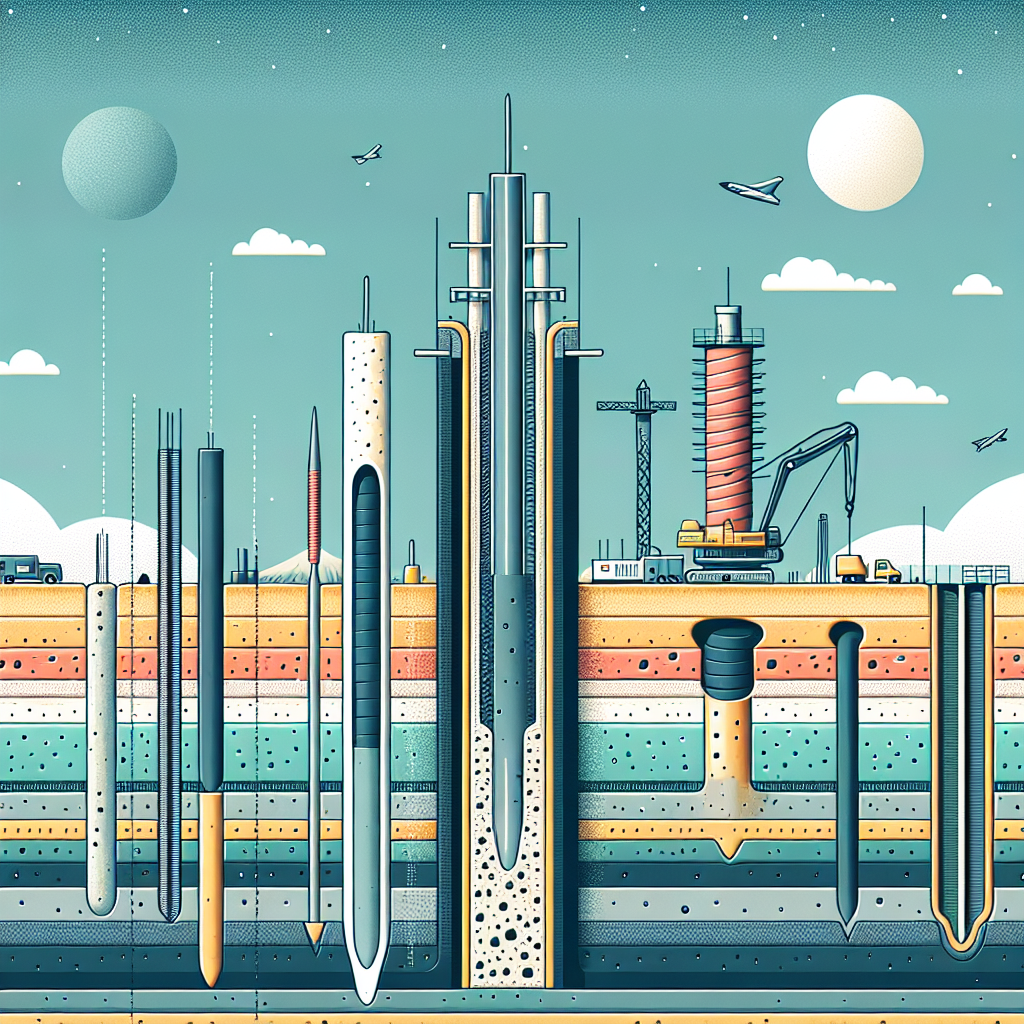
Choosing the right deep foundation approach means matching soil conditions, loads, and site limits to a method that will safely carry a structure over its life. This article breaks down common methods, how they perform, and the practical factors that influence selection.
The text focuses on clear comparisons and real-world considerations that help clarify when one option makes more sense than another. Short explanations and organized subsections make complex ideas easier to apply on site or in planning.
When deep foundations are chosen
Deep foundations are selected when surface soils cannot support required loads without excessive settlement or when high uplift, lateral forces, or weak near-surface strata are present. Often the decision follows geotechnical testing and an assessment of constructability and cost.
Key triggers include thick compressible layers, high groundwater, nearby structures sensitive to settlement, and very heavy columns or piers. Project constraints, access, and noise limits also narrow viable options.
Soil and site conditions
Subsurface investigation identifies bearing strata depth, relative stiffness, and groundwater. Soft clays, loose sands, organic layers, and fill commonly push designers toward deeper solutions.
Presence of obstructions, contamination, or high water table changes drilling and excavation choices, often increasing the attractiveness of driven elements or grout-based systems.
Load type and distribution
Axial loads, uplift, bending moments, and lateral loads all affect selection. Buildings with concentrated loads (like tower bases) often need deep elements that reach stiff layers or spread loads into a dense zone.
For bridgelike structures, lateral stability and moment resistance are paramount, so foundation choices emphasize stiffness and group interaction.
Main methods and how they work
There are several widely used methods, each transferring load with different mechanisms: end-bearing, skin friction, or a blend of both. Construction method, equipment availability, and environment dictate which is most practical.
Below are the typical types and the situations they best address, described with strengths and typical limitations.
Piles (driven)
Driven piles are prefabricated elements (concrete, steel, or timber) hammered into the ground. They rely on skin friction along their length and/or end-bearing at the tip when they reach firm strata.
Advantages include predictable quality when driven into place and good performance in displacement-friendly soils. Noise and vibrations during driving, and obstructions in the soil, can be drawbacks.
Drilled shafts (bored piles)
Drilled shafts are deep, cast-in-place concrete elements formed by drilling a borehole and placing reinforcement and concrete. They can be installed through dense or stiff layers with minimal vibration.
This method suits large axial loads and cases where displacement or vibration must be minimized. Temporary casing or slurry may be needed in unstable or saturated soils.
Caissons and piers
Caissons are similar to drilled shafts but often larger and may be open-bottomed or bell-shaped to increase bearing in deep strata. Piers are generally smaller elements used where loads and access are moderate.
These elements are chosen when a larger footprint at depth improves end-bearing or to step through variable strata with selective enlargement.
Micropiles and grouted elements
Micropiles are small-diameter, high-capacity elements installed by drilling and grouting with steel casing or tendon reinforcement. They are ideal in restricted sites, under existing structures, or in remediation work.
They handle tension well, can be installed in low-headroom environments, and cause minimal disturbance, though cost per unit capacity can be higher.
Continuous flight auger (CFA) piles
CFA piles use an auger to form the hole and then inject concrete through the hollow stem as the auger is withdrawn. Reinforcement is inserted into the fresh concrete to form a cast-in-place pile.
This method is efficient and low-vibration, making it suitable for urban projects. Soil conditions with high obstructions or boulders may limit its use.
Design factors and performance
Design blends geotechnical data with structural needs. Key aspects include how load moves into the ground, acceptable settlement, and element behavior under combined loads.
Understanding group interaction, stiffness, and construction tolerances helps translate laboratory numbers into practical, buildable solutions.
Load transfer mechanisms
End-bearing piles transfer most load to a firm layer at the tip, while friction piles rely on shear along the shaft. Many elements combine both.
Designers calculate allowable capacities using empirical correlations, pile load tests, and factor-of-safety approaches, often confirming with settlement estimates.
Settlement and consolidation
Permissible settlement depends on structure sensitivity. Deep elements that bypass compressible layers reduce long-term consolidation but may still rotate or settle if group effects concentrate stresses.
Predicting settlement requires attention to time-dependent consolidation in clays and secondary compression in organic soils; load testing provides the most reliable check.
Lateral capacity and group effects
Foundations must resist lateral loads from wind, seismic activity, or earth pressure. Lateral resistance depends on element stiffness, embedding depth, and soil modulus.
Groups of piles interact through shared load paths; close spacing can change individual shaft capacity and increase overall stiffness, which both helps and complicates design.
Materials and durability
Material choice (concrete grade, steel type, corrosion protection) affects service life. In aggressive environments, coatings, cathodic protection, or higher-quality concrete minimize deterioration.
Design life and maintenance expectations should influence the upfront specification of materials and protective measures.
Construction challenges and practical measures
Field execution often drives the final selection. Access, noise restrictions, presence of nearby structures, and environmental constraints limit what methods are feasible.
Anticipating problems such as boulders, high groundwater, or contaminated fill helps avoid delays and change orders.
Dealing with obstructions and difficult ground
Pre-drilling, jetting, or choosing a different foundation type are common responses to obstructions. In some cases, pile driving can penetrate obstructions that would halt drilling rigs.
When contamination exists, containment and dewatering plans are necessary. Grouted or encased elements reduce direct contact with pollutants.
Quality control and testing
Pile load tests, integrity tests (like low-strain sonic testing), and cross-hole logging for drilled shafts verify capacity and continuity. Monitoring during construction catches deviations early.
Consistent supervision of concrete mixes, reinforcement placement, and curing ensures elements perform as designed.
Noise, vibration, and environmental limits
Urban projects may ban high-vibration methods; bored and grouted systems or micropiles become attractive there. Driven elements can suit remote sites where vibrations are less critical.
Permitting, community impact, and timing constraints should be evaluated in the planning stage to avoid costly method changes.
Conclusion
Choosing the right deep foundation option requires balancing geotechnical conditions, loads, construction constraints, and long-term performance needs. No single method fits every situation.
Careful site investigation, conservative design where uncertainty is high, and thoughtful attention to construction realities reduce risk and help deliver durable foundations.
Frequently Asked Questions
When is a deep element needed instead of shallow footings?
A deep element is chosen when near-surface soils lack the stiffness or strength to support loads without unacceptable settlement, or when groundwater, expansive soils, or high lateral forces make shallow foundations impractical.
How do driven piles compare with cast-in-place elements?
Driven piles are prefabricated and installed by impact, offering quick installation but higher vibration. Cast-in-place elements like drilled shafts are quieter and better in obstructed sites, but often cost more and require more complex support during construction.
What role do load tests play in design?
Load tests provide direct evidence of capacity and settlement behavior and are the best way to validate design assumptions, especially where data is limited or consequences of failure are high.
Can deep elements be used to resist uplift?
Yes. Elements designed with sufficient bond strength, mechanical anchors, or large end-bearing areas can resist uplift. Tension tests and design details that account for cyclic loads are important when uplift is a primary concern.
What affects the long-term performance of deep elements?
Soil changes, corrosion of reinforcement, poor concrete quality, and unexpected loading changes can affect performance. Durable materials, protective measures, and monitoring reduce long-term risk.
Are there cost-effective ways to test subsurface conditions?
Standard penetration tests, cone penetration tests, and borehole sampling offer a balance of information and cost. Combining methods often yields the best picture and reduces the chance of surprises during construction.
How do group effects influence foundation layout?
Pile groups interact through overlapping stress zones, which can increase or reduce performance relative to single elements. Spacing, cap stiffness, and soil stiffness all factor into group behavior and must be evaluated in design.