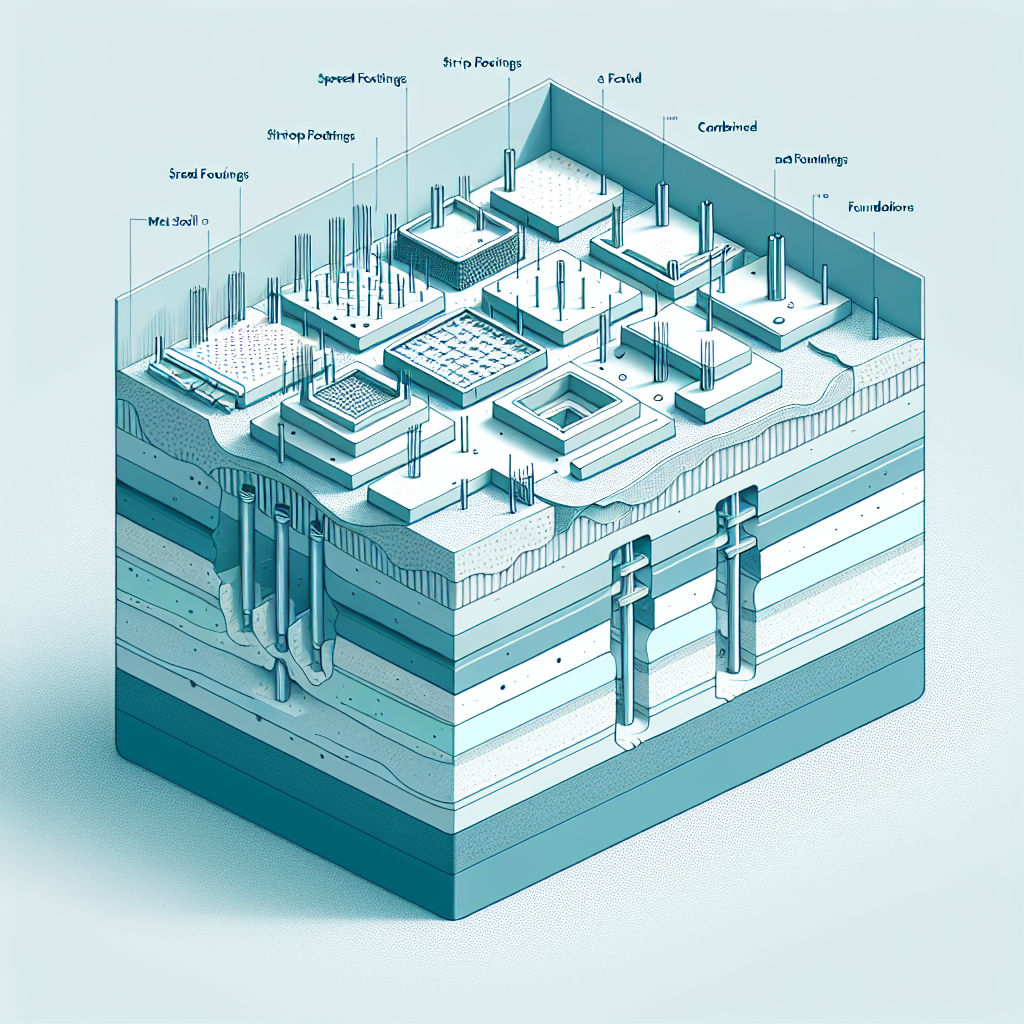
Shallow foundations are the first choice when soil near the surface can safely carry building loads. They sit close to the ground and spread weight over an area to prevent excessive settlement.
This article explains the common shallow foundation forms, how soil and load affect selection, practical construction notes, and the trade-offs to expect when choosing a shallow solution.
Common forms and when each fits
There are several common shallow foundation forms used on small to moderate structures. Each type matches a different load pattern, footprint shape, and soil condition.
Spread footings
Spread footings are isolated pads placed under individual columns. They are simple, cost-effective, and ideal when columns are spaced and soil bearing capacity is adequate.
- Best when loads are concentrated at discrete points.
- Requires uniform soil under the pad to avoid uneven settlement.
- Size is driven by column load and allowable soil pressure.
Strip footings
Strip footings run continuously under load-bearing walls. They distribute the wall load across a wider area of soil and are common in low-rise masonry or timber buildings.
- Simple trench excavation and reinforcement, often economical.
- Work well where wall loads are continuous and ground conditions are stable.
Combined and strap footings
When column positions are close to property lines or uneven loads occur, paired or combined footings join two or more columns on the same footing. Straps transfer moments between columns without expanding footing width excessively.
- Used to keep footings within site limits.
- Designed to balance eccentric loads and limit tilting.
Mat or raft foundations
Mats cover the entire building footprint and act as a single slab supporting many columns and walls. They are useful where soil bearing capacity is low or where differential settlement must be minimized.
- Distributes loads uniformly across weak soils.
- Can reduce excavation and shorten construction when deep foundations would be needed otherwise.
Soil behavior and how it drives choices
Soil type and behavior determine allowable bearing pressure and expected settlement. A simple soil report often decides whether shallow solutions are feasible.
Granular versus cohesive soils
Gravel and sand provide higher, more predictable bearing capacity and drain easily. Clay and silt can be weaker, compressible, and sensitive to moisture changes.
- Granular soils: shallower foundations often perform very well.
- Cohesive soils: may need larger footings or mats to control settlement.
Groundwater and frost effects
High groundwater lowers effective stress and bearing capacity, and may require dewatering or deeper foundations. Frost can cause heave; footings must be placed below frost depth or insulated.
- Check seasonal water table and drainage before sizing footings.
- Provide protection where frost heave is a risk to shallow systems.
Design basics and key calculations
Design of shallow foundations balances load, soil capacity, and acceptable settlement. Calculations are straightforward but must consider local codes and safety factors.
Bearing capacity and safety factors
Bearing capacity estimates how much pressure soil will take under a footing. Engineers apply factors to allow margin against failure and account for uncertainty in soil properties.
- Use conservative allowable values from reports or codes.
- Consider strip, isolated, and unilateral failure modes as needed.
Settlement estimates
Even if soil won’t fail, excessive settlement can damage structure. Estimate immediate and consolidation settlement, and compare to acceptable limits for the type of building.
- Immediate settlement occurs in granular soils; consolidation in clays over time.
- Stiffening the footing or preloading soil reduces settlement where needed.
Reinforcement and slab behavior
Reinforcement controls cracking and helps footings act together with the supported structure. Mats often need a regular grid of rebar and thickening where loads concentrate.
- Detail rebar to resist bending and punching shear around columns.
- Ensure adequate concrete cover and placement practices to avoid durability issues.
Practical construction and quality points
Construction of shallow foundations is typically quicker than deep systems, but workmanship and site preparation strongly affect performance.
Site preparation
Remove organic topsoil and replace with compacted fill if needed. Leveling and a stable subgrade help ensure uniform bearing and prevent localized settlement.
- Document subgrade conditions and compaction tests.
- Address soft spots by removal, replacement, or local stabilization.
Formwork, concrete, and curing
Use proper formwork to achieve designed dimensions. Concrete strength, mix, and curing time influence long-term behavior, especially for thin mats.
- Follow mix specifications and avoid excessive water in the concrete.
- Protect fresh concrete from rapid drying and freezing during early cure.
Inspection and testing
On-site inspection, compaction testing, and concrete sampling catch issues early. Verify depths, reinforcement placement, and drainage before pouring.
- Record bearing strata encountered during excavation to compare with the report.
- Carry out slump and cylinder tests to confirm concrete performance.
Pros, cons, and typical cost drivers
Shallow systems are often economical and fast, but not always the right choice where loads or soils are challenging.
Advantages
They frequently require less excavation, are easier to form and pour, and use less specialized equipment than deep foundations.
- Lower material and labor costs in suitable conditions.
- Shorter schedule and simpler inspection needs.
Limitations
When surface soils are weak, have high compressibility, or if loads are very large, shallow options may lead to excessive settlement or instability.
- May need extensive ground improvement where soils are poor.
- Not suitable where deep groundwater or very soft organic layers exist near the surface.
Conclusion
Choosing the right shallow system blends structural needs, soil behavior, and practical construction concerns. Many small to medium projects benefit from spread footings, strips, or mats when the ground is cooperative.
Careful attention to site preparation, correct sizing, and thoughtful reinforcement keeps performance reliable over the building life.
Frequently Asked Questions
What determines whether a shallow option is acceptable?
Primary factors include allowable bearing capacity, expected settlement, groundwater depth, and the nature of building loads. A soil report and simple calculations usually decide feasibility.
How deep should a footing be placed?
Depth must reach undisturbed, stable soil and remain below frost depth where frost heave is a concern. Typical depths vary by climate and local regulations.
When is a mat better than individual footings?
A mat suits sites with low bearing capacity or closely spaced columns where differential settlement could be an issue. It spreads loads across a larger area and acts as a single structural slab.
Can shallow foundations be used on sloping sites?
Yes, but slope stability and stepped footings often require extra design. Retaining soils and controlling drainage are important to prevent undermining.
What common repairs are needed if shallow foundations settle?
Minor settlement can sometimes be addressed by underpinning, grout injection, or local re-leveling. Major issues may require structural repair and soil stabilization depending on the cause and extent.