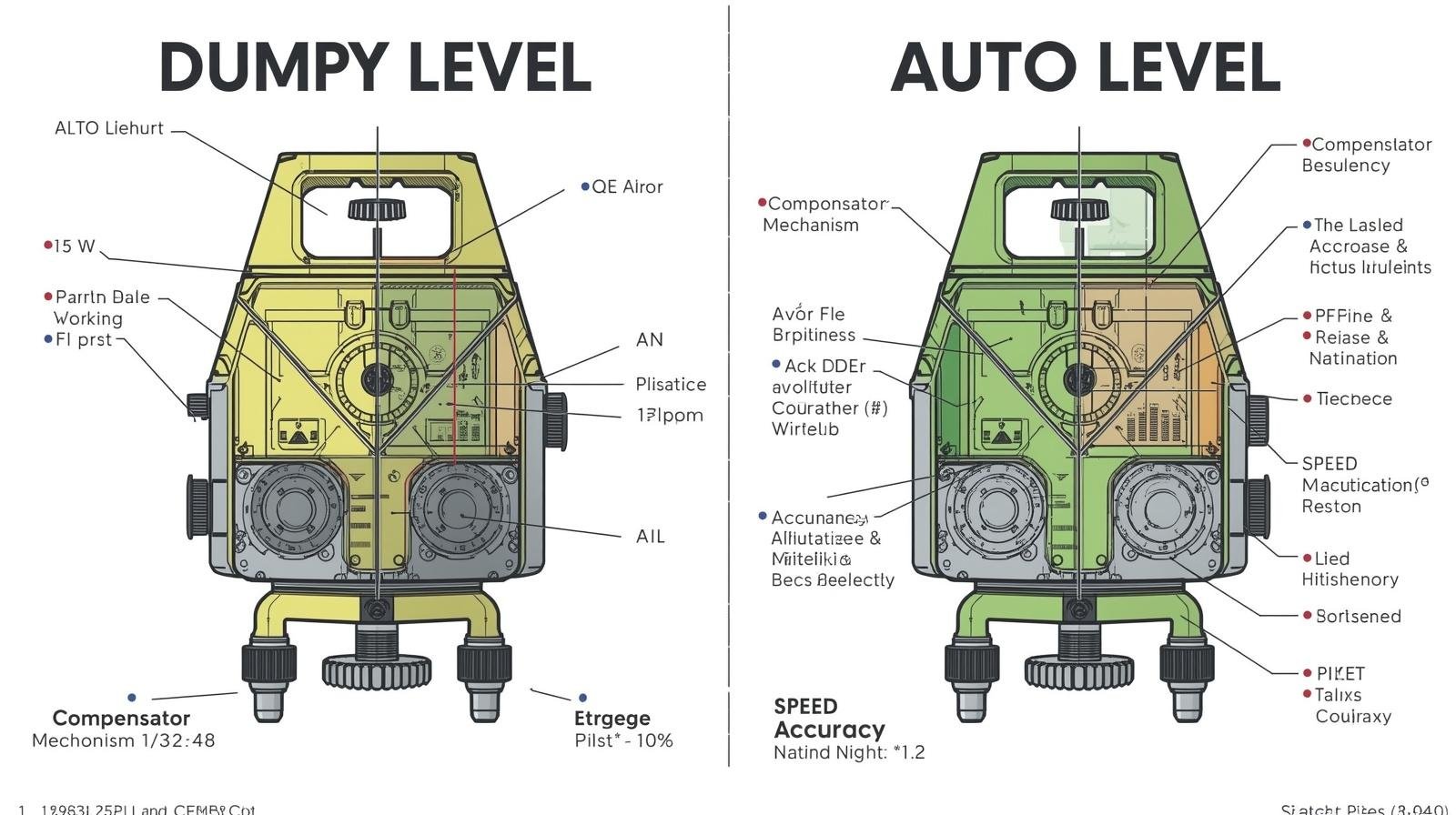
The debate “Dumpy Level vs Auto Level” is common on construction sites. Choosing the right tool affects survey speed, accuracy, and daily productivity. In this article I explain the compensator mechanism, compensator speed, accuracy differences, and real-world comparison based on practical construction site analysis.
Overview of Dumpy Level and Auto Level
Here is a short introduction to both instruments before we dive into details. Understanding basics helps on-the-ground decisions.
What is a Dumpy Level?
The dumpy level is a traditional optical leveling instrument. It uses a fixed telescope set on a tripod. The user manually aligns the instrument with a spirit level bubble.
What is an Auto Level?
An auto level, also called a self-leveling level, has an internal compensator mechanism. It automatically corrects small tilts so the telescope becomes level without manual bubble centering.
Compensator Mechanism Explained
Now a short intro to compensator function and why it matters on site. Then we look at technical and practical differences.
How the Dumpy Level Compensates
Dumpy levels do not have an internal compensator. Compensation is manual. The operator centers the spirit bubble and checks the setup often. This requires steady hands and time.
How the Auto Level Compensator Works
Auto levels use a pendulum or magnetic compensator inside. The pendulum holds the optical axis vertical. Small tilt errors are corrected quickly by gravity or magnetic damping, keeping the line of sight level.
Compensator Speed and Limits
Compensator speed refers to how fast the auto level returns to true level after disturbance. Typical modern auto levels re-center in a fraction of a second to a few seconds. They do not correct very large tilts; setup must be close to level first.
Speed and Accuracy Comparison
Here is a brief intro before detailed points. Speed and accuracy are the two main reasons teams choose one instrument over the other.
Work Speed
- Auto level: Faster setup and fewer re-checks. Useful for long runs and repeated backsights.
- Dumpy level: Slower because of manual centering. Better for short, careful checks where time is less critical.
Measurement Accuracy
Both instruments can deliver high accuracy when used correctly. Auto levels reduce human error by self-centering. Dumpy levels can be equally accurate in skilled hands but need more frequent verification.
Stability and Environmental Factors
Auto level compensators can be affected by strong vibrations, magnetic fields, or sudden shocks. Dumpy levels have no internal moving parts so they can be more robust in rough handling, though setup is more sensitive to operator technique.
Practical Construction Site Analysis
Before choosing, consider site conditions. Here are practical points from typical site work and maintenance needs.
When to Use a Dumpy Level
- Short-term checks and tight-detail work.
- Environments with strong magnetic interference that may affect some compensators.
- When budget is very tight and simplicity is needed.
When to Use an Auto Level
- Long leveling runs and repeated setups.
- Jobs where speed and reduced operator fatigue matter.
- Teams with moderate experience who want consistent results quickly.
Comparison Table: Key Differences
| Feature | Dumpy Level | Auto Level |
| Compensator Mechanism | No internal compensator; manual bubble centering | Internal pendulum or magnetic compensator; self-leveling |
| Setup Speed | Slower | Faster |
| Typical Accuracy | High if operator skilled | High with less operator error |
| Durability | Simple and rugged | Good, but sensitive to shocks and strong magnets |
| Best Use | Short careful surveys | Long runs, production surveys |
Tips for Best Results
Use these simple tips to get accurate work from either instrument.
- Always check instrument calibration before use.
- Set tripod firmly and rough-level before relying on compensator.
- Allow auto level compensator time to settle after moving the instrument.
- Protect instruments from shocks, dust, and moisture.
- Train operators on proper sighting, focusing, and reading techniques.
Maintenance and Troubleshooting
A little care keeps instruments accurate for longer. Here are quick maintenance notes.
Routine Checks
- Check optical alignment and crosshair clarity.
- Verify compensator function by tilting slightly and watching recovery.
- Keep lenses clean and dry.
Common Problems
- Slow or stuck compensator: may need professional repair or cleaning.
- Inaccurate readings: re-check calibration and verify instrument setup.
- Loose tripod or mount: tighten and stabilize before measuring.
Frequently Asked Questions
Which is more accurate: dumpy level or auto level?
Both can be very accurate. Auto levels reduce human error with a compensator. Dumpy levels match accuracy with careful setup and frequent checks.
How fast does an auto level compensator work?
Most modern auto level compensators settle in fractions of a second to a few seconds. Speed varies by model and condition.
Can a compensator be damaged on site?
Yes. Strong shocks, drops, and magnetic fields can damage or misalign a compensator. Handle with care and store properly.
Is the dumpy level still useful today?
Yes. It is simple, rugged, and useful for short precision tasks or where self-leveling features are unnecessary.
Which should I buy for my construction crew?
For production surveys and speed, choose an auto level. For budget constraints, simplicity, or short detailed checks, a dumpy level may be enough.
Conclusion
Both dumpy level and auto level have strengths. The dumpy level is simple and rugged. The auto level offers fast setup and consistent accuracy thanks to an internal compensator mechanism. Consider compensator speed, site conditions, and your team’s needs when choosing. Practical construction site analysis usually favors auto levels for long runs and dumpy levels for targeted detailed work.