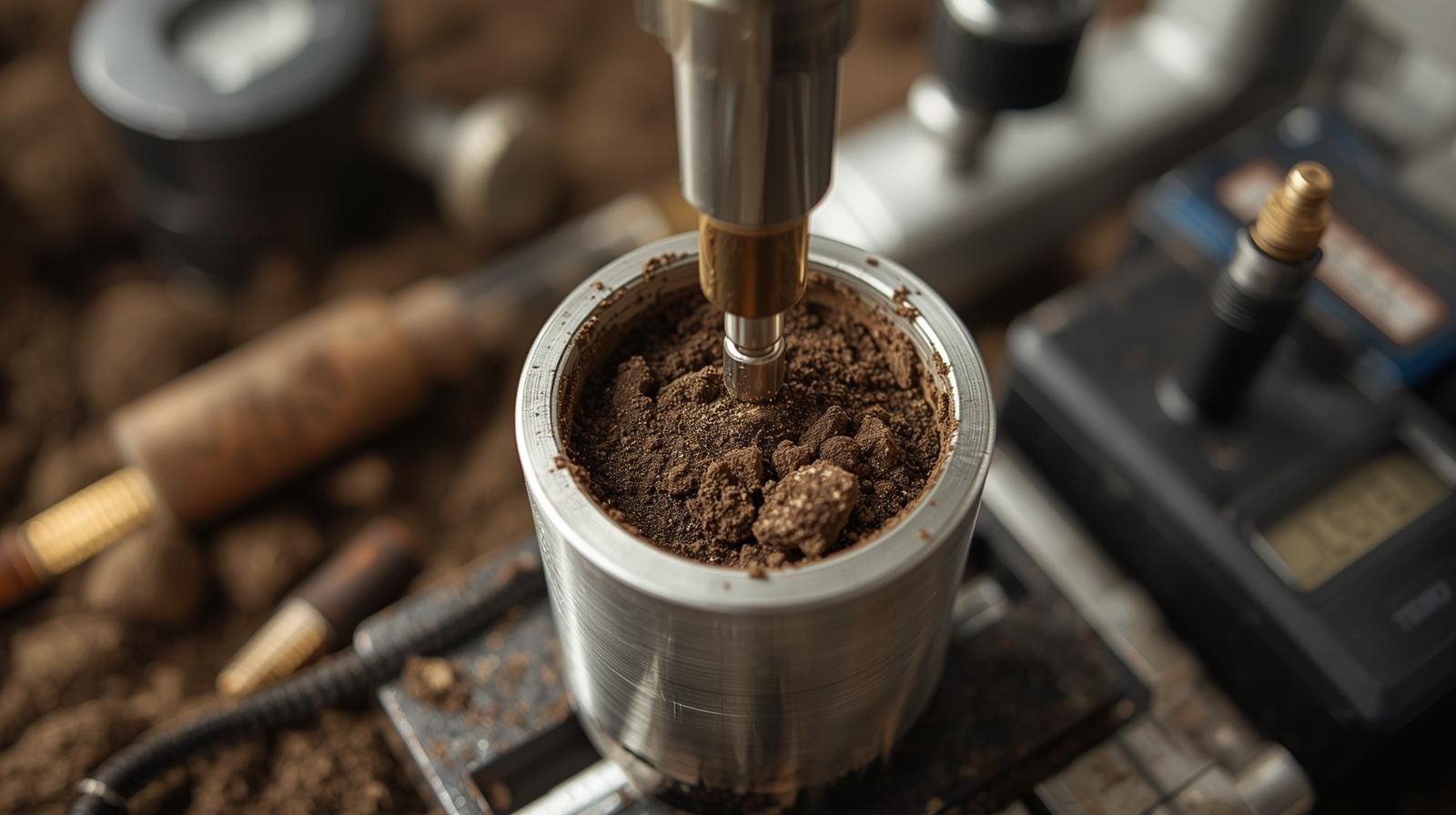
The California Bearing Ratio (CBR) is one of the most widely used soil strength evaluation parameters in civil engineering, especially in highway engineering, pavement design, and airport runway construction. It provides a direct indication of the load-bearing capacity of subgrade soil, which is critical for designing safe, durable, and cost-effective pavement structures.
Developed initially for road construction in California, the CBR test has now become a global standard, referenced in multiple national and international codes. Its simplicity, reliability, and direct relevance to pavement thickness design make it indispensable in modern infrastructure projects.
What Is California Bearing Ratio (CBR)?
The California Bearing Ratio is defined as the ratio of the force per unit area required to penetrate a soil sample with a standard plunger to the force required for the same penetration in a standard crushed stone material.
This ratio is expressed as a percentage.
In simple terms, higher CBR value means stronger soil, while lower CBR value indicates weaker soil requiring thicker pavement layers.
Purpose of California Bearing Ratio Test
The primary purpose of the CBR test is to evaluate the strength and stiffness of subgrade soil and pavement materials under controlled conditions. It helps engineers:
- Determine pavement thickness
- Assess soil suitability for road construction
- Compare different soil materials
- Optimize construction cost and safety
Importance of California Bearing Ratio in Pavement Design
The CBR value directly influences pavement thickness. Roads constructed on low-CBR soils require thicker layers of sub-base and base courses, while high-CBR soils allow thinner pavements without compromising performance.
Key Engineering Benefits
- Accurate subgrade strength assessment
- Reduced risk of pavement failure
- Improved load distribution
- Long-term structural stability
Standard CBR Test Methods
CBR testing is performed using two standard approaches depending on site conditions and project requirements.
Laboratory CBR Test
The laboratory CBR test is conducted on remolded or undisturbed soil samples under controlled moisture and density conditions. This method provides precise and repeatable results, making it ideal for design purposes.
Field CBR Test
The field CBR test is conducted directly on prepared subgrade at the construction site. It reflects actual soil conditions, including moisture and compaction variations.
CBR Test Equipment
The standard CBR test apparatus includes:
- Loading frame with penetration plunger
- Dial gauges for load and penetration measurement
- CBR mould
- Spacer disc
- Annular surcharge weights
- Soaking tank
Each component ensures accurate simulation of real-world pavement loading conditions.
CBR Test Procedure
The CBR test procedure follows a systematic sequence to ensure consistency and accuracy.
Sample Preparation
Soil is compacted into a mould at optimum moisture content using standard compaction energy. The sample may be soaked for four days to simulate worst-case field conditions.
Penetration Test
A standard plunger of 50 mm diameter is penetrated into the soil at a uniform rate of 1.25 mm per minute. Load readings are taken at specific penetration depths.
CBR Calculation
CBR value is calculated at 2.5 mm and 5.0 mm penetration. The higher of the two values is reported as the final CBR.
CBR Formula
The California Bearing Ratio formula is:
CBR (%) = (Test Load / Standard Load) × 100
Where:
- Test Load = load required for soil sample
- Standard Load = load required for crushed stone
Typical CBR Values of Soils
Different soil types exhibit different CBR ranges, which directly influence pavement design.
| Soil Type | Typical CBR (%) |
|---|---|
| Soft clay | 2 – 4 |
| Silty clay | 4 – 8 |
| Sandy soil | 8 – 20 |
| Gravelly soil | 20 – 60 |
| Crushed stone | 80 – 100 |
CBR Value Requirements as per Standards
Many highway authorities specify minimum CBR values for different pavement layers.
Subgrade
Minimum CBR generally ranges between 5% and 8% for flexible pavements.
Sub-base and Base
Higher CBR values are required to support traffic loads effectively.
Factors Affecting California Bearing Ratio
Several parameters influence the CBR value of soil, including:
- Moisture content
- Dry density
- Soil gradation
- Plasticity characteristics
- Compaction energy
- Soaking condition
Understanding these factors helps engineers improve soil performance through stabilization techniques.
Soaked vs Unsoaked CBR
Soaked CBR
Represents worst-case moisture conditions. It is mandatory for pavement design in areas prone to waterlogging.
Unsoaked CBR
Used for preliminary analysis or where drainage conditions are excellent.
Role of CBR in Flexible Pavement Design
The CBR method is extensively used in IRC and AASHTO pavement design charts. Based on subgrade CBR value and expected traffic, engineers can directly determine the required pavement thickness.
This method ensures:
- Uniform stress distribution
- Reduced rutting
- Improved riding quality
Advantages of California Bearing Ratio Test
The CBR test remains popular due to multiple advantages:
- Simple and economical
- Requires minimal equipment
- Direct application to pavement design
- Suitable for a wide range of soils
- Reliable for comparative analysis
Limitations of CBR Test
Despite its usefulness, the CBR test has certain limitations:
- Empirical nature
- Not suitable for all soil types
- Sensitive to moisture variation
- Time-consuming for soaked samples
However, when applied correctly, it remains a highly effective design tool.
CBR Improvement Techniques
Low CBR soils can be improved using:
- Lime stabilization
- Cement stabilization
- Mechanical compaction
- Geosynthetics
- Drainage improvement
These methods significantly enhance load-bearing capacity and pavement life.
CBR vs Other Soil Strength Tests
Compared to other tests like plate load test and triaxial test, the CBR test offers a direct link to pavement thickness design, making it more practical for road engineers.
Applications of California Bearing Ratio
CBR testing is essential in:
- Highway construction
- Airport runways
- Industrial pavements
- Rural roads
- Temporary haul roads
- Parking areas
Why California Bearing Ratio Remains a Global Standard
Despite advancements in soil mechanics, the California Bearing Ratio continues to be the foundation of flexible pavement design worldwide due to its practicality, cost-effectiveness, and proven reliability over decades of field performance.
Conclusion
The California Bearing Ratio (CBR) is a cornerstone of modern pavement engineering. Its ability to quantify soil strength in a practical, design-oriented manner makes it indispensable for highways, runways, and infrastructure projects. By accurately determining CBR values and applying them effectively in pavement design, engineers ensure durability, safety, and long-term performance of transportation networks.