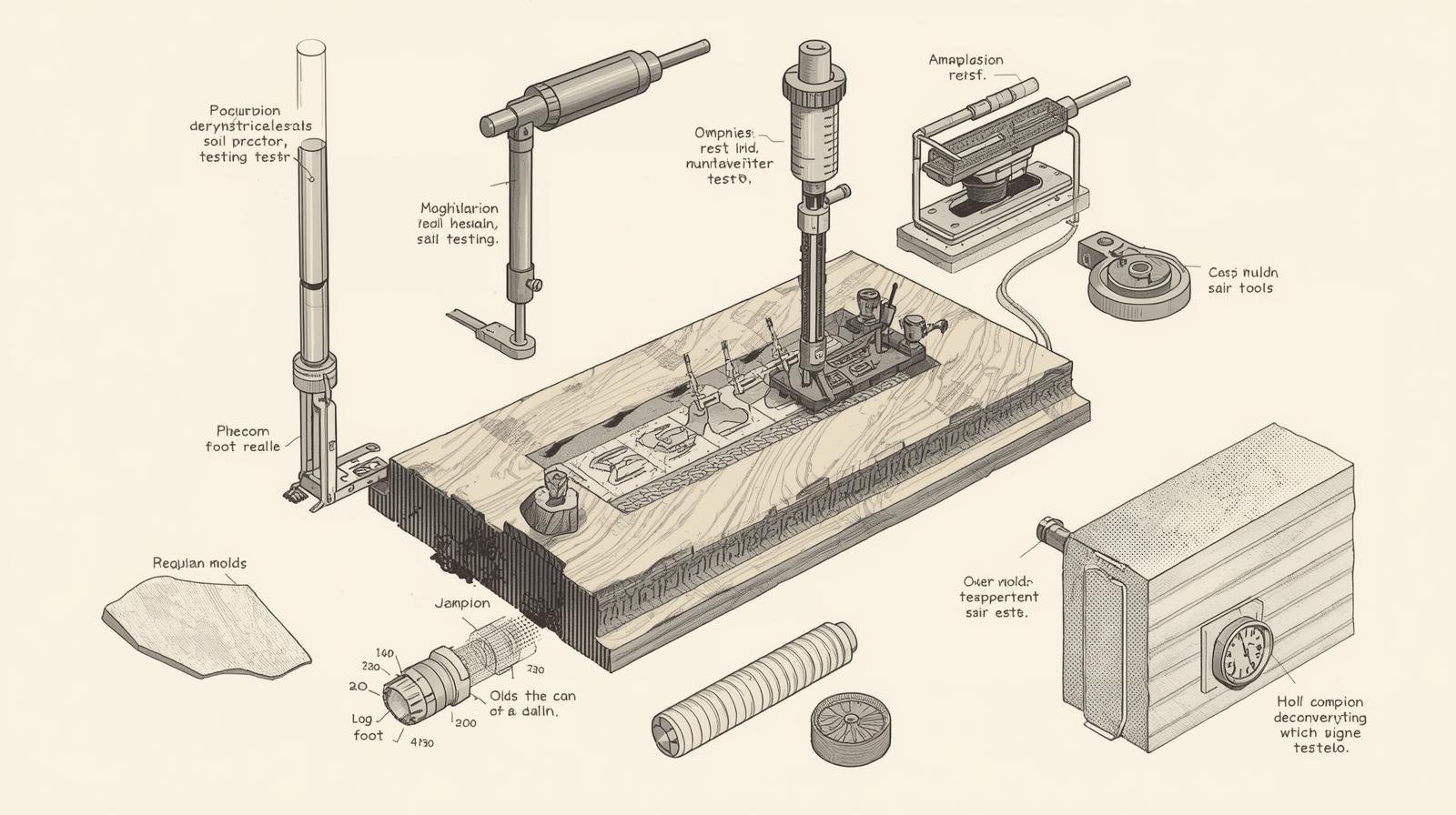
The Proctor density test is one of the most essential tests in geotechnical and civil engineering. It helps determine the optimum moisture content (OMC) and maximum dry density (MDD) of soil. These values are crucial for ensuring proper soil compaction, which directly affects the stability and strength of any structure. In this article, we’ll discuss everything about the Proctor density test, including its purpose, principle, procedure, types, advantages, and practical applications in construction.
What is the Proctor Density Test?
The Proctor density test is a laboratory experiment that measures how soil compacts at different moisture levels. It establishes the relationship between moisture content and dry density. The goal is to determine the maximum dry density that can be achieved for a soil type under specific compaction energy. The test was first introduced by R.R. Proctor in 1933, which is why it bears his name. Engineers use this test to find how much water is needed to achieve maximum compaction in a soil sample. This information is vital for constructing stable roads, embankments, and foundations.
Purpose of the Proctor Density Test
The main purpose of the Proctor density test is to ensure that soil used in construction is compacted to its highest possible density while maintaining proper moisture levels. Compaction increases soil strength, reduces settlement, and prevents erosion. The test helps engineers determine: the optimum moisture content (OMC) for achieving maximum dry density, the maximum dry density (MDD) of soil, the quality of soil compaction in field projects, and the stability of soil layers in embankments, pavements, and foundations.
Principle of the Proctor Density Test
The principle of the Proctor density test is based on the fact that for any soil type, there exists an optimum moisture content at which it can be compacted to achieve maximum dry density. When water is added to dry soil, it acts as a lubricant, allowing soil particles to rearrange and pack closer together. Initially, as moisture increases, dry density also increases. But beyond a certain point, further addition of water fills the voids and reduces density. This point is called the optimum moisture content (OMC), and the corresponding dry density is known as the maximum dry density (MDD).
Types of Proctor Density Tests
There are two main types of Proctor density tests based on the level of compactive effort used.
Standard Proctor Test
The Standard Proctor Test is the original version developed by R.R. Proctor. It uses a 2.5 kg rammer dropped from a height of 305 mm to compact the soil in three layers, with 25 blows per layer. This test is suitable for normal construction works like embankments, foundations, and light structures.
Modified Proctor Test
The Modified Proctor Test uses higher compactive energy to simulate modern construction requirements. In this method, a 4.5 kg rammer is dropped from a height of 457 mm, compacting the soil in five layers with 25 blows per layer. This test is used for pavements, runways, and other heavy-duty projects where stronger soil compaction is required.
| Test Type | Rammer Weight | Drop Height | Layers | Blows per Layer | Application |
|---|---|---|---|---|---|
| Standard Proctor | 2.5 kg | 305 mm | 3 | 25 | Embankments, foundations |
| Modified Proctor | 4.5 kg | 457 mm | 5 | 25 | Highways, runways, heavy structures |
Equipment Required for the Proctor Density Test
The following apparatus are used to conduct the Proctor density test accurately: a Proctor mold with collar and base plate, rammer (2.5 kg or 4.5 kg depending on the test), balance with 1 g accuracy, oven, moisture tins, mixing tray, straight edge, sieve (4.75 mm), and drying tools. Each piece of equipment ensures precision and consistency during testing.
Procedure of the Proctor Density Test
The Proctor density test follows a systematic procedure. First, soil is air-dried and passed through a 4.75 mm sieve. A portion of the sample is mixed with a known amount of water to reach a specific moisture content. The mold is assembled, and the soil is placed inside in layers. Each layer is compacted using the rammer with the prescribed number of blows. After compaction, the collar is removed and the excess soil is trimmed flush with the top of the mold. The mold with compacted soil is weighed, and then the soil sample is taken for moisture content determination by oven drying. The dry density is calculated using the formula:
Dry Density = Bulk Density / (1 + Water Content)
The test is repeated with varying moisture contents to obtain a range of densities. The results are plotted on a graph of dry density versus moisture content. The curve peaks at the maximum dry density (MDD), and the corresponding water content represents the optimum moisture content (OMC).
Observations and Calculations
The key observations recorded during the test include the weight of the empty mold, weight of mold with soil, volume of mold, and moisture content. From these values, bulk density and dry density are determined. The relationship between dry density and moisture content is plotted to create the compaction curve, which helps identify the OMC and MDD for that particular soil type.
Factors Affecting the Proctor Density Test Results
Several factors influence the outcome of the Proctor density test. These include:
- Soil type: Clayey soils usually have higher OMC and lower MDD, while sandy soils have lower OMC and higher MDD.
- Compactive effort: Greater compactive energy increases dry density.
- Water content: Proper moisture levels are critical for achieving maximum compaction.
- Soil gradation: Well-graded soils compact better than poorly graded ones.
- Presence of organic matter: Organic soils do not compact effectively and yield lower densities.
Importance of the Proctor Density Test in Construction
The Proctor density test is essential in construction to ensure soil strength, durability, and stability. It helps avoid problems such as differential settlement, cracks in pavements, and foundation failures. By determining the OMC and MDD, engineers can control compaction during construction and verify field results using field density tests like the Sand Cone or Core Cutter method.
Applications of the Proctor Density Test
The Proctor density test is used widely in civil engineering projects including road and railway embankments, earthen dams, airport runways, retaining walls, and landfill constructions. It helps ensure that soil layers are compacted uniformly and safely, maintaining the desired load-bearing capacity for long-term stability.
Advantages of the Proctor Density Test
The test provides a reliable understanding of soil behavior under compaction. It helps determine the most efficient water content for compaction, ensures uniform compaction in the field, reduces settlement, and increases soil shear strength. Moreover, it provides valuable data for quality control during construction.
Limitations of the Proctor Density Test
Despite its usefulness, the Proctor density test has certain limitations. It is time-consuming and cannot perfectly simulate field conditions. Coarse-grained soils and soils with large particles may give inconsistent results. Additionally, field compaction energy may differ from laboratory energy, causing slight variations in density values.
Difference Between Standard and Modified Proctor Test
| Parameter | Standard Proctor Test | Modified Proctor Test |
|---|---|---|
| Compactive Effort | Low | High |
| Rammer Weight | 2.5 kg | 4.5 kg |
| Drop Height | 305 mm | 457 mm |
| Layers | 3 | 5 |
| Application | Light structures | Heavy-duty pavements |
FAQs About the Proctor Density Test
What is the purpose of the Proctor density test? The purpose is to determine the optimum moisture content and maximum dry density for achieving maximum soil compaction.
What are OMC and MDD? OMC stands for Optimum Moisture Content, the water content at which soil achieves its maximum dry density (MDD).
Which test is suitable for highways? The Modified Proctor Test is ideal for highways and airfields due to its higher compactive energy.
Why is compaction important? Proper compaction improves soil strength, reduces permeability, and prevents settlement or failure.
Can the Proctor test be performed in the field? The laboratory test gives reference data, while field compaction is checked using field density tests like the Sand Cone or Core Cutter method.
Conclusion
The Proctor density test plays a critical role in ensuring the safety and performance of construction projects. By identifying the optimum moisture content and maximum dry density, engineers can achieve proper soil compaction and design stable foundations and pavements. Whether you perform the Standard or Modified Proctor Test, it remains one of the most valuable tools in geotechnical engineering for assessing soil compaction behavior.