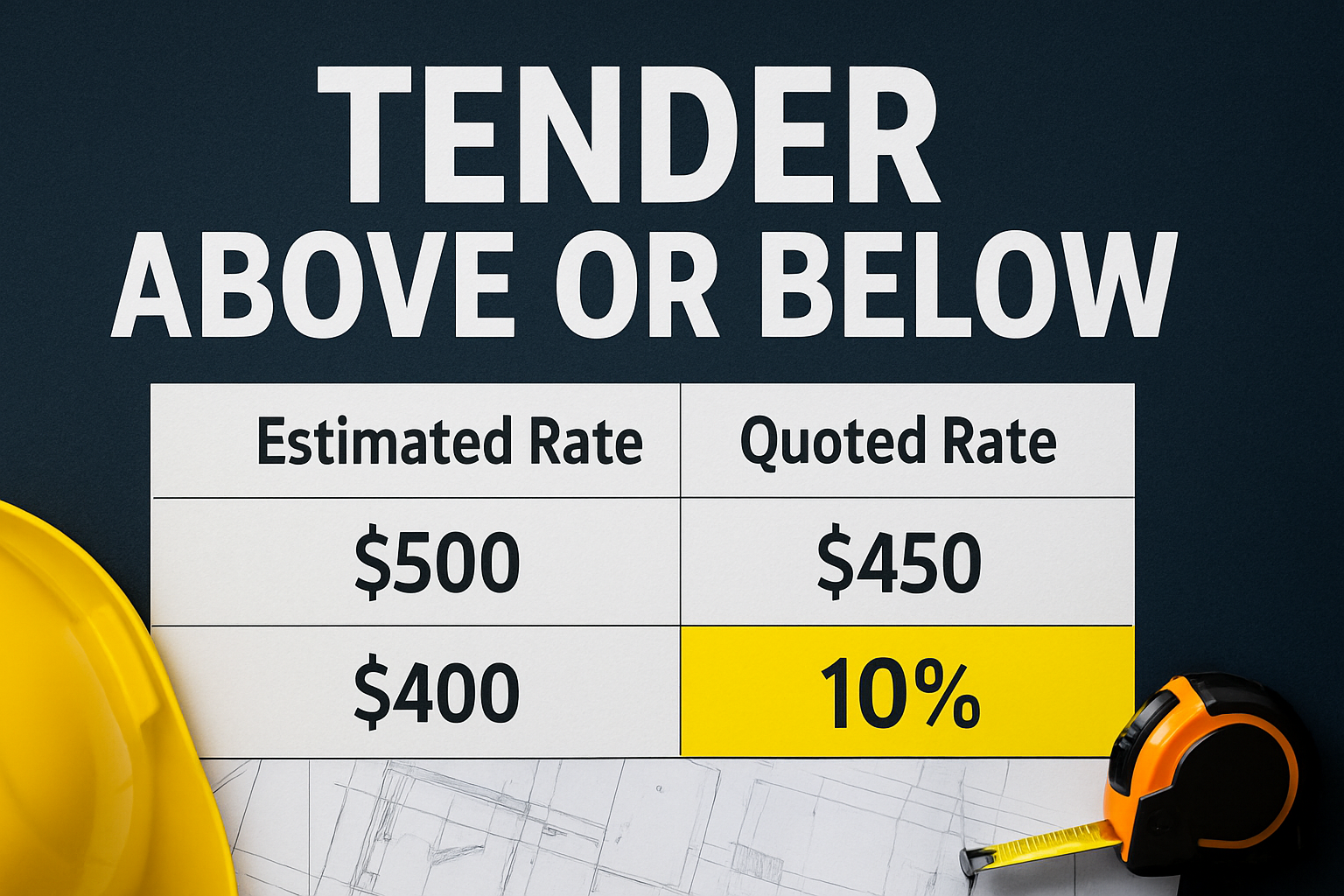
Tender premiums and below rates are crucial concepts in the construction industry, particularly in the bidding process. Understanding these terms is essential for contractors, civil engineering students, site engineers, and construction professionals, as they significantly impact the financial aspects of a project. This article provides an in-depth look at tender premium and below rates, including their meanings and how to calculate them effectively.
Understanding Tender Premium and Below Rates
When contractors submit bids for construction projects, they often present their quotes based on estimated or schedule rates determined by the project owner or engineer. The way these quotes compare to schedule rates determines whether they are categorized as a tender premium, at par tender, or below tender rates:
- Tender Premium: This occurs when a contractor’s quoted rate is above the estimated or schedule rate.
- At Par Tender: In this scenario, the quoted rate matches the estimated rate exactly.
- Below Tender Rate: This indicates the contractor’s quoted rate is less than the estimate or schedule rate.
Understanding these categories helps stakeholders analyze bid competitiveness and cost-effectiveness, influencing project feasibility and contractor selection.
Calculating Tender Premium and Below Rates
The calculation of tender premium and below rates involves simple percentage computations. Here’s how to perform these calculations:
1. Identification of the Estimated Rate
First, identify the estimated or schedule rate provided by the project owner or engineer. This rate serves as the baseline for comparison.
2. Quoted Rate Analysis
Next, obtain the contractor’s quoted tender rate. This is the price at which the contractor is willing to undertake the project.
3. Percentage Calculations
The percentage above or below the schedule rate is calculated using the following formulas:
- Tender Premium Calculation:
- If the quoted rate is greater than the estimated rate:
- Premium (%) = [(Quoted Rate – Estimated Rate) / Estimated Rate] x 100
- Below Tender Rate Calculation:
- If the quoted rate is less than the estimated rate:
- Below Rate (%) = [(Estimated Rate – Quoted Rate) / Estimated Rate] x 100
Example Calculation
Consider an estimated rate of $100,000 for a construction project:
- If a contractor quotes $110,000, the calculation for tender premium would be:
- [($110,000 – $100,000) / $100,000] x 100 = 10%
- If another contractor quotes $90,000, the calculation for below tender rate would be:
- [($100,000 – $90,000) / $100,000] x 100 = 10%
In these examples, the first contractor’s bid is a 10% premium, while the second is 10% below the estimated rate.
Interpreting Tender Rates
Understanding the implications of tender rates is vital for assessing the bids. Here’s what the interpretations generally mean:
- Tender Premium: A higher quoted price may indicate that the contractor believes the project is complex, risks are higher, or they may have a reputation for quality. However, bids above the market rate may also lead to losing the project.
- At Par Tender: This is often viewed as a fair balance, suggesting the contractor is offering a competitive rate that matches the estimated financial expectations of the project.
- Below Tender Rate: This may attract attention due to its cost-saving potential. However, it can also raise red flags regarding the contractor’s ability to fulfill the project requirements without compromising quality or safety.
Common Mistakes in Bidding
Both contractors and project owners can make mistakes when interpreting tender rates:
- Contractors may underbid to win projects, risking financial losses.
- Project owners may overlook the quality track record of lower bids.
- Miscommunication about the estimated rate can lead to confusion and disputes.
FAQs about Tender Premium and Below Rates
What is a tender premium?
A tender premium is when a contractor’s quoted rate exceeds the estimated or schedule rate for a project, indicating a higher overall project cost.
How do you calculate below tender rates?
Below tender rates are calculated by taking the difference between the estimated rate and the quoted rate, dividing by the estimated rate, and multiplying by 100 to get a percentage.
What does ‘at par tender’ mean?
‘At par tender’ refers to a bid that matches the estimated or schedule rate, indicating a balanced approach between cost and projected expenses.
What are the risks of submitting a tender premium?
Submitting a tender premium can lead to losing out on projects if competitors offer lower bids, and it may signal higher risk or costs associated with the work.
Why is below tender rate appealing?
A below tender rate is appealing because it suggests potential cost savings for the project owner, but it can also pose risks related to quality and project completion.
Conclusion
In summary, understanding tender premium and below rates is crucial for all stakeholders in the construction industry. It helps in assessing bids, negotiating contracts, and ensuring fair pricing for projects. Mastery of these concepts and their calculations can significantly improve decision-making in construction procurement.