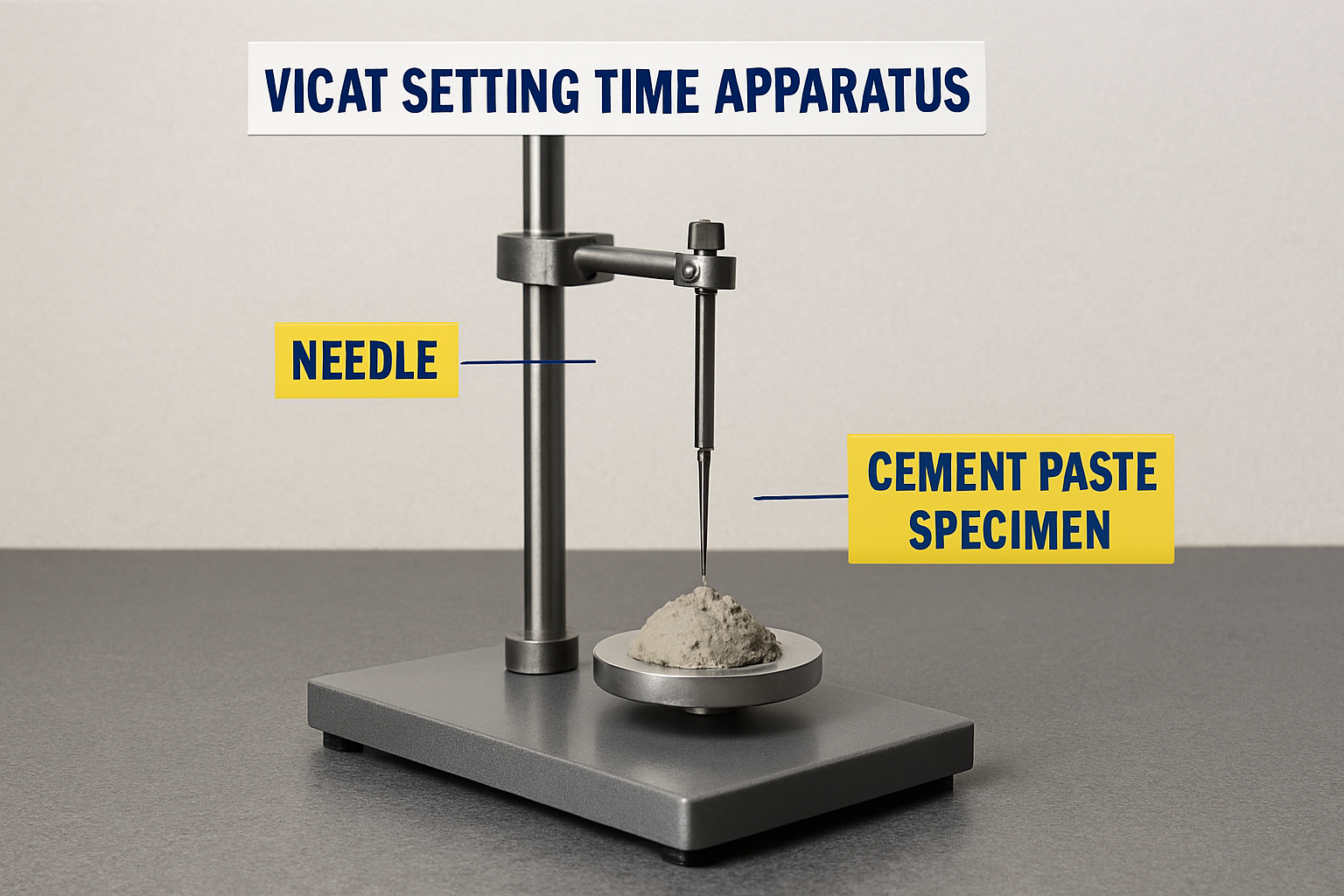
The setting time test of cement is a crucial quality control procedure in civil engineering, determining how long it takes for cement to start and finish its initial curing processes. This test helps ensure that the cement used in construction projects will meet performance requirements related to strength and stability. Accurately testing the initial and final setting times of cement enables engineers to make informed decisions about when to commence further construction activities after mixing cement with water. For the applicable test method and revision, refer to the BIS standards portal.
The initial setting time of cement refers to the point at which the cement paste begins to harden and lose its plasticity, while the final setting time indicates when the cement has completely set and can bear weight. Understanding these parameters is essential for structural integrity in concrete and other cement-based materials.
Understanding Initial and Final Setting Time
Setting-time limits depend on the cement type and the governing product specification. ASTM C191 describes the Vicat test method; it does not by itself establish one universal acceptance range for every cement. For Indian ordinary Portland cement, check the current applicable edition of IS 269 and the project specification before stating acceptance limits. Report measured initial and final setting times rather than presenting typical values as universal requirements.
Vicat Test Procedure
The Vicat test is a widely accepted means to determine the setting times of cement. The following outlines the step-by-step procedure to perform this test:
- Prepare the paste: Determine the water quantity from the standard consistency test and prepare a fresh paste using the cement mass, water quantity, mixing sequence and timing specified by the applicable setting-time method.
- Fill and condition the mould: Fill the Vicat mould promptly, level the surface and keep the specimen under the prescribed temperature and moisture conditions during the test.
- Determine initial setting time: Use the initial-setting needle and the penetration criterion specified in the governing method. Take readings at the required intervals and record the elapsed time from the defined start of mixing to the first reading that satisfies the criterion.
- Determine final setting time: Use the final-setting needle with its prescribed attachment and the applicable final-set criterion. Record the elapsed time from the defined start of mixing when the criterion is first satisfied. Do not use a generic “no further than 1 mm” rule for every apparatus or standard.
- Report the result: Record cement identification, water content, mixing start time, test temperature, apparatus, observation times and the initial and final setting times.
Observations and Reporting
Upon completion of the Vicat test, the following data should be recorded:
- Initial Setting Time (in minutes)
- Final Setting Time (in minutes)
- Ambient temperature during the test
It is advisable to conduct the test under controlled temperature conditions, usually around 25°C (±2°C), as external factors can influence setting times. Documentation should also include visual observation notes regarding the paste’s consistency, color, and any irregularities.
Difference Between Initial and Final Setting Time
The difference between initial and final setting times reflects the stages of cement hardening:
- Initial Setting Time: At this stage, the cement transitions from a fluid to a semi-solid state, indicating the beginning of hydration. The mixture remains workable but starts to thicken, making it essential for contractors to plan their pouring and finishing operations accordingly.
- Final Setting Time: This marks the point at which cement has fully solidified, achieving sufficient strength to support loads. No further work can be done on the concrete structure, emphasizing the importance of timely reporting to avoid construction delays.
Common Mistakes in Conducting the Setting Time Test
As with any technical procedure, accuracy is paramount. Here are common mistakes to avoid when performing the setting time test of cement:
- Inconsistent water-cement ratio, which can significantly alter setting times.
- Not calibrating the Vicat apparatus, leading to measurement inaccuracies.
- Conducting tests at fluctuating temperatures, which may produce unreliable results.
- Failing to monitor the sample at regular intervals during the final setting process.
Applications of Setting Time Tests
Understanding the setting times of cement is crucial for various applications in civil engineering, such as:
- Timing for placing concrete in mass construction operations.
- Determining the optimal time for finishing operations, like smoothing or texturing the surface.
- Planning for concrete curing cycles, essential for achieving desired strength.
Frequently Asked Questions (FAQs)
1. What factors affect the initial and final setting times of cement?
Factors include the type of cement, temperature, humidity, and the water-cement ratio used during mixing.
2. Can the setting time of cement be adjusted?
Yes, using retarders can extend the setting time, while accelerators can shorten it.
3. How do I know if my cement is still usable?
Conduct setting time tests. If the initial setting time exceeds the specified limit, the cement may not be suitable for use.
4. Is there a maximum allowable setting time for cement?
The maximum permitted final setting time depends on the cement type and its current product specification. Check the applicable cement standard and project requirements; 10 hours should not be presented as a universal limit for every cement.
5. What happens if cement sets too quickly?
Rapid setting can lead to difficulties in placement and finishing operations, potentially compromising structural integrity.
Conclusion
The setting time test of cement is vital in ensuring quality and performance in various construction projects. By following standardized procedures to measure initial and final setting times, practitioners can prevent complications during concrete work. Accurate reporting and understanding of setting times facilitate effective project planning and execution, promoting structural safety and longevity.