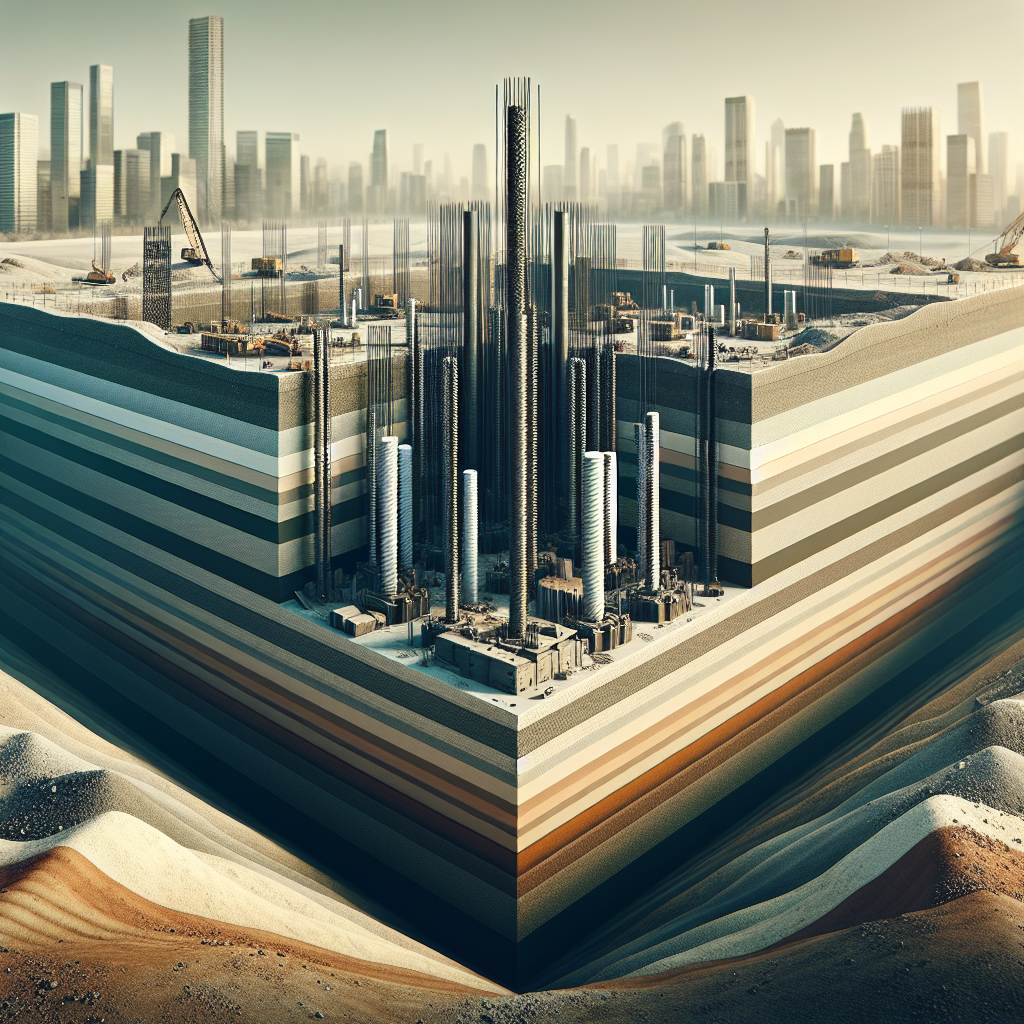
Deep foundations carry loads through weak near-surface soils down to stronger layers or by developing skin friction along the length of piles and shafts. They are essential when shallow spread foundations cannot safely support the structure or when excessive settlement must be avoided.
This article explains how deep solutions work, how to evaluate soil and load conditions, the common types used in practice, and practical checks during design and construction. Emphasis is on clarity and practical reasoning rather than lengthy formulas.
How deep foundations transfer loads
Structures transfer vertical and lateral loads through elements that interact with soil at depth. Two main mechanisms are end bearing and skin friction; many elements use a combination of both.
Understanding which mechanism dominates helps select the right element type and estimate capacity, settlement, and the need for group effects or lateral reinforcement.
End-bearing versus skin friction
End-bearing elements rest on a competent stratum and carry loads primarily through the bearing area at their tips. When competent rock or dense sand is present at manageable depth, end-bearing piles or drilled shafts are common choices.
Skin friction relies on shear resistance along the embedded surface area. In soft clays or medium-density sands where deep competent layers are absent, friction piles can develop significant capacity over their length.
Load paths and group action
Individual deep elements change behavior when placed in groups. Load distribution can be non-uniform due to stiffness differences, and overlapping stress bulbs may reduce effective capacity per element.
Group settlement and negative skin friction (down-drag) must be assessed. Design should consider pile spacing, pile-to-soil stiffness ratio, and potential interaction with adjacent structures.
Common element types and when to use them
Several element types are available; each has strengths based on site conditions, load type, and construction constraints. Selection balances capacity, cost, constructability, and risks like vibration or spoil disposal.
Below are the typical choices and practical notes about when each is preferable.
Driven piles
Driven piles are prefabricated elements (timber, steel, concrete) hammered into the ground. They are fast and offer immediate load testing through driving resistance, but they generate vibration and noise.
Use driven piles where access permits, vibrations are acceptable, and high-quality off-site fabrication ensures uniformity.
Drilled shafts and bored piles
Drilled shafts are cast in place after excavation or boring. They are suitable where vibration must be minimized or where large diameters and high capacities are needed.
They require slurry or casing in unstable soils and careful control of concrete placement to avoid defects like necking or inclusions.
Micropiles and grouted anchors
Micropiles are small-diameter, high-capacity elements installed with drilling and high-pressure grouting. They work well in restricted sites, under existing structures, or where access prevents larger rigs.
They can be installed at angles to resist uplift and lateral forces, and they adapt well to ground improvement and underpinning tasks.
Secant, contiguous, and caisson types
Secant and contiguous piles are used to create retaining walls or water-tight barriers. Caissons can be massive cast-in-place elements suitable for large vertical loads and where excavation support is needed.
These methods are chosen when simultaneous earth retention and load-bearing are required, such as deep basements adjacent to sensitive structures.
Site investigation and soil behavior
A thorough site investigation is the backbone of any successful design. Key data include stratigraphy, groundwater level, index properties, and in-situ strength and stiffness tests.
Lab tests and in-situ tests like CPT or SPT provide complementary views of how the ground will behave under the concentrated stresses imposed by deep elements.
Essential tests and what they reveal
- Cone Penetration Test (CPT): continuous profile of resistance and tip resistance helpful for estimating frictional capacity and stratigraphy.
- Standard Penetration Test (SPT): widely used for basic stratigraphic correlation and empirical capacity correlations.
- Undrained shear strength and triaxial tests: useful in clayey soils to predict settlement and undrained behavior during construction.
- Permeability and consolidation tests: needed when settlement control and pore pressure dissipation are concerns.
Groundwater, corrosion, and special soils
Shallow groundwater raises concerns about scour, buoyancy during construction, and corrosion for metallic elements. Corrosive soils require protective measures or alternative materials.
Finally, organic soils, collapsible soils, and highly compressible silts demand conservative approaches and additional reliance on long-term monitoring.
Design checks: bearing, settlement, and lateral performance
Design combines geotechnical judgment with calculations that address strength, settlement, and lateral stability. Each check uses different input parameters from the site investigation.
Safety factors and serviceability limits depend on codes and the importance of the structure. Experience and testing narrow uncertainty ranges.
Vertical capacity estimation
For end-bearing piles, compute capacity using the area of the tip and the allowable bearing pressure of the supporting layer. For friction piles, integrate unit skin friction along the embedded length using appropriate correlations from CPT or lab data.
Factor of safety values are chosen based on local practice and variability of soil parameters.
Settlement prediction
Settlement can govern design even when strength is adequate. For deep elements, predict settlement from load transfer mechanisms and stiffness of surrounding soil and element.
Elastic analyses, empirical correlations, and numerical models (finite element or boundary element) help estimate both immediate and consolidation settlement.
Lateral capacity and flexibility
Lateral loads are resisted through pile bending and soil reaction along the embedded length. Methods like p–y curves model nonlinear soil response and are commonly used for single elements and groups.
Consider head fixity, pile stiffness, pile length, and soil layering. For tall slender elements, buckling checks may be needed when compression and lateral loads act together.
Construction and quality control
Construction methods influence final performance: poorly placed concrete, inadequate reinforcement, or improper grout can reduce capacity and durability. Quality control during construction reduces risk and unexpected costs.
Procedures should include monitoring, records, and remedial plans if anomalies appear during installation.
Pre-construction checks
- Review access, logistics, and vibration constraints before selecting the installation method.
- Confirm materials, corrosion protection plans, and reinforcement detailing.
- Plan for spoil management, water control, and temporary works to avoid delays and environmental issues.
During installation
Keep detailed daily records: drive counts and refusal for driven piles, volumes and slurry management for drilled shafts, and grout pressures for micropiles. These records form the baseline for assessing in-situ capacity.
Perform integrity tests like low-strain dynamic testing for driven piles and cross-hole or sonic testing for bored piles when concerns about defects exist.
Load testing and verification
Static load testing remains the most reliable way to verify capacity and settlement behavior. High-strain dynamic testing offers rapid assessments, but interpretation requires expertise.
Test results refine design assumptions, confirm safety margins, and indicate if remedial measures are necessary before full loading.
Common pitfalls and practical tips
Avoiding common mistakes saves time and cost. Many issues are related to underestimating variability, poor communication between design and construction teams, or inadequate testing.
Simple checks and clear documentation reduce the chance of expensive surprises during later construction stages.
Underestimating variability
Soil properties can change significantly over short distances. Relying on too few boreholes increases risk. Use conservative assumptions where data are sparse and increase testing where critical.
Poor interface detailing
Connections between piles and superstructure must account for differential stiffness and settlement. Detail piles to facilitate load transfer without creating stress concentrations.
Environmental and durability concerns
Consider chemical aggression, sulfate levels, and oxygen availability when specifying concrete mixes, coatings, or cathodic protection for metallic elements.
Maintenance and monitoring plans extend service life and prevent premature failures.
Conclusion
Effective foundation solutions begin with good data and practical thinking. Understanding load transfer, soil behavior, and construction implications leads to economical and reliable designs.
Using appropriate checks, testing strategically, and coordinating closely between site and design teams reduces uncertainty and delivers predictable performance.
Frequently Asked Questions
What determines whether deep elements are needed?
When shallow foundations would experience excessive settlement or when competent bearing strata lie below a practical shallow depth, deep solutions become appropriate. Site investigation results and settlement limits of the structure guide this decision.
How many tests are enough in a preliminary study?
There is no universal number; it depends on site variability, project size, and risk tolerance. For larger or critical projects, increasing the density of CPTs or boreholes and performing confirmatory lab tests is usually warranted.
Which is better: driven piles or drilled shafts?
Neither is universally better. Driven piles are fast and reliable when vibrations are acceptable and access allows. Drilled shafts work well where vibration must be limited or where high capacities and large diameters are needed.
Can load testing be skipped if calculations show sufficient capacity?
Calculations provide design estimates, but load testing reduces uncertainty, especially on sites with complex geology or when high loads are applied. Many projects include at least one test element to verify assumptions.
What maintenance is required for deep elements?
Maintenance needs depend on exposure and materials. Regular inspections of head connections, corrosion monitoring when metallic elements are used, and ensuring drainage and protection against scour or erosion help maintain long-term performance.