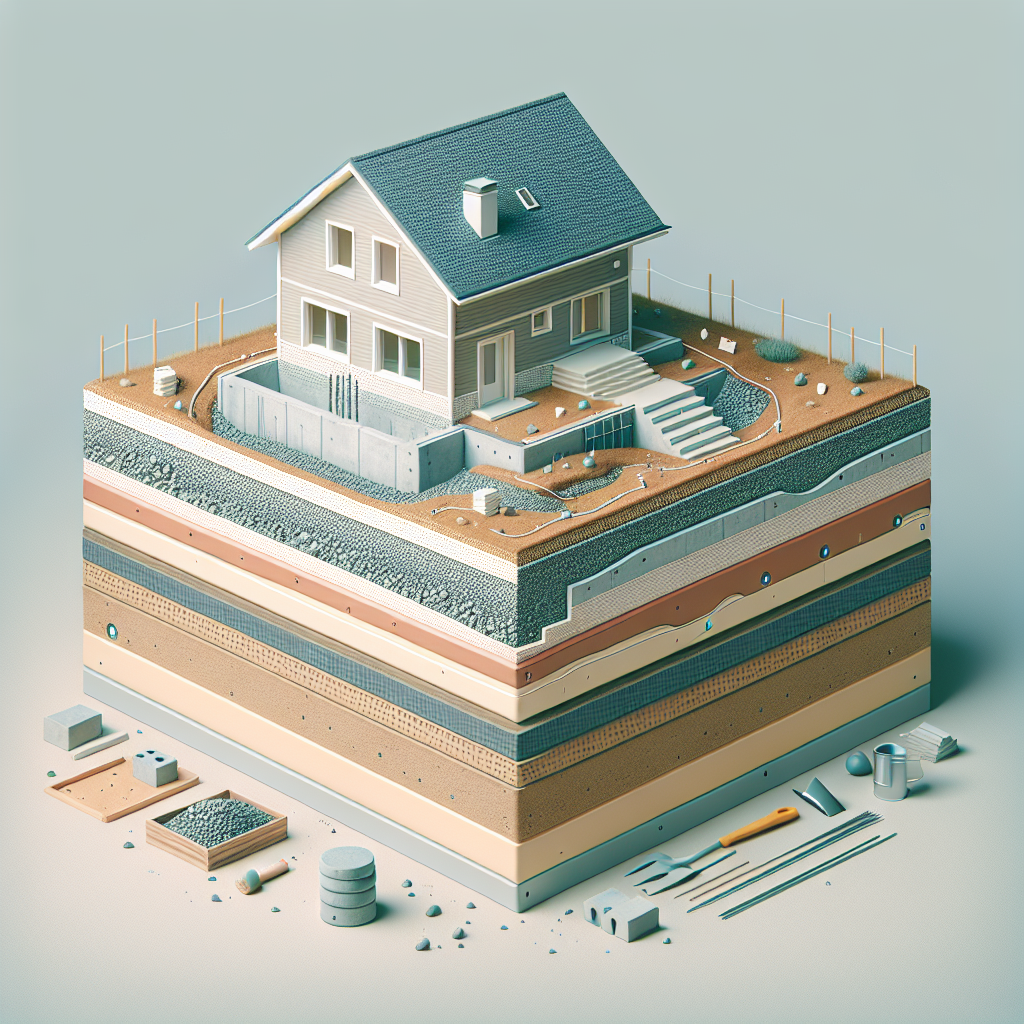
Choosing the right foundation is one of the most important decisions when building a home. The right base keeps the structure stable, controls settlement, and protects against moisture and seasonal changes.
This article explains common foundation choices seen across India, how soil and budget affect the decision, and practical points to consider during construction.
Understanding soil and site conditions
Soil type and groundwater level shape which foundation will work best. A small plot with firm soil needs a very different approach than a site with soft clays or high water table.
Basic site checks and a simple soil test help avoid costly corrections later. Know whether the soil is rocky, sandy, silty, or clayey, and check how deep the water table sits.
Common soil types in India
Sandy soils drain well and usually support shallower foundations, but they can shift under loads if loose. Clay soils hold moisture and can swell or shrink with seasons, causing uneven settlement.
When to get a professional soil test
If the plot shows signs of waterlogging, deep soft soil, or previous nearby construction issues, a proper subsurface investigation is worth the cost. Even a basic bore-log and bearing capacity estimate prevent many problems.
Shallow foundation options and when they work
Shallow foundations sit close to the ground surface. They are common for single and low-rise houses where soil bearing capacity is adequate.
Shallow types are usually faster and less expensive than deep foundations, but they require uniform, stable soil conditions.
Strip (continuous) foundation
Strip foundations are long continuous footings under load-bearing walls. They spread the load along the length of the wall and work well on firm soils.
- Suitable for small to medium houses with good bearing soil.
- Less costly and easier to construct than deeper options.
Isolated (pad) foundation
Pad foundations are discrete footings under columns. They concentrate loads into pads, connected by beams when needed.
- Used when columns carry heavy loads but soil is consistent.
- Requires careful dimensioning to avoid differential settlement.
Raft (mat) foundation
Raft foundations cover the entire building footprint, distributing loads across a large area. They are ideal where soil capacity is low but relatively uniform.
- Good for weak or compressible soils to reduce uneven settlement.
- Material cost is higher, but it may save money compared to deep foundations in some sites.
Deep foundation types and when they are needed
Deep foundations transfer loads to stronger soil layers or rock found at greater depth. They are chosen when surface soils cannot safely support the structure.
These solutions are more complex and costlier, but often necessary for tall buildings, heavy loads, or poor ground conditions.
Pile foundations
Piles are long columns driven or cast into the ground. They reach down to firm strata and carry loads through friction or end-bearing.
- Useful where top soils are weak but stable layers exist deeper down.
- Types include driven concrete, bored cast-in-place, and steel piles.
Caissons and drilled shafts
Drilled shafts, also called caissons, are large diameter holes filled with concrete and reinforcement. They are suitable for heavy loads and where vibration from driven piles must be avoided.
- Common near existing structures or in urban areas to reduce disturbance.
- Requires careful excavation and proper reinforcement detailing.
Key factors that determine the best choice
No single option fits every plot. The choice depends on soil, building load, groundwater, budget, and local construction practices.
Assess each factor and weigh trade-offs between upfront cost and long-term performance.
Load and building type
Light single-storey homes typically do well with shallow footings if soil is strong. Multi-storey structures or heavier masonry may need raft or piled solutions.
Groundwater and drainage
A high water table complicates excavation and demands waterproofing and drainage. Foundations must be designed to avoid buoyancy or long-term moisture damage.
Local availability and costs
Material and labor prices vary by region. In many areas, reinforced concrete and skilled labor are readily available, making conventional footings economical.
- Deep foundations raise costs due to equipment and time.
- Raft slabs use more concrete but reduce need for deep works in some weak soils.
Construction practices and common mistakes to avoid
Even the right design can fail with poor execution. Quality control during foundation work is crucial for safety and durability.
Pay attention to excavation, formwork, reinforcement placement, concrete quality, and curing.
Improper soil compaction
Loose backfill or under-compacted layers lead to settlement and cracks. Compact in thin layers and check density with simple field tests when possible.
Reinforcement and cover issues
Inadequate reinforcement or insufficient concrete cover exposes steel to moisture and accelerates corrosion. Maintain specified cover and properly tie rebars.
Poor concrete mix or curing
Using weak concrete, excessive water, or skipping curing reduces strength and increases permeability. Use the right grade and keep the concrete moist during the initial days.
Cost expectations and rough comparisons
Costs vary widely by region, material quality, and skilled labor availability. The following are approximate relative comparisons, not fixed prices.
Shallow footings are usually the cheapest, rafts are moderate to high depending on thickness, and deep foundations cost the most due to equipment and time.
- Strip or pad footings: lowest material and labor cost on good soil.
- Raft foundations: medium to high cost based on slab depth and reinforcement.
- Piles and caissons: high cost due to drilling/driving and specialized work.
Conclusion
Picking the right foundation depends on careful assessment of the soil, water conditions, building load, and budget. What works in one neighbourhood may fail in another.
Start with a clear site study and match the foundation type to site realities. Proper construction practices and material quality ensure long-term performance and peace of mind.
Frequently Asked Questions
Below are common questions people have when deciding on a foundation. Short answers focus on practical points to consider.
How does soil type change my foundation choice?
Soil controls bearing capacity and settlement behavior. Sandy, rocky soils allow shallower footings while soft clays or peat need rafts or piles to transfer loads to stronger layers.
Is a raft slab always better than strip footing?
Not always. Raft slabs are helpful on weak but uniform soils to reduce differential settlement. On strong soil, strip or pad footings are more economical and simpler to build.
When are piles necessary for a house?
Piles are needed when the top layers are too weak or compressible and no suitable bearing stratum exists at shallow depth. They are also used for very heavy loads or poor drainage sites.
Can poor construction ruin a good design?
Yes. Mistakes like inadequate compaction, wrong concrete mix, or incorrect reinforcement placement can cause significant issues despite sound design. Supervision and quality checks matter.
What is the first step before choosing any foundation?
Perform a basic site assessment: observe surface conditions, check for waterlogging, and get at least a simple soil investigation. That information guides design and avoids surprises.