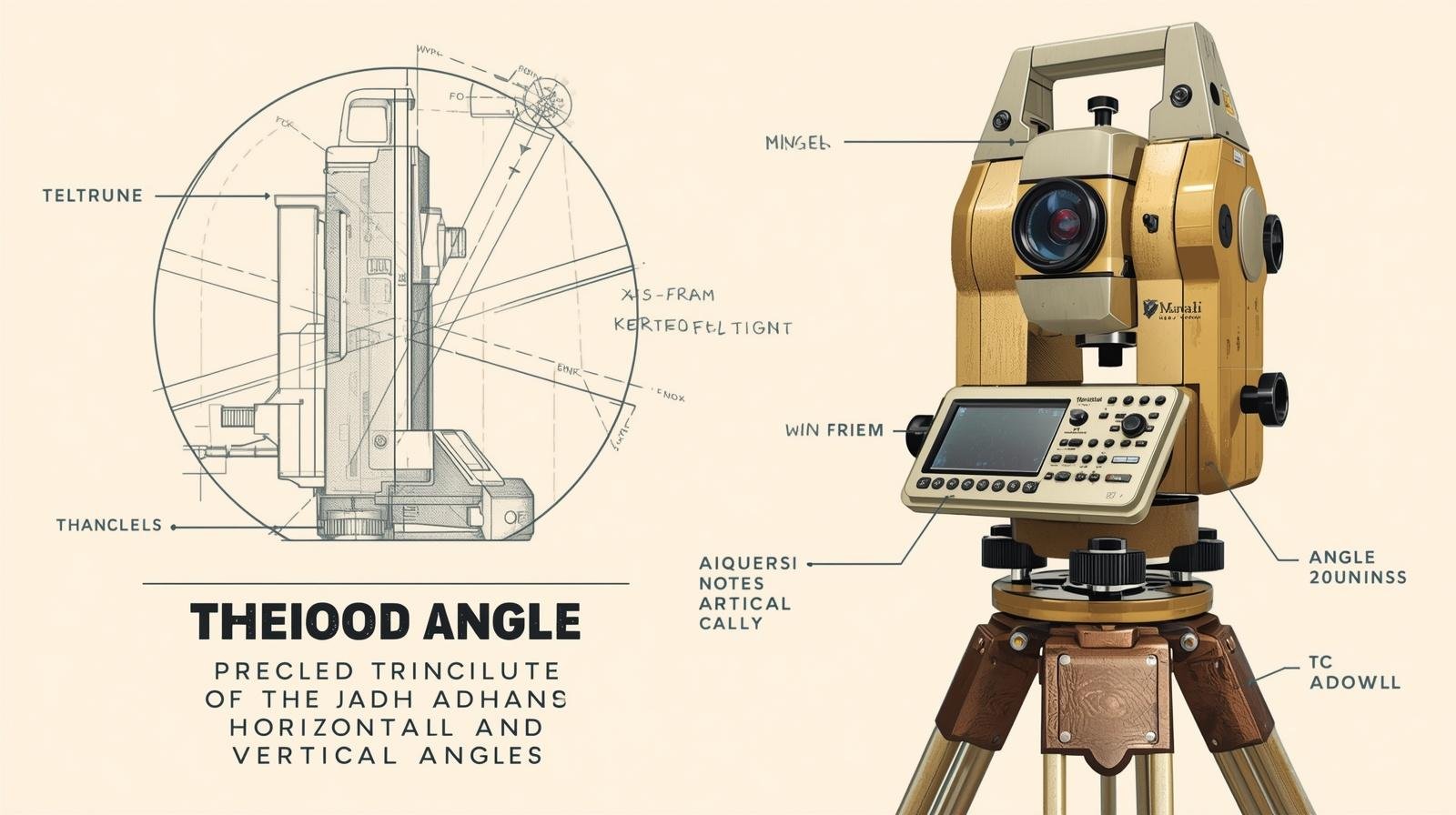
This Theodolite Surveying Principle Complete Guide explains how to measure horizontal and vertical angles with a theodolite. Theodolite surveying principle and angle measurement are covered in simple steps. This guide is a practical step guide and includes field examples. It also follows the Theodolite surveying principle complete guide – horizontal vertical angle measurement step-by-step with practical field examples for easy learning.
Overview of Theodolite Surveying
Here is a quick introduction before we go into steps. A theodolite is a precise instrument for measuring angles in the horizontal and vertical planes. Understanding the basic parts and the main principle helps you get correct results in the field.
What is a Theodolite?
A theodolite is a surveying tool. It has a telescope mounted on a base that can rotate horizontally and vertically. It reads angles using graduated circles or digital displays.
Main Parts
- Tribrach and base
- Vertical circle and horizontal circle
- Telescope with crosshairs
- Levelling screws and spirit level
- Optical or digital readout
Principles of Horizontal and Vertical Angle Measurement
Before doing field work, learn the basic principle. Angle measurement is the difference between two directions. Theodolite surveying principle uses precise sighting, leveling, and reading to find that difference. Below are step-by-step methods for each type of angle.
Horizontal Angle Measurement — Step Guide
Follow these steps to measure a horizontal angle between two points A and B from instrument station O.
- Set up the tripod at station O. Fix the tribrach and mount the theodolite.
- Level the instrument using the levelling screws and the spirit level.
- Center the theodolite over the station mark. Use the optical plummet or plumb bob.
- Sight point A through the telescope and clamp the horizontal circle.
- Set the horizontal circle to zero or note the reading.
- Rotate the telescope to sight point B. Read the horizontal circle.
- The horizontal angle = reading to B minus reading to A (adjust for circle graduation).
- Repeat and take the mean of multiple readings to reduce error.
Practical field example: At station O, zeroed on A, you read 45°30′ on B. The horizontal angle AOB is 45°30′. If reversed reading gives 45°32′, use the average 45°31′.
Vertical Angle Measurement — Step Guide
Measure vertical angles to get elevation differences or slopes. The vertical angle is the angle between the horizontal plane and the line of sight.
- Level the instrument precisely at station O.
- Sight the target (top of a pole or staff) and focus the telescope.
- Read the vertical circle. Note whether the instrument uses zenith or altitude angles.
- If needed, take face left and face right readings and average them.
- Calculate height difference: height = instrument height + staff reading – target height, using tangent of vertical angle if needed for slope distance.
Field example: The vertical angle to the top of a pole is 12°15′. With instrument height 1.6 m and staff reading 2.2 m, compute height or distance using trigonometry as required.
Setting Up the Theodolite in the Field
Good setup improves accuracy. Read these tips before you measure angles.
Tripod and Centering
Place the tripod over the station mark. Spread legs so the head is roughly level. Push legs firmly into the ground. Use the optical plummet to center the instrument over the mark.
Leveling the Instrument
Level in two stages. First, use the levelling screws and circular bubble to get close. Then use the tubular spirit level or electronic level for fine adjustment. Always recheck after centering.
Focus and Collimation
Focus the telescope on the crosshairs and on the target. Proper focus reduces parallax. Check the collimation by sighting a distant object, rotating the telescope 180°, and re-sighting.
Measurement Procedure: Step Guide with Practical Examples
This section shows a simple field workflow and an example table for clarity. Use repeated observations for better results.
Field Workflow
- Plan your stations and targets before you start.
- Set up instrument and level it.
- Take initial readings on reference points.
- Measure horizontal angles first, then vertical angles if needed.
- Record all readings and note face left/face right if applicable.
- Compute angles, apply corrections, and average repeated readings.
Sample Readings Table
| Station | Target | Horizontal Reading | Vertical Reading |
| O | A | 0°00′ | 0°00′ |
| O | B | 45°31′ | 12°15′ |
| O | C | 120°45′ | -2°10′ |
Use the table to compute angles like AOB = 45°31′ and slope or height using vertical angles.
Common Errors and Practical Tips
Knowing common errors helps you avoid bad data. Here are quick tips and fixes.
Typical Error Sources
- Poor centering over the station mark
- Instrument not perfectly level
- Parallax from poor focus
- Incorrect face left/face right handling
- Wind or unstable tripod
How to Reduce Errors
- Always center and level carefully.
- Take face left and face right readings and average them.
- Use multiple observations and compute the mean.
- Keep sentences short and notes clear in your field book.
- Calibrate the instrument regularly.
Frequently Asked Questions
What is the basic principle of theodolite surveying?
The basic principle is to measure angles by sighting two directions with a telescope. Horizontal and vertical circles give angle values. Proper leveling and centering make the readings accurate.
How do you measure a horizontal angle with a theodolite?
Level the instrument, sight the first point and set zero or record reading. Rotate to the second point and read the horizontal circle. Subtract readings and average repeated measures.
How is vertical angle used to find height?
Measure the vertical angle to a target and note staff reading. Use the tangent of the vertical angle with measured distance or combine staff readings and instrument height to compute elevation differences.
What is face left and face right reading?
Face left and face right refer to two telescope orientations when reading angles. Taking both and averaging removes some instrument errors like eccentricity and misalignment.
Can a beginner use a theodolite easily?
Yes. With practice and this step guide, beginners can measure angles accurately. Start with short tasks, check results often, and learn to level and focus well.
Conclusion
This guide covered the theodolite surveying principle, horizontal and vertical angle measurement, and a clear step guide with field examples. Follow the setup, measure carefully, and record repeated readings. With practice you will get reliable survey angles and useful data for any project.