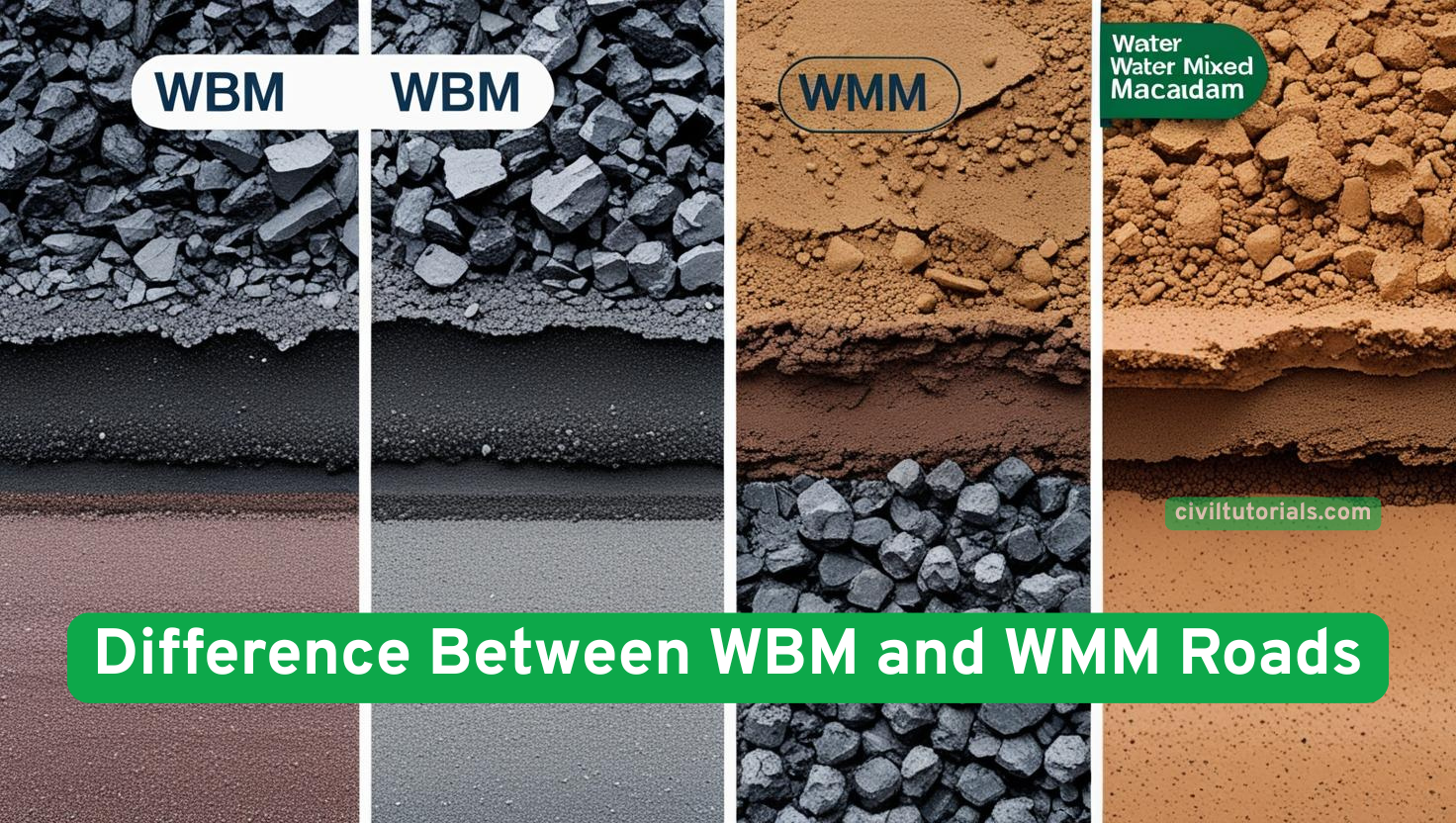
The difference between WBM and WMM roads lies mainly in how the aggregate layer is mixed, placed and compacted. Water Bound Macadam (WBM) uses coarse aggregates with screenings and water worked into the voids in stages, while Wet Mix Macadam (WMM) uses a controlled, premixed blend of graded aggregates and water that is spread and compacted mechanically. Both are used in pavement construction, but the selected layer and its requirements must follow the approved road design and applicable specifications.
What Is WBM (Water Bound Macadam)?
For further reading on the older macadam pavement method, see Water Bound Macadam (WBM). For construction sequence and equipment differences, compare the relevant project specifications rather than assuming WBM and WMM are interchangeable.
WBM is one of the oldest road construction techniques, where crushed stone aggregates are compacted and bound using stone dust and water. It relies on mechanical interlocking rather than strong binding agents.
Key Features of WBM Roads
- Made of layered aggregates (coarse to fine).
- Uses stone screenings as filler material.
- Requires manual labor for spreading and compaction.
- Suitable for low-traffic rural roads and temporary pathways.
Construction Process of WBM Roads
- Preparation of Subgrade – The ground is leveled and compacted.
- Laying Base Course – Large aggregates (75-90mm) are spread and rolled.
- Adding Screenings – Smaller stones and dust fill the gaps.
- Wetting & Compaction – Water is sprayed, followed by heavy rolling.
- Final Layer – Fine aggregates are added for a smoother surface.
Pros and Cons of WBM Roads
| Advantages | Disadvantages |
|---|---|
| Low initial cost | Weak under heavy traffic |
| Easy to construct | Requires frequent maintenance |
| Good drainage | Prone to potholes and erosion |
| Eco-friendly (no chemicals) | Shorter lifespan |
What Is WMM (Wet Mix Macadam)?
WMM is a modern road construction method where aggregates are pre-mixed with water and binding materials (like stone dust or cement slurry) in a pug mill before laying. It offers better strength and durability than WBM.
Key Features of WMM Roads
- Uses mechanized mixing for uniform consistency.
- Contains better binding materials for stability.
- Faster construction due to less manual work.
- Ideal for highways and urban roads.
Construction Process of WMM Roads
- Mixing in Pug Mill – Aggregates, filler, and water are blended uniformly.
- Transporting & Laying – The mix is brought to the site and spread.
- Compaction – Rollers compress the layer for maximum density.
- Curing – The surface is kept moist for strength gain.
Pros and Cons of WMM Roads
| Advantages | Disadvantages |
|---|---|
| Higher load-bearing capacity | More expensive than WBM |
| Longer lifespan | Requires specialized machinery |
| Resists water damage | Needs skilled labor |
| Low maintenance | Initial setup cost is high |
Key Differences Between WBM and WMM Roads
Here’s a quick comparison table:
| Factor | WBM | WMM |
|---|---|---|
| Material Binding | Stone dust + water | Bitumen/cement slurry |
| Mixing Process | Manual | Machine (pug mill) |
| Strength | Moderate | High |
| Durability | 3-5 years | 10+ years |
| Traffic Suitability | Light vehicles | Heavy vehicles |
| Cost | Cheaper | More expensive |
Which One Should You Choose?
- For rural roads with low traffic → WBM (cost-effective).
- For highways and city roads → WMM (long-lasting).
- For temporary pathways → WBM (easy to construct).
- For heavy-load areas → WMM (better durability).
FAQs on WBM vs WMM Roads
1. Which is stronger, WBM or WMM?
WMM is stronger due to better binding and compaction.
2. Can WBM be used for highways?
No, WBM cannot handle heavy traffic—WMM is preferred.
3. Is WMM more expensive than WBM?
Yes, due to machinery and better materials.
4. How long does WBM last compared to WMM?
WBM lasts 3-5 years, while WMM lasts 10+ years.
5. Which is more eco-friendly?
WBM (no chemicals), but WMM has better long-term sustainability.
Final Verdict
While WBM is economical for low-traffic areas, WMM is the superior choice for modern roads requiring durability. Your choice depends on budget, traffic load, and project requirements.