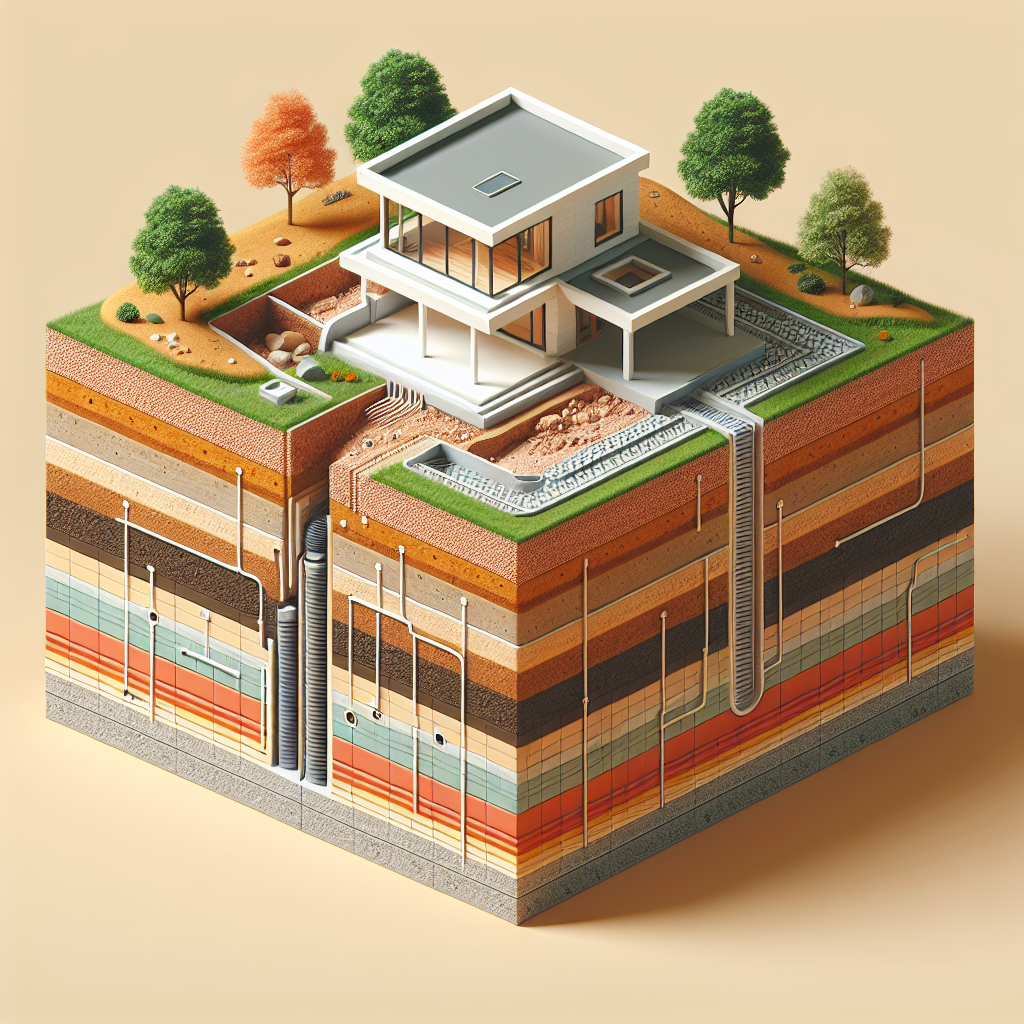
Clay soil can feel solid one week and unpredictable the next. Its tendency to shrink and swell with moisture makes planning and construction more demanding than on sandy or rocky ground.
This article explains how clay moves, what to look for at a site, practical foundation options, and ways to reduce the risk of future damage. The aim is clear information you can use when evaluating a property or during early design work.
How clay soil behaves and why it matters
Clay is made of very fine particles that hold water tightly. When moisture increases, clay swells; when it dries, it shrinks. That cyclical movement can apply uneven forces to foundations over months and years.
Not all clay is the same. Some types expand a little, others a lot. The local climate, drainage, and nearby vegetation change how severe movement becomes.
Common signs of clay-related movement
Look for hairline cracks in walls, doors that stick, uneven floors, or stair-step cracks in brickwork. These often point to differential movement rather than a single catastrophic failure.
Clay types and their risks
Some clays are highly plastic and show large volume changes. Others are less reactive but still problematic if drainage is poor. A simple visual test or a basic lab test can tell you how reactive the soil is.
Assessing site and ground conditions
A thorough site check helps match the right foundation approach to the soil. Small parcels can behave differently across short distances, so multiple checks are often needed.
Key items include depth of clay, moisture variation, and presence of organic material. These factors shape both short-term and long-term performance.
Simple field checks you can do
Dig small pits or probe boreholes to inspect the soil profile. Note color, texture, and presence of layers like sand or silt. Smearing a wet sample between fingers gives a rough sense of plasticity.
- Measure how deep wet clay extends from the surface.
- Watch how the soil dries after rain over a few weeks.
- Check for nearby trees and large shrubs that draw moisture.
When professional testing helps
Lab tests give precise measures: plasticity index, moisture content, and bearing capacity. These results guide decisions about depth, footing size, and whether soil treatment is needed.
Practical foundation approaches on clay soil
Choosing the right foundation depends on how much clay moves, the weight of the building, and the budget available. Several proven options reduce the risk of costly repairs later.
Each option trades off cost, complexity, and performance. The most suitable choice often combines a structural approach with moisture control.
Shallow slab-on-grade with stiffening ribs
A reinforced concrete slab that spans lightly reactive soils can work if the slab is designed to resist bending and the site has controlled moisture. Thickened edges and internal ribs add stiffness.
Pier and beam or strip footings
Piers extend to deeper, more stable layers or are founded on compacted zones. Beams bridge between piers and allow some differential movement without cracking finishes.
Deep foundations
Piles or drilled shafts transfer loads to firmer soils below the active clay zone. This is more expensive but often the most reliable solution for heavy structures on very reactive sites.
Soil improvement and moisture control methods
Improving the ground and managing water around a site tends to be more affordable than over-engineering foundations. Small changes can greatly reduce movement.
Focus on consistent moisture levels near the foundation and on increasing the strength of the near-surface soil.
Drainage and grading
Grade the site so water moves away from the structure. Gutters, downspouts, and perimeter drains keep water from saturating clay next to foundations.
- Maintain a slope of at least 1:50 for the first few meters away from the building.
- Direct roof runoff into well-placed collection or infiltration areas, avoiding the foundation line.
Vegetation and root management
Large trees near a foundation can cause uneven drying of clay soil. Where root systems are a problem, consider planting low-water shrubs or installing root barriers to limit moisture extraction close to the foundation.
Soil replacement and compaction
Excavating reactive clay and replacing it with well-compacted granular fill creates a stable zone under shallow foundations. This method works well on smaller sites when deeper solutions are not feasible.
Chemical stabilization
Additives like lime or cement can reduce plasticity and increase strength in clay layers. Treatment depth and mixing method matter; professional input ensures the correct blend and curing time.
Design and construction details that limit problems
Small design choices make a big difference over decades. Aim to reduce stress concentrations and allow predictable movement where it must occur.
Consistency during construction — proper curing, controlled backfill, and careful compaction — prevents early failures and avoids introducing new moisture paths.
Control joints and flexible connections
Place control joints where surface cracking is likely and use flexible connections between structural elements and non-structural finishes. This accepts some movement without widespread cracking.
Uniform footing depth and load distribution
Keeping footing depths consistent across the building footprint reduces differential settlement. When depth must vary, use design features that bridge or transfer loads safely.
Material choices
Use reinforced concrete mixes suited to local conditions and corrosion risks. Durable materials reduce long-term maintenance and perform better under cyclical stress.
Cost considerations and long-term thinking
Upfront spending on proper foundations and site preparation often saves far more than repair bills later. Assess the likely movement and choose a solution that balances risk and cost.
Factor in lifecycle costs: repairs, maintenance, and insurance impacts. A slightly higher initial cost can deliver decades of trouble-free performance.
- Compare shallow improvement vs deep foundation costs early.
- Include drainage and landscaping in the project budget.
- Request references and past performance on similar soils.
Conclusion
Clay soils demand careful attention but they are manageable with the right mix of assessment, moisture control, and foundation selection. Understanding how the soil behaves is the first step toward a durable structure.
Whether by improving the near-surface soil, choosing a foundation that spans unstable layers, or controlling water at the surface, effective planning reduces future repair needs and protects investment value.
Frequently Asked Questions
Below are common questions about building and maintaining foundations on clay-rich ground, with concise answers to help clarify typical concerns.
How much does clay movement affect small houses?
Small houses can be affected significantly if the clay is highly reactive or if moisture varies a lot near the foundation. Lighter buildings often move but may tolerate modest shifts if the foundation is designed for flexibility.
Can drainage alone fix a clay problem?
Good drainage reduces the severity of moisture swings and often reduces movement substantially. However, drainage alone may not eliminate risk when clay is very reactive; combining drainage with structural or soil treatments gives better results.
Is it better to remove clay and replace with gravel?
Replacing wet, organic, or highly plastic clay with compacted granular fill creates a stable base for shallow foundations. This works well on smaller sites where deeper solutions are unnecessary, but costs and excavation limits need consideration.
When are deep piles needed on clay sites?
Deep piles are useful when the active clay zone is very thick or weak near the surface, and when the building loads are high. Piles transfer loads to firmer layers below the moving clay, offering long-term stability.
How does seasonal weather affect foundation performance?
Seasonal wet and dry cycles drive clay shrink-swell behavior. Extended wet periods cause swelling, then drying causes shrinkage. Predictable moisture control and consistent landscaping reduce the seasonal extremes that cause most damage.