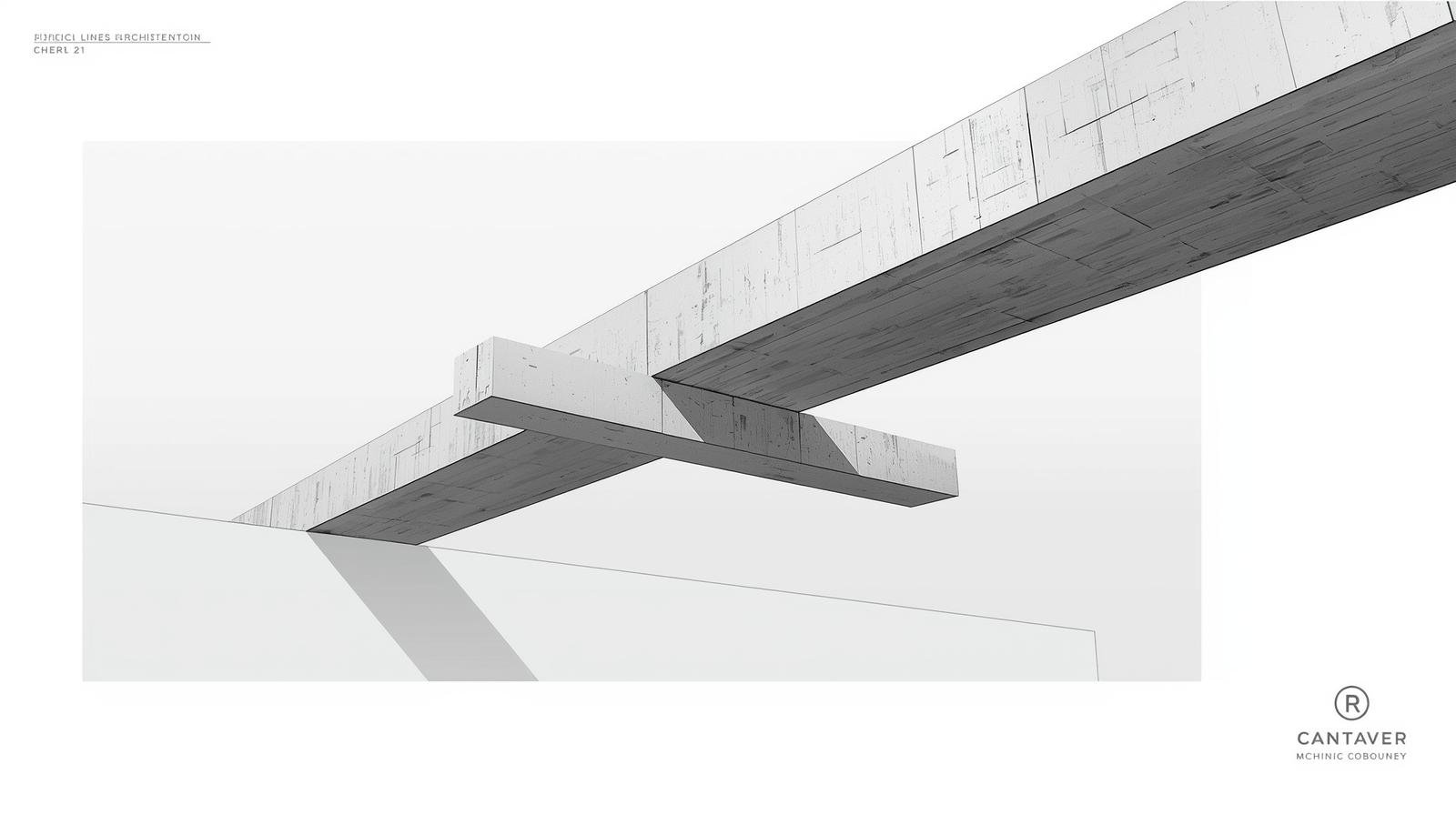
A cantilever beam is a structural member that is fixed at one end and free at the other end. It extends horizontally and transfers loads back to the fixed support through bending moment and shear force. Cantilever beams are widely used in buildings, bridges, industrial platforms, and architectural projections where providing support at both ends is not practical.
Basic Concept of Cantilever Beam
A cantilever beam is supported only at one end, and that fixed end resists bending moment, shear force, and reaction forces generated by applied loads. The free end has zero bending moment and zero reaction.
Key Characteristics
- Fixed at one end and free at the other
- Maximum bending moment occurs at the fixed support
- Maximum shear force occurs at the support
- Maximum deflection occurs at the free end
- Tension develops at the top face under downward loading
Structural Behavior of Cantilever Beam
When a downward load is applied, the upper portion of the beam near the fixed support experiences tensile stress, while the lower portion experiences compressive stress. In reinforced concrete cantilever beams, reinforcement is therefore placed at the top near the support. Deflection gradually increases toward the free end, and improper design may cause excessive cracking and serviceability problems.
Loading Conditions and Formulas
Cantilever beams may be subjected to point loads, uniformly distributed loads, or combined loads, and structural design depends on accurate moment and shear calculations.
1. Point Load at Free End
Maximum Bending Moment: M = W × L
Maximum Shear Force: V = W
Where W is the applied load and L is the beam length.
2. Uniformly Distributed Load (UDL)
Maximum Bending Moment: M = wL² / 2
Maximum Shear Force: V = wL
Where w is the load per unit length and L is the span length.
Cantilever Beam Design Considerations
Proper design ensures structural safety and long-term durability. The beam must resist maximum bending moment at the fixed support, and shear capacity must be checked carefully. Span-to-depth ratio should be maintained to control deflection. Adequate development length and anchorage of reinforcement are essential to achieve proper fixity. Crack control measures such as correct bar spacing and sufficient concrete cover must also be ensured.
Comparison: Cantilever Beam vs Simply Supported Beam
| Feature | Cantilever Beam | Simply Supported Beam |
|---|---|---|
| Support Condition | One end fixed | Both ends supported |
| Maximum Bending Moment Location | At fixed support | At mid-span |
| Maximum Deflection Location | At free end | At center |
| Reinforcement Placement (RCC) | Top near support | Bottom at mid-span |
| Structural Application | Projections and overhangs | Regular span systems |
Advantages of Cantilever Beam
Cantilever beams eliminate the need for support at the free end, offering architectural flexibility and open space beneath projections. They are efficient for balconies, sunshades, canopies, and bridge segments.
Limitations of Cantilever Beam
Cantilever beams experience high bending stress at the fixed support, requiring strong and rigid anchorage. Longer spans demand greater depth and stronger materials. Deflection control is critical to prevent structural and serviceability issues.
Applications of Cantilever Beam
Cantilever beams are commonly used in residential balconies, overhead slabs, canopies, flyovers, bridge construction, industrial platforms, and signboard supports. Their ability to extend outward without additional support makes them a fundamental component of structural engineering design.