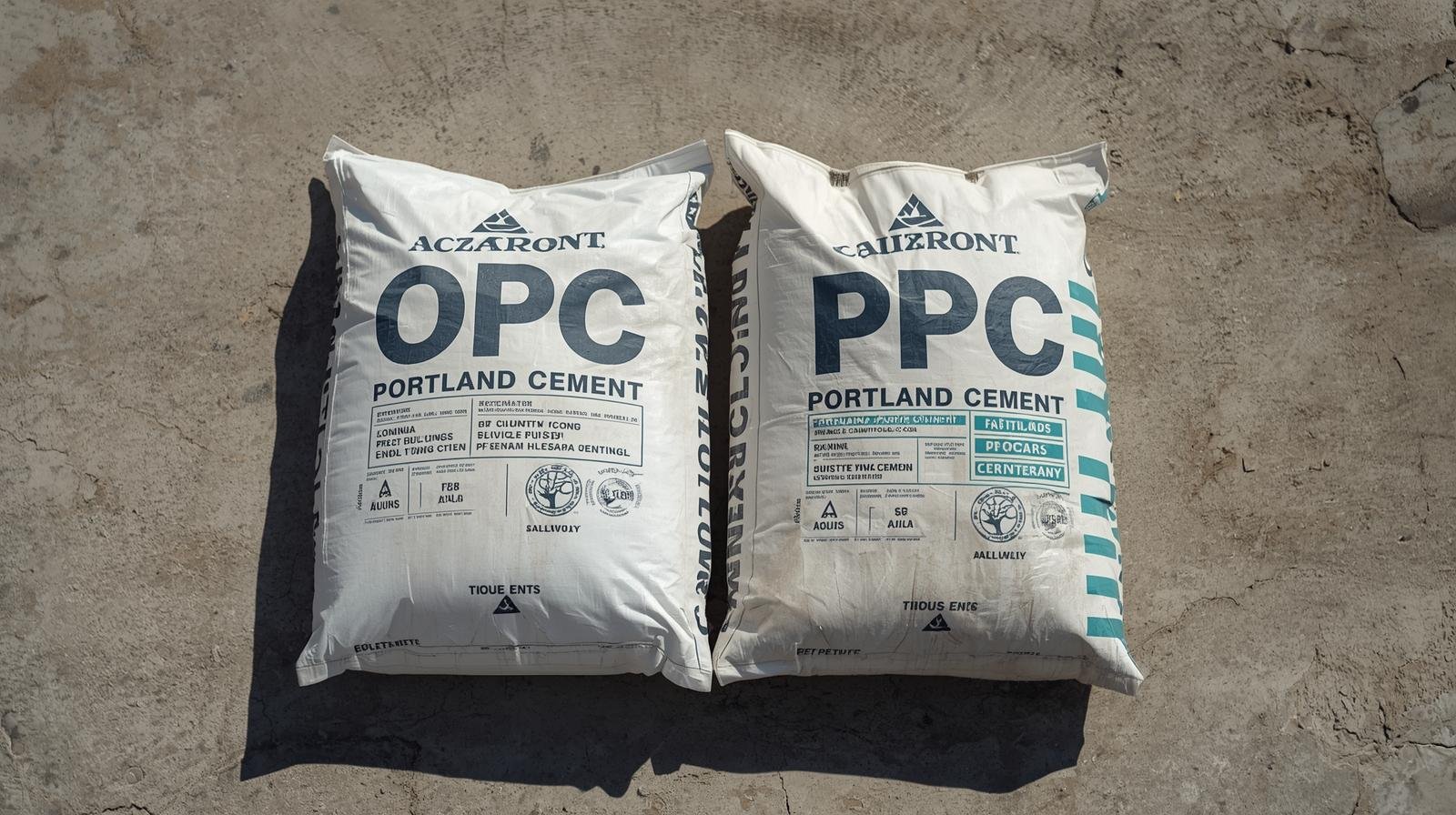
The difference between OPC and PPC cement is one of the most common questions in construction because choosing the right cement directly affects strength, durability, and long-term performance of structures. OPC (Ordinary Portland Cement) and PPC (Portland Pozzolana Cement) are both widely used in building works, but their composition, properties, and applications are different. Understanding these differences helps engineers, contractors, and site supervisors select the correct cement for each type of project.
What Is OPC Cement?
OPC cement is manufactured by grinding clinker with a small percentage of gypsum. It gains strength quickly and is known for its high early strength. Because of this property, OPC is often used where early formwork removal or faster construction progress is required. OPC cement is commonly available in grades like 33, 43, and 53, with OPC 43 and OPC 53 being the most used in modern construction.
What Is PPC Cement?
PPC cement is produced by blending Ordinary Portland Cement clinker with pozzolanic materials such as fly ash or calcined clay. The presence of pozzolana improves long-term strength and durability. PPC gains strength more slowly than OPC, but it performs better over time, especially in aggressive environmental conditions. PPC is widely used in residential buildings and mass concrete works.
Key Difference Between OPC and PPC Cement
The main difference between OPC and PPC lies in their composition and performance characteristics. OPC provides higher early strength, while PPC offers better durability and resistance to chemical attacks. OPC is suitable for fast-track projects, whereas PPC is preferred for long-lasting and sustainable construction.
OPC vs PPC Cement – Comparison Table
| Feature | OPC Cement | PPC Cement |
|---|---|---|
| Full Form | Ordinary Portland Cement | Portland Pozzolana Cement |
| Strength Gain | High early strength | Slow early strength, higher long-term strength |
| Heat of Hydration | High | Low |
| Durability | Moderate | High |
| Crack Resistance | Lower | Better |
| Environmental Impact | Higher | Lower (eco-friendly) |
| Cost | Slightly higher | Generally economical |
Strength Difference Between OPC and PPC
OPC cement achieves higher strength in the early days, especially within 7 days, which makes it suitable for projects where early load application is required. PPC cement gains strength gradually and often exceeds OPC strength at later ages like 90 days. For structures where long-term performance is more important than early strength, PPC is considered a better option.
Durability and Resistance Comparison
PPC cement performs better in terms of durability because pozzolanic materials reduce permeability. This makes PPC more resistant to sulphate attack, chloride penetration, and chemical reactions. OPC cement, due to higher heat of hydration, is more prone to thermal cracks in mass concrete works. For coastal areas and sewage-related structures, PPC is generally preferred.
Workability and Finish
PPC cement provides better workability and a smoother finish compared to OPC. The fine pozzolanic particles improve cohesion in concrete and reduce bleeding. OPC concrete may require more water to achieve the same level of workability, which can affect strength if not properly controlled.
Uses of OPC Cement
OPC cement is commonly used in projects where early strength is critical. It is suitable for RCC works, precast concrete elements, pavements, and fast-track construction. High-rise buildings and structures requiring quick formwork removal often use OPC cement.
Uses of PPC Cement
PPC cement is widely used in residential buildings, plastering, masonry works, mass concreting, and hydraulic structures. It is also preferred in areas with aggressive environmental conditions due to its enhanced durability. PPC is ideal for sustainable and long-life construction projects.
FAQs on Difference Between OPC and PPC Cement
Which cement is better, OPC or PPC?
Both OPC and PPC are good, but the better choice depends on the project. OPC is better for early strength requirements, while PPC is better for durability and long-term performance.
Is PPC cement stronger than OPC?
PPC cement gains strength slowly but can achieve higher long-term strength compared to OPC, especially after 90 days.
Which cement is best for house construction?
For most residential buildings, PPC cement is preferred due to better durability, workability, and lower cracking risk.
Can OPC and PPC be used together?
Mixing OPC and PPC in the same concrete batch is not recommended because their properties and setting behavior are different.
Conclusion
The difference between OPC and PPC cement lies mainly in strength development, durability, and application. OPC cement is suitable for projects requiring fast strength gain, while PPC cement is ideal for long-lasting and durable construction. Selecting the right cement based on structural requirements and environmental conditions ensures better performance, safety, and cost efficiency in construction projects.