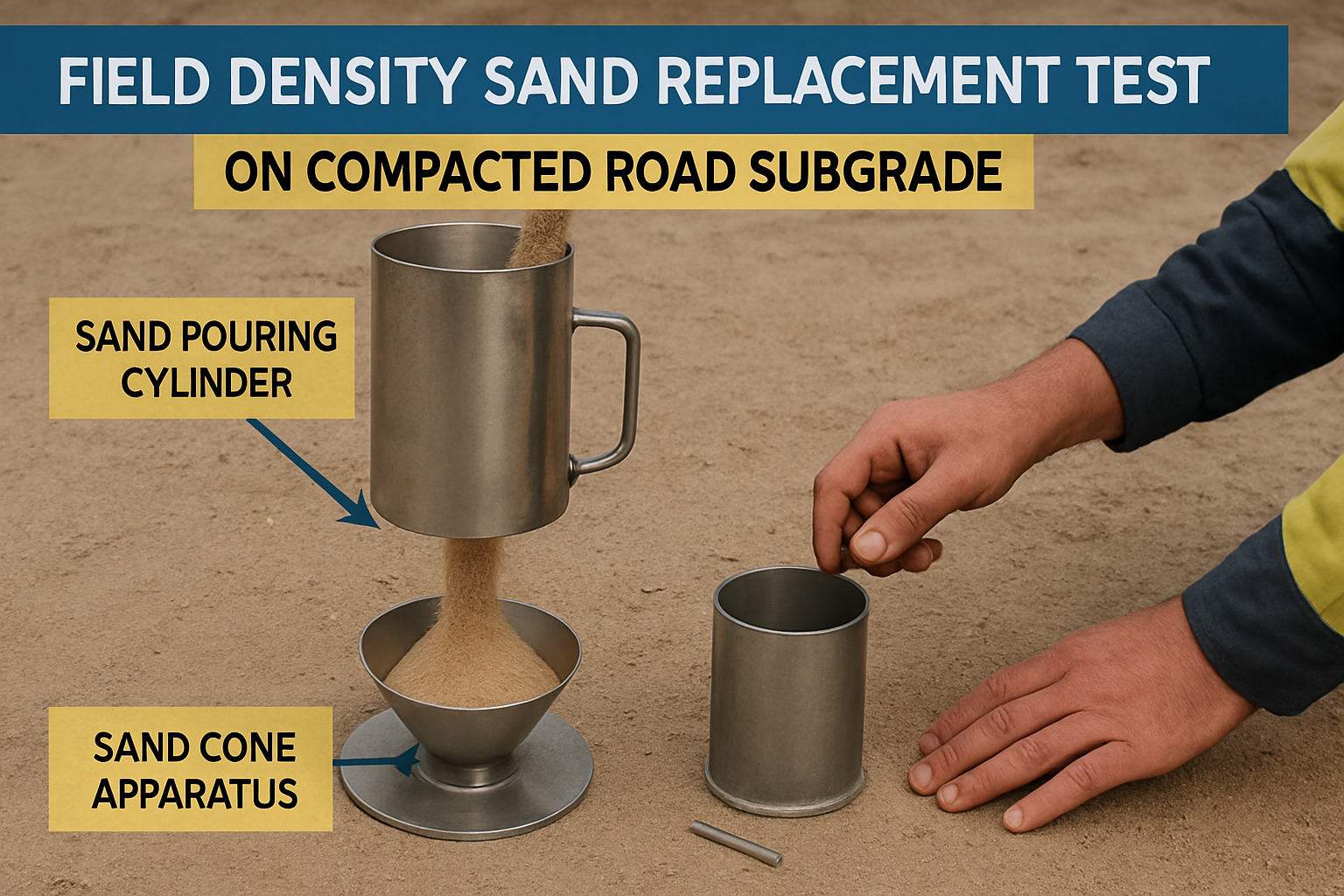
The Sand Replacement Method is a widely utilized field density test that allows engineers and construction professionals to determine the in situ soil density of various types of soil. This method is particularly essential in ensuring that the soil used in foundation construction and other applications meets the required density specifications necessary for structural integrity. Understanding the sand replacement test procedure enables enhanced quality control and accurate assessments during construction projects. For the applicable test method and revision, refer to the NPTEL Geotechnical Engineering course.
By utilizing the sand replacement method, practitioners can effectively analyze the compaction of soil layers, which is crucial for the stability and performance of the infrastructure being built. This article explores the sand replacement test procedure, including detailed explanations of apparatus calibration, test-hole preparation, sand mass determination, and dry density calculations.
Apparatus Required for Sand Replacement Method
Before commencing the test, specific apparatus must be prepared to ensure accurate measurements. The essential equipment includes:
- Sand cone apparatus: This includes a sand cone, a graduated measuring cylinder, and a stopcock.
- Scale: A balance scale is necessary for measuring the mass of the sand.
- Trenching tools: Common tools include shovels and trowels for preparing the test holes.
- Calibrated container: A container is used to collect the displaced soil from the hole being tested.
- Plastic sheeting or tarp: This helps in preventing contamination of the sand with any surrounding materials.
Calibration of the Sand Cone Apparatus
To ensure the accuracy of the sand replacement method, proper calibration of the sand cone apparatus is essential. This involves the following steps:
- Determine the cone correction: On a level, non-absorbent surface and with the apparatus configuration specified by the test method, allow calibrated sand to fill the cone and base-plate space. Determine and record this correction mass separately; do not confuse it with the mass of sand that fills the test hole.
- Determine calibrated sand bulk density: Using the specified calibration container and procedure, determine the mass of standard sand per unit volume. Use the same sand and apparatus configuration for the field test, and recalibrate if the sand condition or equipment changes.
Density (ρ) = Mass (m) / Volume (V)
This calibration process ensures that the mass and volume measurements later obtained during testing are accurate.
Preparation of Test Hole
The next step in the sand replacement test procedure is preparing the test hole, which must be completed with care to avoid disturbance of the surrounding soil. The procedure includes:
- Excavate the test hole: Use a shovel or digging tool to create a circular hole. Typical diameter ranges from 115 mm to 150 mm, ensuring it is deep enough to obtain a satisfactory soil sample.
- Clean the test hole: Remove any loose soil or debris using a brush or a gentle air blast, ensuring that the sides of the hole remain intact.
Conducting the Sand Replacement Test
Once the test hole is prepared, you can proceed with the sand replacement method:
- Fill the hole with calibrated sand: Place the apparatus on the prepared base plate over the test hole and allow the sand to flow freely as prescribed. Avoid vibration or disturbance while the sand is flowing, then close the shutter and record the mass used.
- Measure the mass of the sand used: After the sand has completely filled the hole, weigh the collected sand in the graduated measuring cylinder to determine the mass.
At this point, the total mass of sand used will be crucial for calculating the dry density of the soil.
Calculating Soil Density
After completing the above steps, you need to calculate the dry density of the soil in situ. This is done as follows:
- Use the following formula to calculate the dry density (ρ_d):
Bulk (wet) density of soil = Mass of excavated moist soil / Volume of test hole
Dry density, ρd = Bulk density / (1 + w), where w is the moisture content expressed as a decimal (for example, 12% = 0.12).
The test-hole volume is obtained from the mass of calibrated replacement sand that fills the hole, divided by the calibrated bulk density of that sand. First deduct the sand required to fill the cone/base plate. Do not treat the mass of replacement sand as the mass of soil.
Make sure to express the dry density in appropriate units (typically kg/m³).
Quality Checks and Common Mistakes
Maintaining high-quality standards during the sand replacement method is critical. Below are some quality checks and common mistakes to avoid:
- Consistency in Sand Density: Always use sand with a consistent density for testing to keep results reliable.
- Proper Hole Preparation: Poorly prepared holes can lead to inaccurate results. Ensure holes are cleaned and that the surrounding soil is undisturbed.
- Measurement Errors: Double-check all weight measurements and volume readings to prevent calculation errors.
- Environmental Considerations: Conduct tests under consistent environmental conditions to minimize variability in results.
Applications of the Sand Replacement Method
The sand replacement method is broadly applicable in various civil engineering fields, including:
- Foundation Engineering: Used to assess soil compaction beneath structures.
- Pavement Design: Helps in evaluating the density of subgrade soils.
- Earthworks Construction: Assists in ensuring optimal compaction for embankments and backfill materials.
FAQs
1. What is the major advantage of the sand replacement method?
The method provides an in-situ bulk density measurement using calibrated replacement sand and a measured excavated-soil mass. Dry density is then calculated using the separately determined moisture content and compared with the specified laboratory reference value.
2. How does the sand replacement method compare to other density testing methods?
While other methods exist, such as the nuclear density test, the sand replacement method is less costly and does not require specialized equipment, making it accessible for many sites.
3. What types of soil can be tested using this method?
It can be used for suitable compacted soils where the test hole can be excavated and retained without collapse, excessive disturbance or loss of material. Very coarse, highly permeable, soft, saturated or unstable materials may require another method or a method-specific correction. Follow the applicable standard’s limits on particle size and hole dimensions.
4. How often should calibrations be performed?
Calibration of the test apparatus should be conducted before significant testing begins and periodically during extensive projects to ensure accuracy.
5. Can the sand replacement method be used in all weather conditions?
While it can be used in various conditions, it is best to conduct tests when the soil is not excessively wet or frozen, as this can affect measurement accuracy.
In conclusion, the sand replacement method is a fundamental technique in geotechnical engineering for assessing soil density. By following thorough procedures for apparatus calibration, test-hole preparation, and accurate density calculations, engineers and construction professionals can ensure the reliability of their soil evaluations. Understanding this method enhances the capability to execute quality control measures and compliance with project specifications effectively.