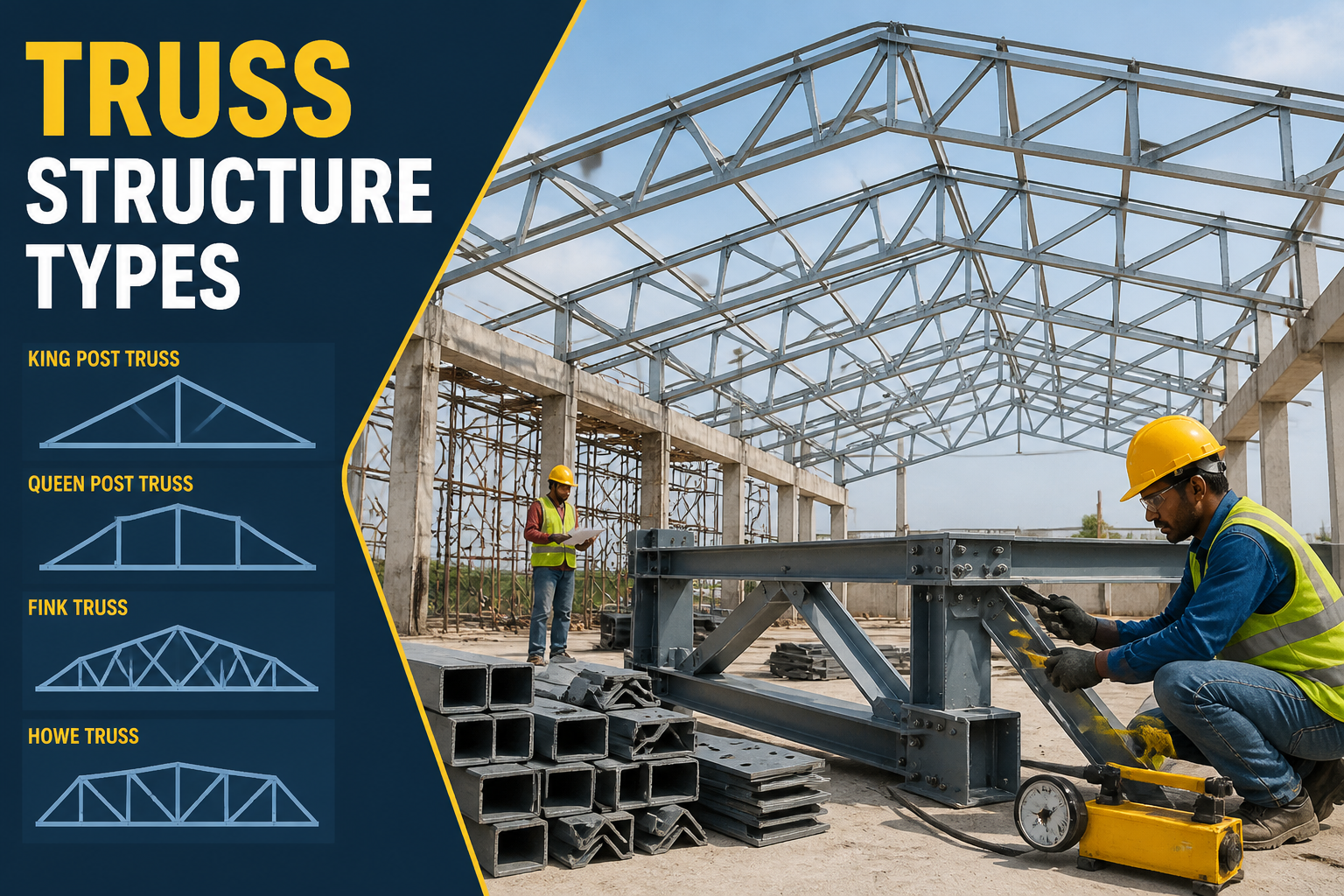
Understanding the various truss structure types is crucial for civil engineering students, site engineers, contractors, and construction professionals. Trusses are structural components that efficiently transfer loads across large distances, combining strength and material efficiency. Their design and applications span numerous sectors in construction and infrastructure development, making it important to grasp their meaning, types, and practical applications.
This article explores different truss structure types, their components, design procedures, and unique applications, providing a comprehensive guide for professionals in the field.
Understanding Truss Structure Types
Truss structures are composed of triangular units that distribute loads effectively. The fundamental design relies on the geometric shapes formed by these triangles, which help maintain stability and resist forces like tension and compression. Common truss structure types include the Pratt, Warren, and Howe trusses, each suited for specific applications based on their geometry and load-bearing characteristics.
Types of Truss Structures
1. Pratt Truss
The Pratt truss is characterized by its diagonal members sloping toward the center and vertical members connecting the top and bottom chords. This design favors tension in the diagonals and is often used in bridges and buildings where vertical loads are prominent.
2. Warren Truss
Featuring equilateral triangles, the Warren truss is celebrated for its efficiency in distributing loads evenly across its length. It utilizes only diagonal members, leading to a lightweight structure. This truss type is particularly effective in bridge construction due to its ability to handle both tension and compression.
3. Howe Truss
The Howe truss is similar to the Pratt but has a different arrangement, with the diagonals sloping away from the center. This design is ideal for heavy load applications, making it a favored choice in railway bridges and industrial buildings.
4. Bowstring Truss
With a curved top chord, the bowstring truss provides significant vertical clearance and is often used in large-span structures such as sports complexes and warehouses. Its unique shape allows for efficient load distribution while maximizing interior space.
Components of Trusses
Essential components of trusses include:
- Top Chord: The upper longitudinal member that resists compressive forces.
- Bottom Chord: The lower longitudinal member that bears tensile forces.
- Web Members: Diagonal and vertical members that connect the top and bottom chords, facilitating load transfer.
- Joint Connections: Points where truss members connect, often using gusset plates or bolts to provide strength and stability.
Design Procedure for Truss Structures
The design of trusses involves several key steps:
- Define Loads: Calculate the dead and live loads that the truss will support.
- Select Truss Type: Choose a suitable truss structure type based on the intended application and load requirements.
- Structural Analysis: Utilize methods such as the method of joints or the method of sections to analyze forces in each member.
- Member Sizing: Use standard formulas to determine appropriate member sizes, considering material properties. For instance, for axial loads, a simple formula can be used:
Stress = Load/Area. - Detail Drawings: Create detailed construction drawings that specify connections, material types, and dimensions.
Applications of Truss Structures
Truss structures find applications in various domains, including:
- Bridges: Commonly used for pedestrian, railway, and vehicle bridges due to their ability to span wide gaps.
- Buildings: Often incorporated in roofs and frameworks, providing robust support and architectural design flexibility.
- Industrial Structures: Utilized in warehouses and manufacturing facilities, where large open spaces are necessary.
- Sports Facilities: Employed in stadium roofs and gymnasiums to create aesthetically pleasing and functional spaces.
Quality Checks in Truss Construction
Ensuring structural integrity involves several quality checks, including:
- Material Testing: Analyze materials for yield strength and other mechanical properties.
- Connection Integrity: Inspect welds and joints to confirm they meet the required standards.
- Load Testing: Perform load tests to evaluate actual performance against theoretical calculations.
Common Mistakes in Truss Design
Professionals must be cautious of certain common mistakes, including:
- Neglecting proper load calculations, which can lead to underestimating member sizes.
- Failing to consider environmental factors such as wind or seismic loads.
- Inadequate detailing of connections, resulting in potential weak points in the structure.
FAQs
What is the meaning of truss structure types?
Truss structure types refer to various forms of trusses, characterized by their member arrangement and load-carrying mechanisms, each designed for specific applications in construction.
What is the general procedure for designing trusses?
The procedure for designing trusses involves defining loads, selecting the truss type, conducting structural analysis, sizing members, and creating detailed construction drawings.
What equipment is commonly used in truss construction?
Common equipment includes cranes for lifting truss sections, scaffolding for access, and tools for cutting, welding, and connecting members such as drills and bolts.
What formula is used to size truss members?
The formula for sizing members generally revolves around stress calculations, using the basic formula: Stress = Load/Area, factoring in allowable stress limits for the material.
What are some practical applications of truss structures?
Truss structures are used in bridges, roofs of buildings, industrial warehouses, and large-span sports facilities, taking advantage of their load-bearing capacities and efficiency.
Conclusion
Truss structures play a vital role in modern engineering and construction. By understanding the various truss structure types, their components, and proper design procedures, professionals can optimize their use in real-world applications. Whether in bridges, buildings, or other infrastructure, the efficient design and application of trusses will contribute to safer, more reliable, and cost-effective construction practices.