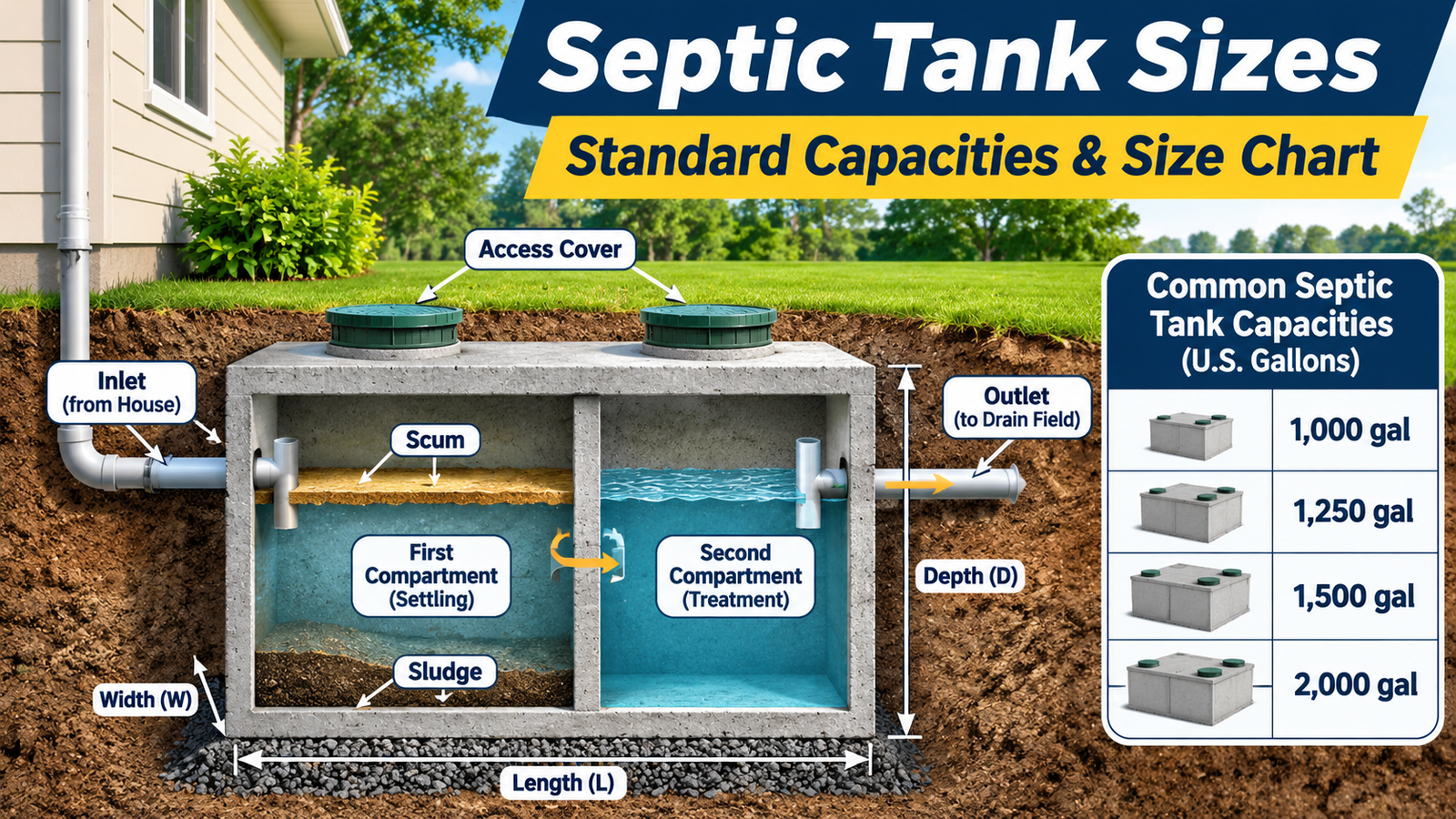
Septic tank sizes vary according to a property’s design requirements, expected wastewater load and applicable local regulations. Common residential capacities in U.S. sizing guidance include 1,000, 1,250, 1,500 and 2,000 gallons, but no single capacity is suitable for every home.
Choosing the right tank involves more than comparing gallon ratings. You need to understand the tank’s rated liquid capacity, physical dimensions and compartment arrangement, and confirm that the proposed model matches the approved design and the complete wastewater treatment system.
This article explains common septic tank capacities with a comparison chart, the factors that affect sizing, ways to identify an existing tank and practical points to check when comparing installation or replacement quotes. All gallon measurements in the U.S. examples refer to U.S. gallons.
What Does Septic Tank Size Actually Mean?
When a septic tank is described as a “1,500-gallon tank,” that number generally refers to its rated liquid capacity. It does not tell you the tank’s exact length or width, and it does not mean the property can send 1,500 gallons of wastewater through the system every day. These distinctions are easy to miss because suppliers, homeowners and installers may use the word “size” to mean different things.
Tank Capacity
Capacity describes the volume held at the tank’s normal operating liquid level, generally associated with the outlet through which wastewater leaves the tank. There is usually space above that level, but you should not count it as additional usable capacity when comparing the tank with a design requirement. The manufacturer’s approved specifications are the appropriate reference for the product’s rated capacity.
Physical Dimensions
Dimensions describe the tank’s length, width and height. Two tanks can have the same capacity but different dimensions: one may be longer and shallower, while another is shorter and deeper. Wall thickness, shape and compartment layout also affect the outside measurements. These details matter when checking the proposed installation location, but dimensions alone do not tell you whether a tank meets the required capacity.
Daily Design Flow
Daily design flow is the wastewater volume used to design the system, usually expressed in gallons per day. It serves a different purpose from tank capacity: the tank must provide space for wastewater separation and solids storage, while the complete system must manage the incoming flow.
| Measurement | What it describes | Where you may see it |
|---|---|---|
| Gallons | Rated tank capacity | Product specifications and permits |
| Feet or inches | Physical dimensions | Manufacturer drawings |
| Gallons per day | Design wastewater flow | System plans and design calculations |
For example, a quote that lists a 1,500-gallon tank gives you a storage-capacity figure; you still need the design documents to understand the wastewater loading the system is approved to handle. Whenever a proposal uses the word “capacity,” check which measurement it means. That one question can prevent an expensive misunderstanding.
Common Septic Tank Sizes: A Quick Comparison Chart
Septic tanks are available in a range of capacities. The chart below includes figures found in residential sizing guidance and registered sewage-tank listings to help you understand volume and compare specifications. It is not a house-sizing recommendation or a substitute for an approved system design.
| Tank capacity | Approximate capacity in liters | How to interpret it |
|---|---|---|
| 750 gallons | 2,839 liters | A smaller capacity appearing in some product listings; suitability depends on the approved application |
| 1,000 gallons | 3,785 liters | A capacity used in residential minimum-sizing schedules |
| 1,250 gallons | 4,732 liters | An intermediate capacity appearing in some residential guidance |
| 1,500 gallons | 5,678 liters | A larger capacity included in residential sizing schedules |
| 2,000 gallons | 7,571 liters | A capacity appearing in schedules for higher residential design loads |
| 2,500 gallons | 9,464 liters | A larger capacity included in some residential schedules |
Liter equivalents are rounded, and available capacities and approved uses vary by manufacturer and location.
How to Use This Chart
Start by identifying the required capacity in your approved plans or the recommendation provided by the designer. Then compare that requirement with the exact product being proposed, including its rated liquid capacity, model number and intended use. Do not assume that a product is suitable simply because its gallon rating appears in the table: a listed tank could be intended for a particular application, and local approval may depend on more than volume. For example, finding a smaller tank in a supplier’s catalogue does not establish that it is permitted for a new residential installation at your address.
What the Chart Does Not Tell You
A general septic tank size chart cannot answer all the questions involved in selecting a system. It does not establish:
- The capacity required for your particular house.
- Whether the tank model is approved locally.
- The correct compartment arrangement.
- The drainfield’s required size.
- Whether the property needs additional treatment components.
- Whether the proposed installation meets site requirements.
Those decisions belong in the property-specific design. Think of the chart as a way to understand the options mentioned in a conversation with a professional; it helps you follow the discussion without turning a general guide into a construction specification.
Check What a Combined Capacity Includes
Some proposals describe more than one tank or chamber. Before comparing their totals, ask what each part does: a septic compartment, pump chamber and holding tank serve different purposes, and their volumes should not automatically be treated as interchangeable septic-treatment capacity. If a quote lists two capacity figures, have the contractor label them clearly. A useful proposal identifies the septic tank capacity separately from any pump-chamber capacity, making it easier to compare the proposal with the design and another contractor’s quote.
Is There a Standard Size for Every Home?
There is no universal standard septic tank size for every house. The word “standard” is often used casually: a supplier may mean a model it regularly stocks, an installer may mean a capacity frequently used on nearby projects, and a permitting office may be discussing the minimum required under a specific rule. Those meanings are not interchangeable.
Common Does Not Always Mean Required
A frequently supplied capacity may be suitable for many installations in an area, but that does not make it the correct choice for every property. Your home may have a different design load, additional fixtures or a proposed change that needs to be considered; the site may also require a different system arrangement. When someone recommends a “standard tank,” ask a simple follow-up:
“Is that the capacity required by this property’s design, or the size you normally supply?”
The answer should help clarify the basis of the recommendation.
Is There a Useful Average Septic Tank Size?
An average is less helpful than it first appears. To be meaningful, it would need to describe a defined group of homes and could vary by location, property age, housing type and the requirements used when those systems were installed. Even a well-supported average would describe other properties, not establish the required capacity for yours. That is why choosing a tank based on an “average size” found online is a weak starting point.
A Better Reference Point
Use the approved design or applicable local sizing requirement rather than an online average. For an existing system, check its permit and installation records; for a new installation, ask the designer to explain the required capacity and the assumptions used. You can then compare the specification with the exact product offered by the supplier.
Why Choosing the Right Capacity Matters
A septic tank gives wastewater space to separate before the liquid moves onward for further treatment. Heavier solids settle to the bottom as sludge, while oils, grease and other floating material collect at the top as scum. Between those layers is liquid that can leave through the outlet; the tank’s internal arrangement helps retain solids while wastewater passes through.
Space for Separation
Wastewater entering a tank needs suitable conditions for separation. Capacity is part of creating those conditions, alongside the tank’s design, inlet and outlet arrangement, and the volume entering it. This is why choosing a tank cannot be reduced to finding a container that physically fits underground; it must function as part of a designed treatment process.
Space for Accumulating Solids
Sludge and scum remain in the tank until they are broken down to some extent or removed during servicing. As these layers accumulate, they occupy space and reduce the available working volume, so a tank needs regular inspection and pumping even when it was correctly sized at installation. Maintenance remains necessary regardless of the tank’s rated capacity.
Protecting the Downstream System
The tank helps prevent solids from reaching components intended to receive liquid effluent. Keeping those solids under control matters because the drainfield and other treatment components have their own operating requirements. However, tank capacity alone cannot guarantee good performance; a damaged outlet, neglected maintenance or excessive wastewater loading can still create problems.
Avoid Diagnosing Problems From Capacity Alone
A backup, slow drain or wastewater surfacing outdoors does not automatically mean the tank is undersized. The cause may involve a blockage, damaged component, excessive solids or a problem in the downstream treatment area.
Have the complete system assessed before choosing a larger tank. The diagnosis should identify the cause and explain why the proposed work will correct it.
What Determines the Right Tank Size?
A suitable septic tank is selected around the home’s design requirements and the system it will serve. You do not need to perform the design calculations yourself, but you do need to provide accurate information and understand the basis of the recommendation.
Your Home’s Design and Potential Occupancy
Bedroom count is commonly used to estimate a home’s potential wastewater load because the design needs to account for possible use over time. A house occupied by one person today could accommodate a family later, which is why current occupancy alone may not be an appropriate sizing basis.
If you are planning an addition, a converted room or extra living space, describe the proposal to the designer and permitting authority. Ask how it affects the approved design rather than deciding independently that it will make little difference. For an existing home, compare the current layout with the available permit records and bring any apparent inconsistencies to the professional’s attention.
Daily Water Use and Busy Periods
Your actual water-use habits help explain how the property operates. Tell the designer if the home has an unusual pattern, such as extended periods of low use followed by frequent guests; the professional can decide whether that information affects the design or operating advice. It also helps to distinguish ordinary use from a temporary problem. A leaking fixture should be investigated rather than treated as a permanent reason to buy a larger tank.
The goal is to understand the wastewater entering the system, not to compensate for avoidable waste without addressing it. Keep any household estimates separate from the official design flow: they can inform a discussion, but they do not replace the method required for approval.
Fixtures and Appliances That Affect the Design
Certain fixtures and wastewater inputs can influence sizing requirements. These may include garbage disposals, large whirlpool baths and arrangements that pump sewage into the septic tank. Their treatment varies by the applicable rules and system design, so avoid assuming that an adjustment described for one jurisdiction applies everywhere.
Prepare a straightforward list of relevant equipment, including planned installations as well as existing ones, and give it to the designer. It is easier to evaluate these details before the design is finalized than after a tank has been purchased. If a contractor asks about a particular appliance, answer as accurately as possible; those questions may relate to loading assumptions rather than optional product upgrades.
Future Renovations and Additional Living Space
A septic installation is not a convenient place to make decisions based on incomplete renovation plans. If you expect to add bedrooms, create another dwelling or substantially change how the property is used, raise that early. Buying a larger tank on your own does not necessarily prepare the whole system for the expansion; the drainfield, treatment arrangement and permit may also need review.
For example, a homeowner planning an addition should ask for a system assessment based on that proposal, because simply choosing the next tank size in a catalogue does not establish that the future use is covered. Ask the designer to distinguish between what is approved now and what might require further work later.
Local Requirements and Approval
Before ordering a tank, identify the office responsible for onsite wastewater approvals at your address. Depending on the location, this may be a health department, environmental office or another permitting authority. The U.S. Environmental Protection Agency explains that single-family septic systems are generally regulated by state and local authorities, so requirements can vary by location; see its frequently asked questions on septic systems and regulations. Ask which requirements apply to your project and whether the proposed tank model needs specific approval. Useful questions include:
- What information is needed to establish the required capacity?
- Does the project need a new or revised permit?
- Are there requirements for compartments or associated equipment?
- Who is authorized to prepare the design?
- What documents should be available before installation begins?
You are not expected to interpret every technical rule. The purpose is to identify the approval process and make sure the proposal follows it.
The Property’s Complete System Design
Finally, the tank must be compatible with the complete installation. Site conditions such as soil, groundwater, slope, available space and required treatment all matter to the overall design. These factors do not always translate directly into “more tank gallons”; they may affect the drainfield or require a different treatment arrangement.
The EPA’s onsite wastewater treatment and disposal systems design resources provide technical background for professionals involved in system design and installation. Ask the designer to explain the complete proposal in ordinary language, including what each component does, why it is included and what maintenance it will need. That explanation is often more useful than comparing tank sizes in isolation.
Tank Capacity vs. Overall Septic System Size
A septic tank and a septic system are not the same thing. The tank is one component: in a conventional system, liquid leaving it moves to a drainfield for further treatment and dispersal through soil. Other system types may include pumps, treatment units or different dispersal arrangements. For a broader explanation of how wastewater is treated, see our article on the wastewater treatment process.
Different Components Have Different Jobs
| Component | Main purpose |
|---|---|
| Septic tank | Separates wastewater and retains solids |
| Pump chamber, where included | Holds and delivers effluent according to the system design |
| Additional treatment unit, where included | Provides further treatment before dispersal |
| Drainfield or dispersal area | Receives and disperses treated or partially treated wastewater as designed |
Not every installation uses every component in this table. Your plans should identify what is included.

Why a Larger Tank Does Not Solve Every Problem
A bigger tank does not reduce the amount of wastewater a household continually produces. If the downstream system cannot accept that ongoing flow, adding tank volume alone does not establish a lasting solution. The drainfield must be appropriate for both the wastewater load and the site, and its performance cannot be inferred from the septic tank’s gallon rating. This matters when someone suggests a larger tank as a quick response to repeated backups; ask what evidence supports that recommendation and whether the rest of the system has been evaluated.
Two Properties Can Need Different Solutions
Imagine two homes with similar layouts. One property has an existing system with good records and a tank that needs replacement, while the other has limited installation space and uncertain soil conditions. Even if their required tank capacities turn out to be similar, their projects may differ substantially: one might involve replacing a component within an approved arrangement, while the other could require a broader design review. That is why a neighbor’s tank size can be useful conversation context but should not become your specification.
Ask for the Whole-System Picture
Request a plan that clearly labels the tank and other components. You should be able to understand where wastewater goes after leaving the house, which parts need servicing and what the project includes. A complete explanation makes it easier to spot whether a quote covers the full proposed work or only one piece of it.
How to Find the Size of Your Existing Tank
Before replacing a tank or evaluating a proposal, try to establish what is already installed. Start with records, which are usually more useful than guesses based on the yard or visible access covers.
1. Find the Original Permit
The septic permit may list tank capacity and the design basis for the system. Check that it belongs to the correct address and, where relevant, the correct installation; older properties may have records for more than one system or a previous replacement. Note the document date and any reference numbers that could help the permitting office locate related information.
2. Look for As-Built Drawings
A design drawing shows what was planned, while an as-built record is intended to document the installed arrangement. If both are available, compare the tank descriptions and ask about any differences. Look for capacity, manufacturer, model number and compartment details. You do not need to interpret every symbol on the drawing; highlight unclear information and ask the professional to explain it.
3. Review Invoices and Service Reports
Installation invoices may identify the purchased model, and inspection reports may include tank details recorded during a visit. Pumping records can provide useful clues, but the amount removed during a service is not necessarily the rated capacity. Treat an undocumented estimate as an estimate; do not turn it into a firm specification simply because it appears on an old handwritten note.
4. Contact the Permitting Office
If your records are missing, ask whether the local office retains permits, drawings or inspection documents for the property. Provide the address and any relevant dates you know. For an older installation, explain whether you are looking for the original system or a later replacement. Keep copies of anything you receive; having the records in one folder will simplify future maintenance and property discussions.
5. Ask a Professional to Verify Uncertain Details
If documents conflict, have a qualified septic professional verify the installation. Do not identify capacity by the size of an access lid, the number of covers or the apparent footprint in the yard, and never open or enter a tank to investigate it yourself. Septic tanks present serious hazards, so verification should be handled with appropriate equipment and procedures.
Build a Simple System Record
Once the information is confirmed, record:
- Rated tank capacity.
- Manufacturer and model, if known.
- Installation or replacement date.
- Permit reference.
- Location of the system plan.
- Recent inspection and service dates.
This small record can save repeated investigation later. It also gives future contractors a better starting point than an uncertain verbal estimate.
Choosing a Tank for a New Home or a Replacement
The questions change depending on whether you are designing a new system or replacing part of an existing one. Both require proper sizing, although the available information and project scope can differ.
For a New Home
Coordinate septic planning with the home design so the designer understands the proposed layout, relevant fixtures and intended use. Major changes made after the septic design is prepared should be discussed before construction proceeds. Ask when the tank specification will be finalized and what approval is needed before purchasing it. A product that looks suitable in a catalogue should not be ordered merely to keep construction moving if the design is still unresolved.
It is also useful to clarify who is responsible for supplying the tank, checking the delivered model and retaining the final documentation. Keeping these responsibilities clear helps prevent confusion when the tank arrives and the installation moves forward.
For an Existing Home
Start by identifying why the tank is being replaced. Is there a documented structural problem, is the property being expanded, or is a broader system upgrade proposed? The reason matters because it helps define the work.
If the problem is limited to the tank, ask whether the existing design can be retained under the applicable approval process. If performance problems are involved, ask what has been assessed beyond the tank itself.
Do not assume that installing the same gallon rating automatically satisfies the requirements for the replacement project.
When the Old Records Are Incomplete
Missing documentation is common enough to plan around. Tell the contractor what you know and what remains uncertain, and ask how the existing installation will be verified and whether that investigation is included in the quote. A proposal based on assumptions should identify them. For example, if the quote assumes the downstream system is suitable, you should understand whether that has been checked or remains to be confirmed.
When Renovations Are Planned
Discuss future changes before committing to a replacement. A homeowner replacing a damaged tank today may also be planning a bedroom addition next year, so those projects should be considered together where possible. However, do not assume that purchasing extra capacity automatically approves the addition. Ask the designer what the current project can accommodate and which future changes would need further review.
Before the Replacement Is Ordered
Confirm the required capacity, approved model and agreed scope in writing. Also ask how the project will address the existing tank and what completion records you will receive. This helps avoid discovering after delivery that the selected product or project scope differs from the approved plan.
Does Tank Material Change the Capacity You Need?
Concrete, plastic and fiberglass tanks can all be described by their rated liquid capacity, but the material does not, by itself, tell you how many gallons your property requires.
A home’s sizing requirement should come from the applicable design criteria. Material selection is a related product and installation decision. If you are comparing concrete models, see our related article on concrete septic tank design, installation and durability for more detail about that tank type.
Compare Capacity Separately From Construction
When comparing two products, first check that each provides the required approved capacity and arrangement, then review the model-specific installation requirements.
Equal capacity does not mean equal weight, dimensions, burial conditions or installation procedures. Those details should be checked against the manufacturer’s documentation and the site design.
Avoid assuming that one product can be substituted for another simply because both display the same gallon rating.
Ask About the Exact Model
A quote that says only “plastic tank” or “concrete tank” is incomplete for comparison purposes. Ask for the manufacturer and model number so the designer or installer can confirm that the product matches the intended use; it also gives you a clear reference for future maintenance.
Keep Material Comparisons Relevant
For a sizing decision, focus on whether the proposed tank meets the required specification. Detailed comparisons of construction methods and physical dimensions can be useful later, but they should not distract from that first check. Choose a product that fits the approved design and installation conditions, rather than choosing a material first and trying to make the system suit it afterward.
Does a Bigger Tank Mean Less Maintenance?
A larger tank can provide more volume, but maintenance needs are not determined by capacity alone. Household use, wastewater production and the amount of solids entering the system also matter, so two homes with the same tank capacity may need different service schedules because their use differs.
Inspection Provides Better Information Than Guesswork
A professional inspection can assess tank condition and accumulated sludge and scum, providing more useful information than assuming a fixed pumping interval based only on the gallon rating. The U.S. Environmental Protection Agency recommends that an average household septic system be inspected at least every three years and notes that household tanks are typically pumped every three to five years; systems with mechanical components may need more frequent inspection. Read the EPA’s septic system care and maintenance recommendations for the factors that affect service frequency. Treat these intervals as general guidance and follow the requirements and service recommendations applicable to your particular system.
Keep the Service History
Save reports from inspection and pumping visits. They can help show whether solids are accumulating faster than expected, whether repairs were recommended and whether earlier concerns were resolved. Ask the service provider to document observations rather than giving you only a payment receipt.
Do Not Use Extra Capacity to Ignore a Problem
If the system has recurring issues, investigate the cause. A bigger tank should not become a substitute for repairing a leak, addressing damaged components or evaluating a struggling drainfield. The most useful maintenance plan is based on how the complete system is performing. When reviewing a new installation, ask what ongoing service the proposed arrangement needs; that helps you compare the ownership responsibilities as well as the installation price.
How to Compare Septic Tank Quotes
Quotes are easier to compare when they describe the same work. If one proposal includes only a tank replacement and another includes additional system work, the total prices will not tell the whole story. Start by checking the specifications and scope.
| Quote detail | What to confirm |
|---|---|
| Rated liquid capacity | The capacity matches the approved requirement |
| Manufacturer and model | The exact product is identified |
| Compartments | The proposed arrangement matches the design |
| Associated equipment | Pumps or other components are listed separately |
| Installation work | Excavation, placement and connection responsibilities are clear |
| Existing tank work | The proposed handling of the old tank is described |
| Approvals and inspections | Responsibility is identified |
| Completion records | You know what documentation will be provided |
When Contractors Recommend Different Capacities
Ask each contractor to explain the basis of the recommendation. A useful response should connect the proposed tank to the property’s design requirements. For example:
- Is this the specified minimum?
- Is a larger capacity being recommended?
- What is the reason for that recommendation?
- Has the designer or permitting authority accepted the proposal?
- Does the recommendation change anything else in the system?
A larger tank is not automatically a better proposal. A smaller one is not automatically a saving. You need to know whether each meets the requirements and what each price includes.
Separate Necessary Work From Optional Work
Ask contractors to identify optional additions separately. That does not mean optional work is unnecessary; it means you should understand which items are required for the proposed installation and which are being offered for another reason. Clear descriptions make decisions easier.
Ask About Assumptions
A quote may depend on conditions that have not yet been verified. Ask what could change the price or design once work begins, such as uncertain existing connections or incomplete records, and have the contractor explain how those uncertainties will be handled.
Retain the Final Specification
Once you select a proposal, keep the final approved specification with the contract. Make sure any agreed changes are documented, because a verbal discussion about a different tank model is easy to forget once several people are involved. The final records should make it clear what was approved, what was supplied and what was installed.
Common Septic Tank Sizing Mistakes
Most sizing misunderstandings come from using a useful piece of information for the wrong purpose. A general chart, a neighbor’s system or an old invoice may help your research, but none should automatically become the final specification.
Treating a Chart as an Installation Recommendation
A chart can explain capacities, but it cannot evaluate your home and site. Use it to understand options, then confirm the property-specific requirement.
Confusing Gallons With Gallons Per Day
Tank capacity and design flow are different measurements. When someone says the system “handles 1,000 gallons,” ask whether they mean tank volume or approved daily flow.
Choosing Around Current Occupancy Alone
A lightly occupied house may have a greater potential load than its present water use suggests, so use the applicable design criteria rather than assuming today’s household will remain unchanged.
Copying the Neighbor’s Tank
Nearby properties can differ in approved use, installation age and system design. A neighbor’s experience can help you prepare questions, but it is not a substitute for your own assessment.
Assuming a Bigger Tank Fixes Everything
More capacity does not establish that the drainfield is suitable or that other components are functioning, so investigate a performance problem before deciding on the remedy.
Comparing Only the Product Price
A tank price does not necessarily include installation, associated equipment or work on the existing system, so compare the complete project scope.
Losing the Paperwork After Installation
Without records, future owners and service providers may have to repeat the same investigation, so keep permits, model details, drawings and service reports together. Avoiding these mistakes does not require technical expertise; it requires a clear specification, a few direct questions and a willingness to verify assumptions before buying.
Frequently Asked Questions
Is a 1,000-Gallon Septic Tank Enough for Every Home?
No. Although that capacity appears in residential sizing guidance, it is not suitable for every house. The required capacity depends on the applicable design criteria and the property’s proposed use; certain fixtures or system arrangements may also affect the requirement. Check the approved design before purchasing, because a general statement that a particular capacity is “normally enough” is not a substitute for that confirmation.
Can a Septic Tank Be Larger Than the Required Minimum?
A designer may specify a capacity above the minimum where appropriate, but the selected product and arrangement should still be reviewed as part of the design. Do not choose extra capacity independently and assume it resolves every concern. Ask what benefit the larger tank is intended to provide, whether it changes installation requirements and whether it affects the rest of the proposed system; the explanation should be specific to the project.
Does a Two-Compartment Tank Hold Twice as Much?
No. The number of compartments does not automatically multiply the rated capacity: a tank listed as having 1,500 gallons of total capacity remains a 1,500-gallon tank even if that volume is divided internally. Check whether the product information describes total capacity or lists separate compartment volumes. If a proposal combines septic and pump functions, ask the contractor to identify the capacity allocated to each.
Can Two Tanks With the Same Capacity Have Different Dimensions?
Yes. Tank shape, construction and internal arrangement can differ between products, so you should not substitute one model for another based only on the gallon rating. Compare the exact specification sheets and confirm that the selected model is suitable for the approved installation. Physical fit is one consideration, but the model’s intended use and installation requirements also matter.
Is the Amount Pumped Out Equal to the Tank’s Capacity?
Not necessarily. The quantity recorded during a pumping visit describes that service, while rated capacity describes the tank itself; those figures should not be assumed to be identical. To establish tank size, use reliable product information, installation documents or professional verification. If a service report provides a capacity estimate, ask how it was determined before using it for a replacement decision.
Can You Identify Tank Size From Its Lid?
An access cover does not provide a reliable capacity measurement, and the number of covers or their visible size should not be used to calculate the tank’s volume. Start with the permit, as-built drawing or model information; if records are missing, have a qualified professional verify the installation. Do not open the tank or attempt to enter it to find out.
Does Adding a Bathroom Automatically Require a Larger Tank?
There is no universal answer. The effect depends on the applicable rules, existing approved design and what the change means for the property’s use. An extra bathroom may be part of a wider renovation that also adds bedrooms or another dwelling, so those details need to be considered together. Discuss the proposal with the designer or permitting authority before construction rather than assuming the fixture count alone determines the outcome.
Is a Septic Tank the Same as a Holding Tank?
No. A septic tank is part of a treatment system that normally allows liquid effluent to move onward for further treatment and dispersal. A holding tank, by contrast, stores wastewater for removal rather than operating with the same discharge arrangement. Because their functions differ, their capacity figures should not be compared as though they represent equivalent systems. Confirm which type of installation a proposal describes.
Should a Replacement Match the Old Tank’s Capacity?
Do not assume that it should. The old capacity is useful information, but the replacement project must be assessed against the requirements that apply to the work. The home’s layout may have changed, the original records may be incomplete or the project may involve broader upgrades. Ask the professional to confirm the required replacement specification and explain any difference from the existing installation.