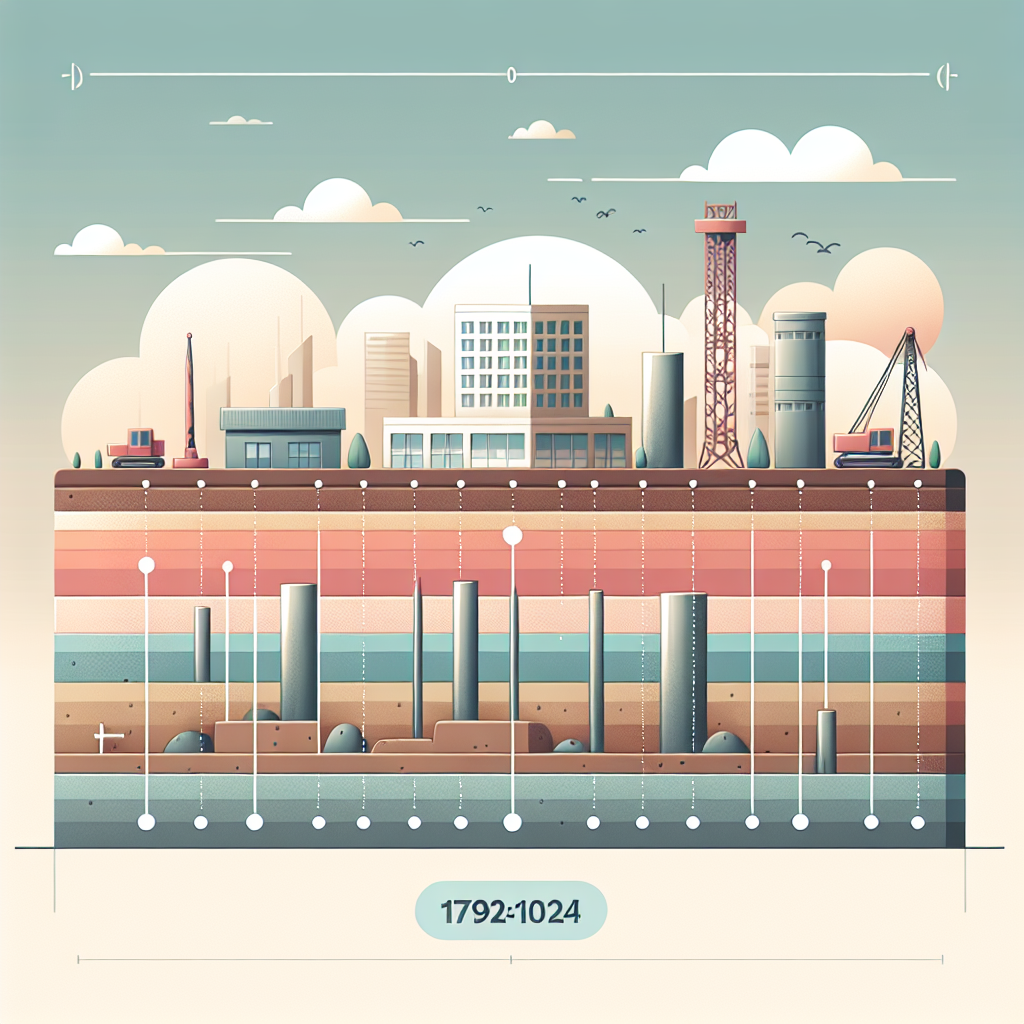
Strong support for tall, heavy, or sensitive structures often begins below ground. Deep foundations transfer loads past weak near-surface soils to deeper, stiffer layers, and the choices made at design stage shape long-term performance.
This article explains when deep solutions are needed, how site information drives choices, the main types of deep foundations, key design checks, and practical steps to manage construction and risk.
When deep foundations are needed
Shallow footings and slabs work when surface soils can safely carry the loads with acceptable settlement. When surface layers are too soft, compressible, or too shallow over bedrock, deeper support is required.
Common triggers include high structural loads, variable groundwater, expansive soils, or the need to limit differential settlement near adjacent structures. Recognizing these triggers early avoids expensive redesign or remedial work later.
Site evaluation and soil testing
Accurate site information is the backbone of any design. A focused investigation reduces uncertainty and narrows the range of suitable foundation types.
Key steps include a drilling program, in-situ testing, and lab tests on disturbed and undisturbed samples. Results feed directly into load capacity and settlement estimates.
Typical field tests
Field testing reveals stratigraphy and strength profiles. Important tests include:
- Standard Penetration Test (SPT) for relative density and empirical correlations.
- Cone Penetration Test (CPT) for continuous resistance and pore pressure data.
- Bore logs with sampling to identify layer thicknesses and groundwater levels.
Laboratory testing and interpretation
Lab data refine stiffness, compressibility, and strength parameters used in design. Common tests are grain-size analysis, Atterberg limits, consolidation tests, and unconfined compressive strength.
Interpreting these results requires balancing conservative assumptions with site-specific evidence to avoid overdesign and unnecessary cost.
Choosing the right deep foundation
Selection depends on soil profile, load type, constructability, access constraints, environmental limits, and budget. Designers often narrow choices to a few practical options and then compare performance and cost.
Below are main foundation types and key considerations for each, followed by practical design and construction checks.
Driven piles
Driven piles are preformed elements (timber, concrete, or steel) hammered or vibrated into the ground. They mobilize capacity through skin friction and end-bearing when they reach denser soils or stratigraphic layers.
Advantages include speed of installation and immediate load application after driving, but noise, vibration, and nearby structure effects must be assessed.
Bored piles (drilled shafts)
Bored piles are constructed by drilling a hole, placing reinforcement, and casting concrete. They are suitable where vibration must be minimized and where large diameters are required.
Bored piles perform well in urban settings, but careful control of bore cleanliness and concrete placement is critical to avoid defects.
Caissons and large-diameter shafts
Caissons are large-diameter shafts typically used for heavy loads and where bedrock is deep. They can be caissons socketed into rock for high end-bearing capacity.
These elements reduce the number of piles required and can be combined with pile caps or diaphragms to spread loads.
Micropiles and grouted anchors
Micropiles are small-diameter, high-capacity elements drilled and grouted in place. They work well in restricted access areas or where ground improvement is preferred over full piles.
Grouted anchors can provide lateral restraint and uplift capacity in slopes or retaining works.
Design checks: capacity and settlement
Design must address both ultimate capacity and serviceability limits. Ultimate checks ensure the pile will not fail under maximum expected loads.
Serviceability checks predict settlements and differential movements under working loads. Excessive settlement often governs pile length or type selection.
- End-bearing vs skin friction: determine which mechanism dominates based on strata.
- Group effects: piles in groups interact; group efficiency often less than sum of single pile capacities.
- Lateral loads: evaluate p-y curves, stiffness of pile, and pile-soil interaction for braced or moment-resisting systems.
Construction and monitoring considerations
Good construction practices protect design performance. Site supervision, quality control testing, and early detection of problems reduce rework and delays.
Monitoring may include pile driving records, dynamic testing, static load tests, and integrity testing depending on risk and code requirements.
- Pile driving analyzer (PDA) tests for driven piles provide dynamic capacity estimates.
- Static load tests confirm design assumptions on capacity and settlement behavior.
- Crosshole sonic logging or low-strain tests detect defects in bored piles.
Cost, program, and lifecycle factors
Cost is influenced by pile type, mobilization, drilling difficulty, access, and disposal of spoil. Early contractor input helps align the design with practical site methods.
Lifecycle thinking includes durability (corrosion protection, cover), maintenance access, and future loading scenarios that could change foundation demands.
Conclusion
Deep foundations are a technical solution that solves complex soil problems and supports heavy or sensitive structures. Success depends on quality site information, matched foundation selection, sound design checks, and controlled construction.
Applying these principles reduces risk and helps deliver foundations that perform reliably through the structure’s life without unnecessary cost or delay.
Frequently Asked Questions
What conditions make deep foundations preferable to shallow ones?
Deep foundations are chosen when near-surface soils cannot carry loads safely, when large settlements are expected, or when groundwater and soft layers undermine shallow systems.
How does a soil investigation influence pile type selection?
Soil data reveal layer depths, strength, and compressibility. These details determine whether end-bearing or friction piles are appropriate and influence diameter, length, and installation method.
What are common methods to verify pile capacity?
Static load tests are the benchmark for capacity verification. For driven piles, dynamic testing and signal matching give reliable estimates. Integrity tests check structural soundness but not capacity directly.
How is settlement estimated for pile groups?
Settlement prediction uses elastic or consolidation analyses using stiffness parameters for the surrounding soil and pile group interaction models. Empirical correlations can help but are less precise than site-specific analysis.
What construction issues most often cause problems?
Poor borehole cleanliness, inadequate concrete placement, uncontrolled groundwater, and improper handling of spoil are common causes of defects in bored systems. For driven piles, uncontrolled driving leads to damage or inadequate capacity.
Can deep foundations be combined with ground improvement?
Yes. Combining piles with grouting, stone columns, or jetting can reduce settlement, limit pile length, or improve load distribution in difficult soils.