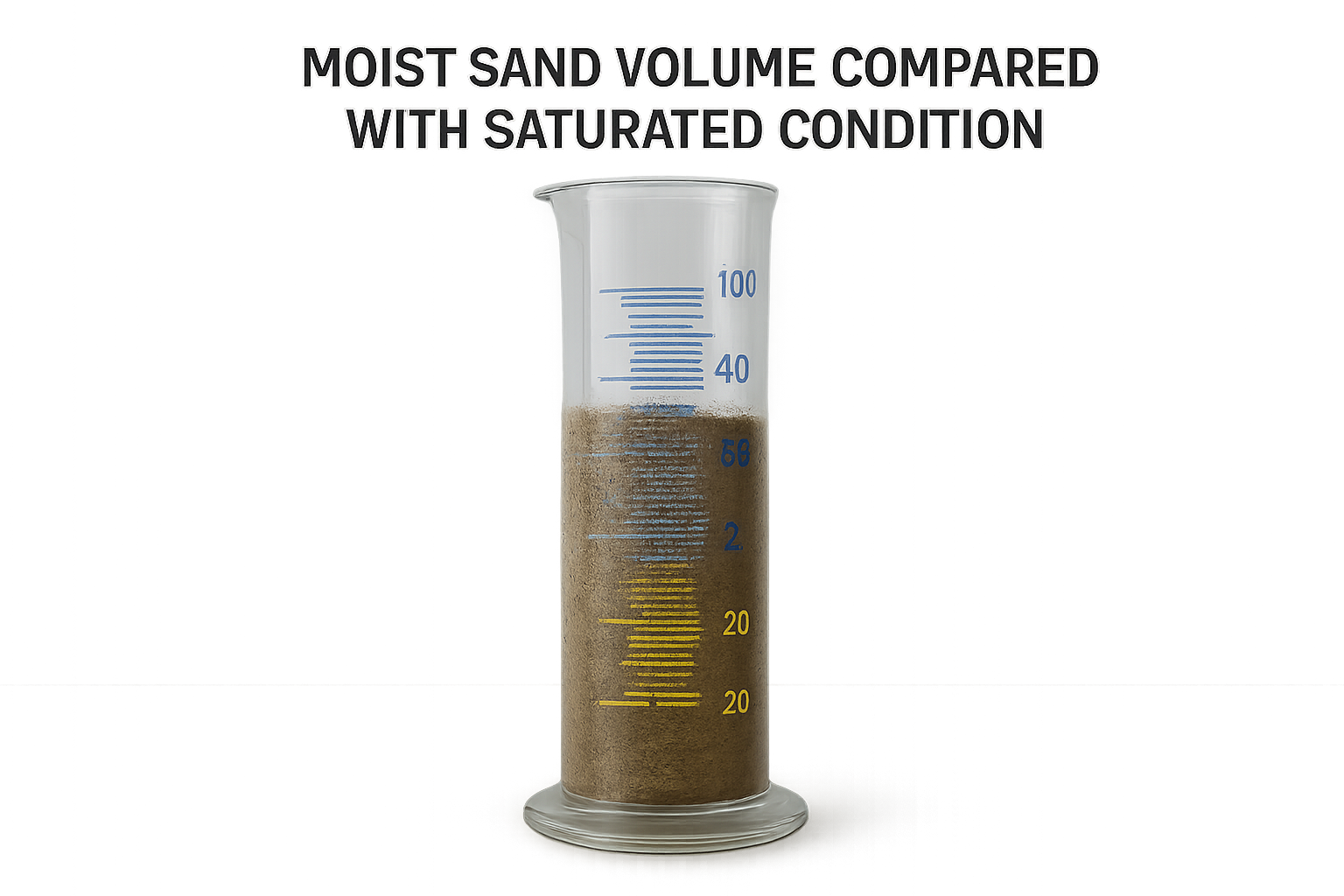
The bulking of sand test is a crucial procedure in civil engineering that determines how moisture affects the apparent volume of fine aggregate. Understanding the bulking of sand is essential for accurate volume batching, as the moisture content can lead to discrepancies in material measurement, thus impacting project quality. This article outlines the procedure, observations, and calculations involved in the bulking of sand test, providing valuable insights for students, site engineers, contractors, and construction professionals. For the applicable test method and revision, refer to the BIS standards portal.
Understanding Bulking of Sand
Bulking refers to the phenomenon where wet sand occupies a larger volume than dry sand. This increase in volume is primarily due to the moisture forming a film around the sand particles, which prevents them from packing closely together. The bulking of sand test is performed to quantify this effect, allowing professionals to adjust their material measurements accordingly when batching concrete.
Procedure of the Bulking of Sand Test
The test procedure involves a few straightforward steps to obtain accurate results. Follow these steps for conducting the bulking of sand test:
- Apparatus Required:
- A graduated measuring cylinder or a container of known volume.
- A balance for weighing the sand.
- Water for moisture application.
- A spatula or trowel for stirring.
- A hygrometer to measure moisture content if necessary.
- Sample Preparation:
Take a dry sample of sand and note its weight. The mass of the dry sand is critical for later calculations.
- Moisture Addition:
Gradually add water to the sand sample while mixing thoroughly. Aim to achieve a moisture content that is representative of field conditions.
- Measuring Volume:
After mixing, transfer the sand into the graduated measuring cylinder and record the apparent volume. Ensure to shake the cylinder gently to remove air pockets.
- Recording Observations:
Record the final volume of the wet sand. This volume should be higher than the volume of the dry sand due to bulking.
Observation and Measurements
The crucial observations to note during the testing process include the weight of the dry sand, the weight of the moist sand, and the volume occupied by the wet sand. By analyzing these values, the following calculations can be performed:
Calculations
The bulking factor (BF) can be calculated using the formula:
Bulking (%) = [(Volume of moist sand − Volume of fully saturated sand) / Volume of fully saturated sand] × 100
In the field test, record the moist-sand volume, then add sufficient water to fully saturate the sample and record the reduced volume. Use the same container and consistent filling procedure for both readings. The simple wet-volume/dry-volume ratio is a bulking factor, not the bulking percentage unless converted appropriately.
This ratio helps in understanding how much additional volume the wet sand occupies compared to its dry state. For practical batching of concrete, adjustments can be made to account for this bulking effect.
Sand Moisture Effect
Understanding the moisture effect on sand bulking is essential for accurate construction practices. The moisture film around each particle increases the inter-particle distance, thus increasing volume. This effect can vary depending on the moisture content, sand type, and environmental conditions. For consistency, it is recommended that field observations of moisture content be accounted for in on-site batching practices.
Volume Batching Correction
To correct for bulking during volume batching, the following adjustments can be utilized:
- Determine the bulking factor using the results from the test.
- Adjust the measured volume of sand to compensate for the increase by using the formula:
Corrected Volume = Measured Volume / Bulking Factor
This corrective measure ensures that the actual amount of sand used in the mix design corresponds accurately to the intended proportions, minimizing potential issues related to workability and strength in the final concrete mixture.
Common Mistakes in Testing
Here are some frequent errors to avoid while conducting the bulking of sand test:
- Not thoroughly mixing sand and water, which can lead to uneven moisture distribution.
- Using an inappropriate measuring cylinder that does not allow accurate volume readings.
- Neglecting to shake the cylinder gently to remove air pockets.
- Failing to record environmental conditions that could impact moisture absorption.
FAQs
What is the main purpose of the bulking of sand test?
The primary purpose is to determine how moisture affects the volume of sand, which is crucial for accurate concrete batching.
How does moisture content affect the bulking of sand?
Moisture causes sand grains to separate, increasing their overall volume, which can lead to inaccurate material measurements if not accounted for.
Can the bulking factor change with different types of sand?
Yes, different types of sand can exhibit varying bulking factors based on their shape, size, and moisture retention properties.
How often should the bulking of sand test be conducted?
It should be performed regularly, especially when there is a change in temperature or humidity that may affect the moisture content of sand.
What are the implications of not accounting for sand bulking in batching?
Failure to consider bulking can lead to an inaccurate mix design, compromising the strength and durability of the resulting concrete.
Conclusion
The bulking of sand test is indispensable for ensuring the accuracy of concrete mixes in civil engineering projects. By understanding the impact of moisture on sand volume and applying correct volume batching adjustments, professionals can ensure high-quality construction outcomes that meet specified standards. Emphasizing the importance of this test in routine practices will enhance the reliability and performance of concrete structures.